Fukushima Kazunori, Aoki Makoto, Kitamura Nobuya, Tagami Takashi, Yasunaga Hideo, Aso Shotaro, Tateishi Yoshihisa, Sawada Yusuke, Oshima Kiyohiro
Department of Emergency Medicine, Gunma University Graduate School of Medicine, Maebashi, JPN.
Emergency Department, National Defense Medical College, Saitama, JPN.
Cureus. 2024 Nov 18;16(11):e73949. doi: 10.7759/cureus.73949. eCollection 2024 Nov.
Out-of-hospital cardiac arrest (OHCA) has a poor prognosis. Patients with shockable rhythms often have better outcomes than those with nonshockable rhythms. A previous study reported a decline in shockable rhythms and poorer outcomes with the use of beta-blockers before OHCA. This study aimed to investigate the association between beta-blocker use and outcomes in OHCA patients using data from a multicenter prospective observational study in Japan.
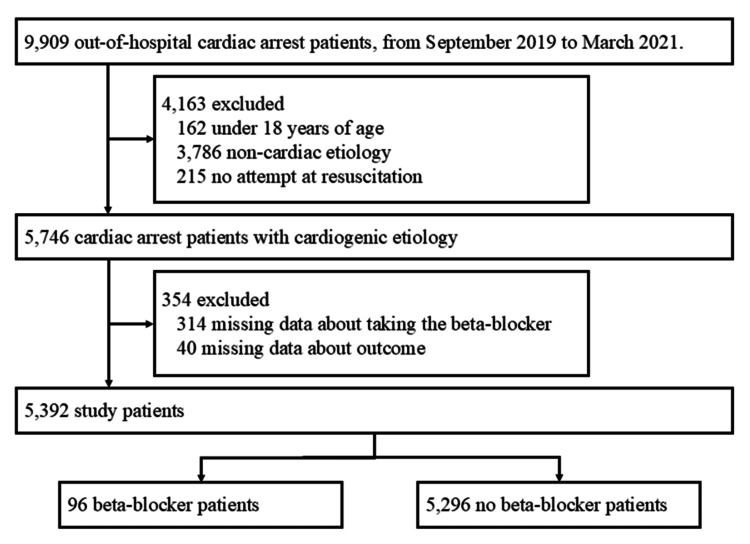
This study is a post hoc analysis based on data from the Survey of Survivors after Out-of-Hospital Cardiac Arrest in Kanto Area 2017 study, which included 9,909 OHCA patients in Japan. Patients aged 18 years or older with cardiogenic OHCA were included in the analysis, which involved multiple imputation and overlap weighting with propensity scores. As a subgroup analysis, data were extracted for patients with a history of cardiovascular disease and who were also subjected to multiple imputations and overlapping weighting. The outcomes were survival and favorable neurological outcomes at 30 days.
Out of the 5,392 analyzed patients, 96 were taking beta-blockers before OHCA, and 5,296 were not. After adjusting for confounding factors using overlap weighting, beta-blocker use was not found to be associated with increased survival (odds ratio, OR, 1.07; 95% confidence interval, CI, 0.64-1.81) and favorable neurological outcomes (OR, 1.09; 95% CI, 0.61-1.95). The analysis of patients with a history of cardiovascular disease also showed no significant difference in survival based on beta-blocker use.
In this study, beta-blocker use was not associated with survival and favorable neurological outcomes in OHCA patients.
院外心脏骤停(OHCA)的预后较差。可电击心律的患者通常比不可电击心律的患者预后更好。先前的一项研究报告称,在OHCA之前使用β受体阻滞剂会导致可电击心律减少且预后更差。本研究旨在利用日本一项多中心前瞻性观察性研究的数据,调查OHCA患者使用β受体阻滞剂与预后之间的关联。
本研究是一项基于2017年关东地区院外心脏骤停幸存者调查研究数据的事后分析,该研究纳入了日本的9909例OHCA患者。分析纳入了年龄在18岁及以上的心源性OHCA患者,采用了多重填补和倾向评分重叠加权法。作为亚组分析,提取了有心血管疾病史且同样接受多重填补和重叠加权的患者的数据。结局指标为30天时的存活情况和良好的神经功能结局。
在5392例分析患者中,96例在OHCA之前服用β受体阻滞剂,5296例未服用。使用重叠加权法调整混杂因素后,发现使用β受体阻滞剂与生存率增加(比值比,OR,1.07;95%置信区间,CI,0.64 - 1.81)和良好的神经功能结局(OR,1.09;95%CI,0.61 - 1.95)无关。对有心血管疾病史的患者进行的分析也显示,基于β受体阻滞剂使用情况的生存率无显著差异。
在本研究中,OHCA患者使用β受体阻滞剂与生存率和良好的神经功能结局无关。