Cao Yan-Hua, Lü Zhao-Long, Li Yuan-Hong, Jiang Yiwei, Zhang Jin-Lin
State Key Laboratory of Herbage Improvement and Grassland Agro-Ecosystems, Center for Grassland Microbiome, Engineering Research Center of Grassland Industry, Ministry of Education, College of Pastoral Agriculture Science and Technology, Lanzhou University, Lanzhou, 730000, P.R. China.
College of Grassland Sciences, Beijing Forestry University, Beijing, 100083, P.R. China.
BMC Plant Biol. 2024 Dec 21;24(1):1225. doi: 10.1186/s12870-024-05961-1.
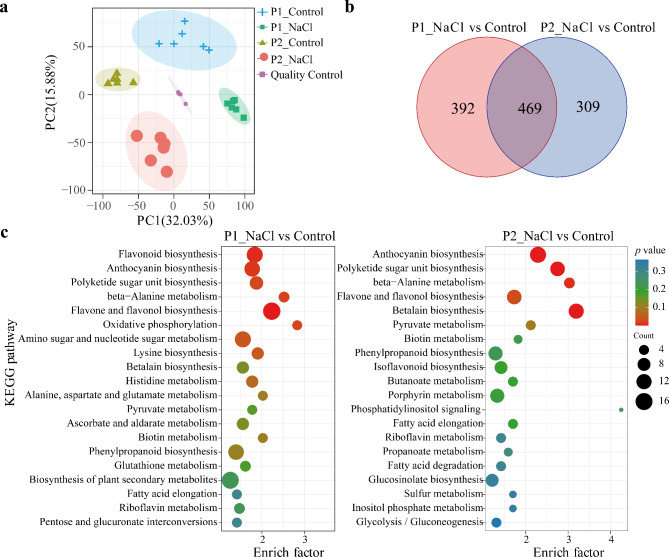
Perennial ryegrass (Lolium perenne) is a widely cultivated forage and turf grass species. Salt stress can severely damage the growth of grass plants. The genome-wide molecular mechanisms of salt tolerance have not been well understood in perennial grass species. In this study, the salt sensitive genotype P1 (PI265351, Chile) and the salt tolerant genotype P2 (PI368892, Algeria) of perennial ryegrass were subjected to 200 mM NaCl, and transcriptomics and metabolomics analyses were performed. A total of 5,728 differentially expressed genes (DEGs) were identified through pairwise comparisons. Antioxidant enzyme encoding genes (LpSOD1, LpCAT1), ion channel gene LpCaC1 and transcription factors (LpERFs, LpHSF1 and LpMYB1) were significantly upregulated in P2, suggesting their involvement in regulating expression of salt-responsive genes for salt tolerance. Functional analysis of DEGs revealed that biosynthesis of secondary metabolites, carbohydrate metabolism and signal transduction were the main pathways in response to salt stress. Weighted gene co-expression network analysis (WGCNA) based on RNA-Seq data showed that membrane transport and ABC transporters were significantly correlated with salt tolerance-related traits. The combined transcriptomics and metabolomics analysis demonstrated that the phenylpropanoid biosynthesis pathway was a major secondary metabolic pathway in the salt response of perennial ryegrass. Especially, the tolerant genotype P2 had greater amounts of upregulated phenylpropanoids, flavonoids and anthocyanins and higher expressions of relevant genes in the pathway than the sensitive genotype P1, indicating a role of phenylpropanoid biosynthesis for perennial ryegrass to adapt to salt stress. The results provided insights into the molecular mechanisms of perennial ryegrass adaptation to salinity and laid a base for genetic improvement of salt tolerance in perennial grass species.
多年生黑麦草(Lolium perenne)是一种广泛种植的饲料和草坪草种。盐胁迫会严重损害草类植物的生长。多年生草种中耐盐性的全基因组分子机制尚未得到充分了解。在本研究中,多年生黑麦草的盐敏感基因型P1(PI265351,智利)和耐盐基因型P2(PI368892,阿尔及利亚)接受200 mM NaCl处理,并进行了转录组学和代谢组学分析。通过成对比较共鉴定出5728个差异表达基因(DEG)。抗氧化酶编码基因(LpSOD1、LpCAT1)、离子通道基因LpCaC1和转录因子(LpERF、LpHSF1和LpMYB1)在P2中显著上调,表明它们参与调节盐响应基因的表达以实现耐盐性。DEG的功能分析表明,次生代谢物的生物合成、碳水化合物代谢和信号转导是响应盐胁迫的主要途径。基于RNA-Seq数据进行的加权基因共表达网络分析(WGCNA)表明,膜转运和ABC转运蛋白与耐盐相关性状显著相关。转录组学和代谢组学的联合分析表明,苯丙烷生物合成途径是多年生黑麦草盐响应中的主要次生代谢途径。特别是,耐盐基因型P2比敏感基因型P1具有更多上调的苯丙烷类、黄酮类和花青素,并且该途径中相关基因的表达更高,表明苯丙烷生物合成在多年生黑麦草适应盐胁迫中的作用。这些结果为多年生黑麦草适应盐度的分子机制提供了见解,并为多年生草种耐盐性的遗传改良奠定了基础。