Bezirgan Uğur, Acar Erdinç, Yoğun Yener, Savran Merve Dursun, Keskin Ömer Halit, Armangil Mehmet
Departamento de Ortopedia, Traumatologia e Cirurgia da Mão, Faculdade de Medicina, Ankara University, Altındağ, Ankara, Turquia.
Departamento de Ortopedia, Traumatologia e Cirurgia da Mão, Ankara Bilkent City Hospital, Çankaya, Ankara, Turquia.
Rev Bras Ortop (Sao Paulo). 2024 Dec 21;59(6):e981-e990. doi: 10.1055/s-0044-1790579. eCollection 2024 Dec.
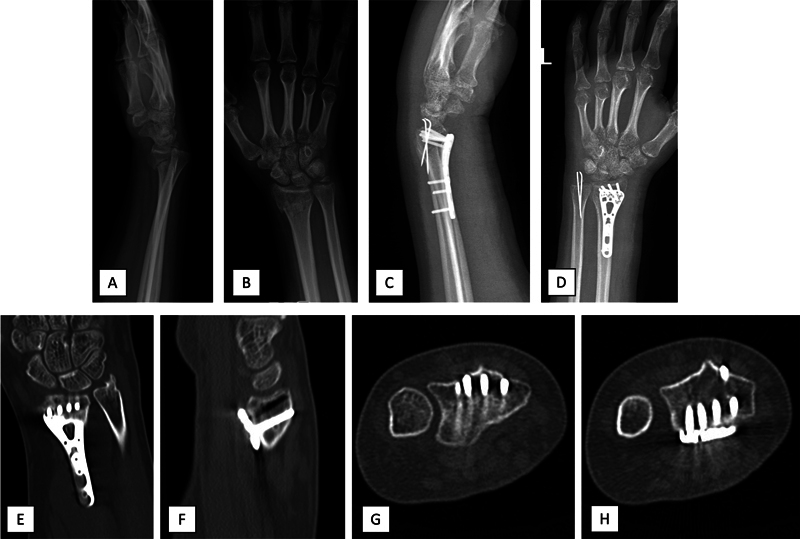
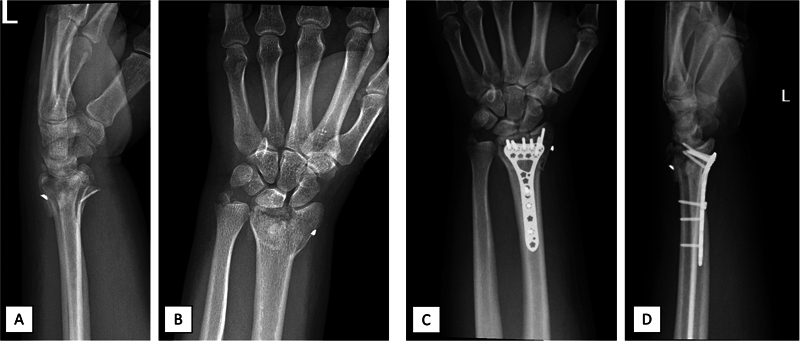
To assess the efficacy of distal radius volar plates in cases involving dorsal fragments at the Ulnar Corner (UC) and Lister Tubercle (LT). A retrospective study that included patients with distal radius fractures (DRFs) featuring UC and LT dorsal fragments treated with volar plates. The exclusion criteria comprised lunate facet fractures, UC fragment ratio below 25%, and patients treated with dorsal plates. Radiographic and tomographic measurements included radial length (RL), radial inclination (RI), ulnar variance (UV), palmar tilt (PT), fragment areas, UC fragment ratio, and displacement. The scores on the Gartland Werley (GW) classification and on the Disabilities of the Arm, Shoulder, and Hand (DASH) questionnaire, as well as grip strength, and range of motion (ROM), were assessed. The study involved 17 male and 5 female subjects (mean age: 39.7 ± 10.7 years). The UC and LT fragments displayed mean areas of 1.6 ± 0.7cm and UC fragment ratio of 0.4 ± 0.1. The fixation rates for UC and LT fragments were of 18.2% and 31.8% respectively. Improved RI, UV, and PT were noted postoperatively. The mean GW and DASH scores were of 2.1 ± 2.0 and 4.3 ± 3.2 respectively. Grip strength on the operated side was of 89.5 ± 9.8% of the healthy side, and at least 90.9% of the patients achieved adequate ROM. While volar plates are the standard treatment for intra-articular DRFs, displaced dorsal fragments can impact the outcomes. Mini dorsal incisions may aid in the fixation of UC fragments that are challenging to secure with volar plates, preserving joint health.
评估桡骨远端掌侧钢板在涉及尺骨角(UC)和月骨结节(LT)背侧骨折块病例中的疗效。 一项回顾性研究,纳入了采用掌侧钢板治疗的伴有UC和LT背侧骨折块的桡骨远端骨折(DRF)患者。排除标准包括月骨关节面骨折、UC骨折块比例低于25%以及采用背侧钢板治疗的患者。影像学和断层扫描测量指标包括桡骨长度(RL)、桡骨倾斜度(RI)、尺骨变异(UV)、掌倾角(PT)、骨折块面积、UC骨折块比例和移位情况。评估了Gartland Werley(GW)分类评分、上肢、肩部和手部功能障碍(DASH)问卷评分、握力以及活动范围(ROM)。 该研究纳入了17名男性和5名女性受试者(平均年龄:39.7±10.7岁)。UC和LT骨折块的平均面积分别为1.6±0.7平方厘米,UC骨折块比例为0.4±0.1。UC和LT骨折块的固定率分别为18.2%和31.8%。术后RI、UV和PT均有改善。GW和DASH评分的平均值分别为2.1±2.0和4.3±3.2。患侧握力为健侧的89.5±9.8%,至少90.9%的患者实现了足够的ROM。 虽然掌侧钢板是关节内DRF的标准治疗方法,但移位的背侧骨折块可能会影响治疗效果。小的背侧切口可能有助于固定用掌侧钢板难以固定的UC骨折块,从而保护关节健康。