Iadnut Anupon, Sae-Lee Tanawan, Tewtrakul Supinya
Department of Pharmacognosy and Pharmaceutical Botany, Faculty of Pharmaceutical Sciences, Prince of Songkla University, Hat Yai, Songkhla, Thailand.
Department of Chemistry and Center of Excellence for Innovation in Chemistry, Faculty of Science, Prince of Songkla University, Hat Yai, Songkhla, Thailand.
PeerJ. 2024 Dec 18;12:e18716. doi: 10.7717/peerj.18716. eCollection 2024.
Oral ulcers have an impact on 25% of the global population including patients who are suffering from chemotherapy and radiotherapy treatments. L. has been traditionally used for treatment of mouth sores and tongue blisters. However, the wound healing study of isopimarane diterpenes isolated from is still limited.
This study aims to evaluate the wound healing potential of 6β-acetoxysandaracopimaradiene-1α,9α-diol (KG), a compound isolated from , by examining its biological activities. Additionally, we investigate the physicochemical and biological properties of (KG) in formulated mouth gels.
The KG mouth gels at 0.10%, 0.25% and 0.50% w/w were formulated using sodium carboxymethylcellulose as a gelling agent, and their physicochemical and biological stabilities were assessed through a heating-cooling acceleration test. The quantification of KG contents in KG mouth gels was determined using gas chromatography. Both KG and KG mouth gels were evaluated for their wound healing properties including cell proliferation, cell migration, and antioxidant activity (HO-induced oxidative stress) in human gingival fibroblast (HGF-1-ATCC CRL-2014) (HGF-1). In addition, the anti-inflammatory activity against nitric oxide (NO) production was investigated in macrophage cells (RAW 264.7).
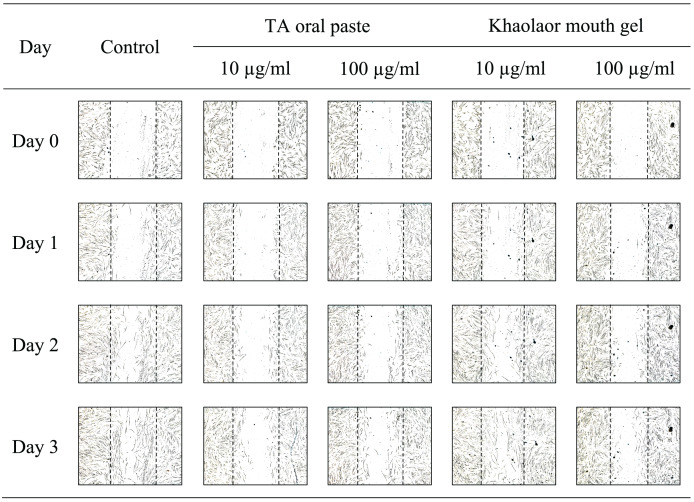
After KG mouth gels were incubated under heating-cooling acceleration condition, the physicochemical properties of the KG mouth gels remain stable across various parameters, including appearance, color, smell, texture, pH, viscosity, separation, and KG content. The biological studies indicated that the KG compound possessed good wound healing potential. The 0.50% KG mouth gel exhibited marked anti-inflammatory effect by inhibiting NO production with an IC of 557.7 µg/ml, comparable to that of Khaolaor mouth gel, a positive control. The 0.25% KG mouth gel increased HGF-1 cell proliferation to 101.7-103.5%, whereas all formulations of KG mouth gel enhanced HGF-1 cell migration to 94.7-98.9%, higher than Khaolaor mouth gel (73.5%). Moreover, 0.50% KG mouth gel also showed a good antioxidant effect under HO-induced oxidative stress.
This study substantiates the significant biological activities related to the wound healing property of 0.50% KG mouth gel for treatment of aphthous ulcers and oral stomatitis from chemotherapy and radiotherapy treatments.
口腔溃疡影响着全球25%的人口,包括接受化疗和放疗的患者。L. 传统上用于治疗口疮和舌疱。然而,从 中分离出的异海松烷二萜的伤口愈合研究仍然有限。
本研究旨在通过检测其生物活性来评估从 中分离出的化合物6β-乙酰氧基山达海松烷-1α,9α-二醇(KG)的伤口愈合潜力。此外,我们还研究了配制的口腔凝胶中(KG)的物理化学和生物学性质。
以羧甲基纤维素钠为凝胶剂,制备了质量分数分别为0.10%、0.25%和0.50%的KG口腔凝胶,并通过加热-冷却加速试验评估其物理化学和生物学稳定性。采用气相色谱法测定KG口腔凝胶中KG的含量。对KG和KG口腔凝胶的伤口愈合特性进行了评估,包括在人牙龈成纤维细胞(HGF-1-ATCC CRL-2014)(HGF-1)中的细胞增殖、细胞迁移和抗氧化活性(HO诱导的氧化应激)。此外,还研究了其在巨噬细胞(RAW 264.7)中对一氧化氮(NO)产生的抗炎活性。
在加热-冷却加速条件下孵育后,KG口腔凝胶的物理化学性质在外观、颜色、气味、质地、pH值、粘度、分离和KG含量等各种参数上保持稳定。生物学研究表明,KG化合物具有良好的伤口愈合潜力。0.50%的KG口腔凝胶通过抑制NO的产生表现出显著的抗炎作用,IC为557.7 μg/ml,与阳性对照Khaolaor口腔凝胶相当。0.25%的KG口腔凝胶使HGF-1细胞增殖提高到101.7-103.5%,而所有配方的KG口腔凝胶均使HGF-1细胞迁移提高到94.7-98.9%,高于Khaolaor口腔凝胶(73.5%)。此外,0.50%的KG口腔凝胶在HO诱导的氧化应激下也表现出良好的抗氧化作用。
本研究证实了0.50%的KG口腔凝胶在治疗化疗和放疗引起的复发性口腔溃疡和口腔炎方面具有与伤口愈合特性相关的显著生物活性。