Yao Shuo-Yi, Li Xin-Meng, Cai Ting, Li Ying, Liang Lun-Xi, Liu Xiao-Ming, Lei Yu-Feng, Zhu Yong, Wang Fen
Department of Gastroenterology, The Third Xiangya Hospital, Central South University, Changsha 410013, Hunan Province, China.
Hunan Key Laboratory of Nonresolving Inflammation and Cancer, The Third Xiangya Hospital, Central South University, Changsha 410006, Hunan Province, China.
World J Gastroenterol. 2024 Dec 21;30(47):4991-5006. doi: 10.3748/wjg.v30.i47.4991.
() is a prevalent pathogen associated with various diseases. Cholelithiasis is also a common condition. infection has been identified in the biliary system, suggesting its potential involvement in biliary diseases. However, the specific role of in the development of cholelithiasis remains inconclusive.
To investigate the potential association between infection and the development of cholelithiasis.
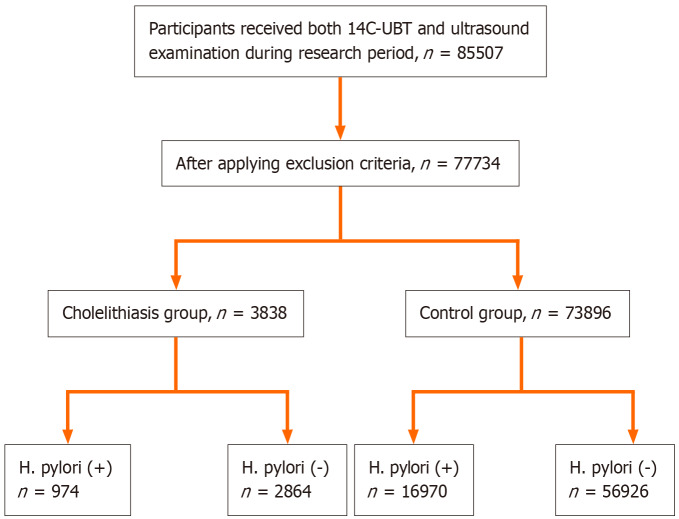
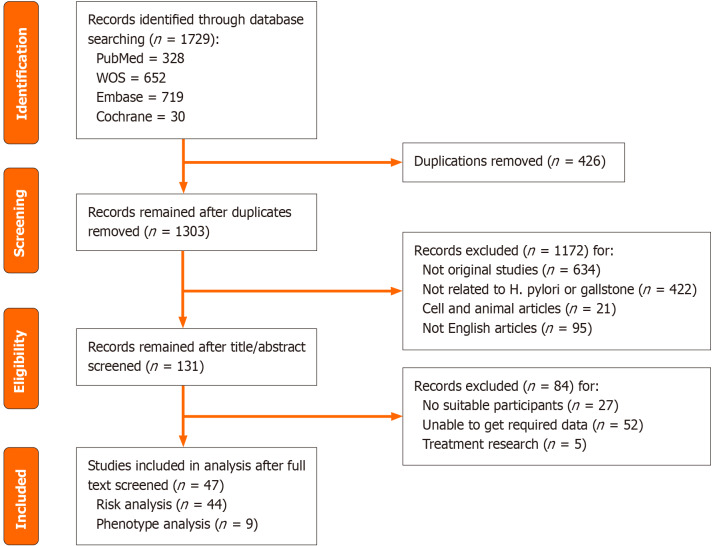
We performed a retrospective study in more than 70000 subjects in health examination center from 3 institutions in the middle, northern and eastern China, from October 2018 to December 2021, to explore the potential association between and cholelithiasis through univariate and multivariate analysis. Meanwhile, the influence of on biliary-related parameters was investigated. A comprehensive analysis of previous studies concerned about and cholelithiasis was also executed.
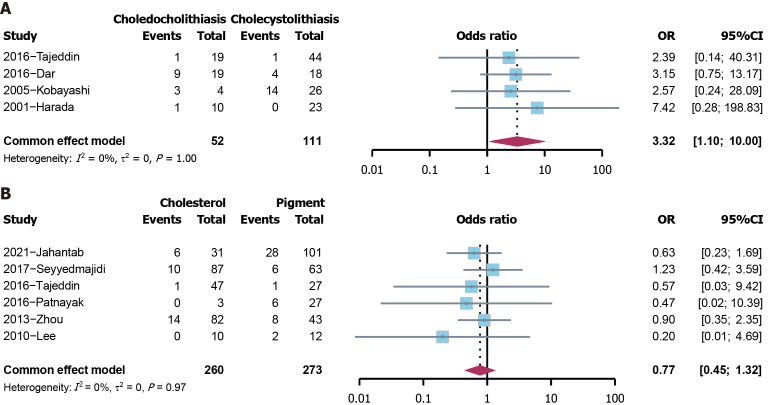
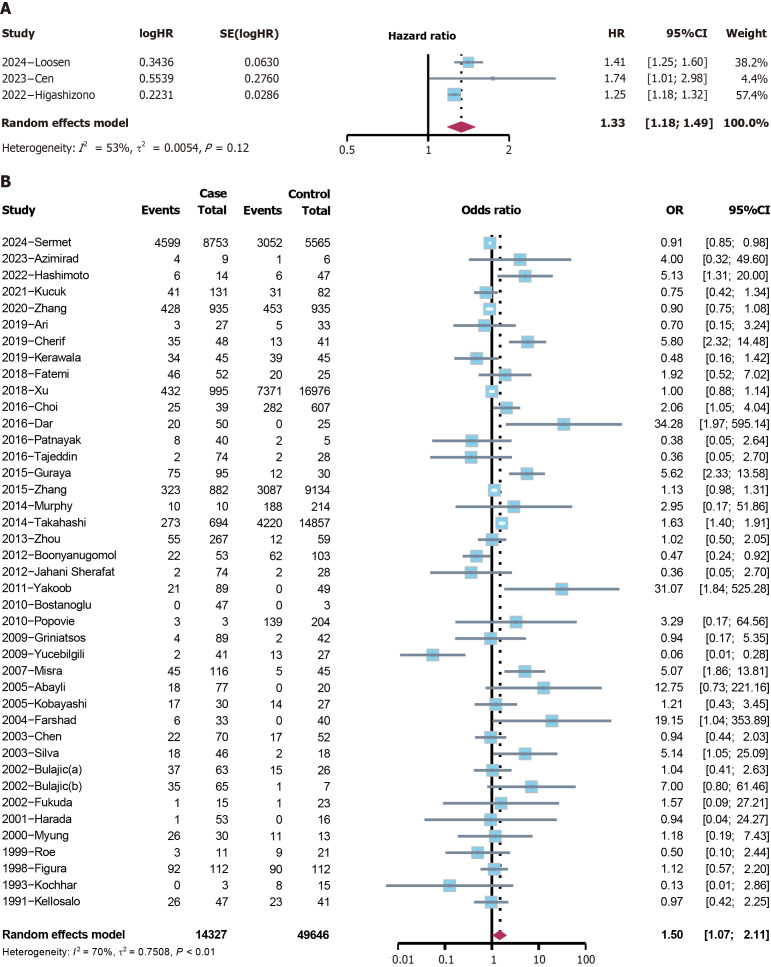
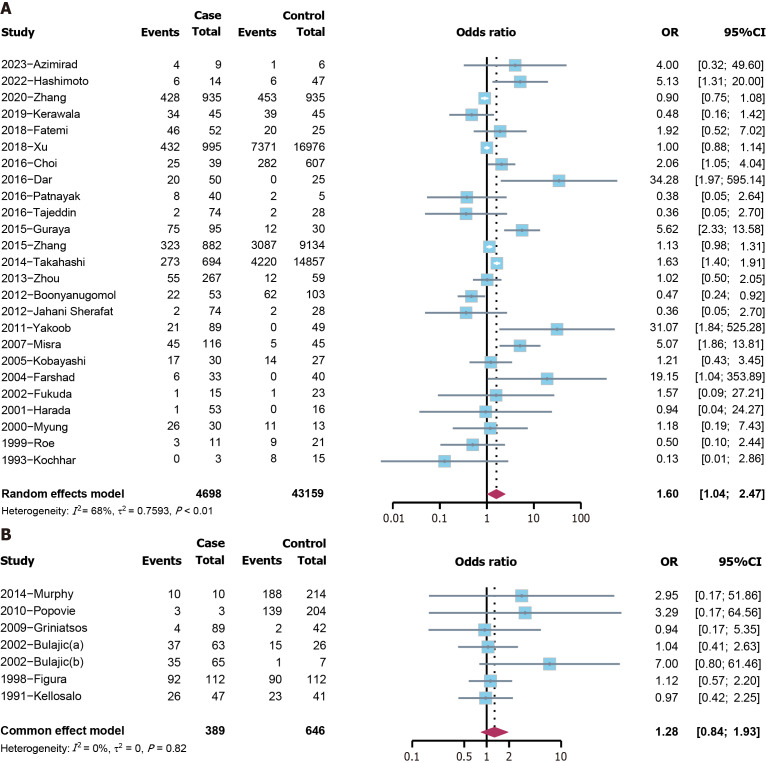
In our multi-center study, was positively associated with cholelithiasis [odds ratio (OR) = 1.103, 95% confidence interval (CI): 1.001-1.216, = 0.049]. Furthermore, patients had less total and direct bilirubin than uninfected patients, while the total cholesterol and low-density lipoprotein cholesterol were more in -positive participants ( < 0.05). In the published articles, the cohort studies indicated was a risk factor of cholelithiasis (hazard ratio =1.3280, 95%CI: 1.1810-1.4933, < 0.0001). The pooled results of case-control and cross-sectional studies showed positive association between and cholelithiasis in Asia (OR = 1.5993, 95%CI: 1.0353-2.4706, = 0.034) but not in Europe (OR = 1.2770, 95%CI: 0.8446-1.9308, = 0.246). Besides, was related to a higher choledocholithiasis/cholecystolithiasis ratio (OR = 3.3215, 95%CI: 1.1034-9.9986, = 0.033).
is positively correlated with cholelithiasis, choledocholithiasis phenotype particularly, especially in Asia, which may be relevant to bilirubin/cholesterol metabolism. Cohort studies confirm an increased risk of cholelithiasis in patients.
(某病原体)是一种与多种疾病相关的常见病原体。胆石症也是一种常见病症。已在胆道系统中发现(该病原体)感染,提示其可能参与胆道疾病。然而,(该病原体)在胆石症发生发展中的具体作用仍无定论。
探讨(该病原体)感染与胆石症发生之间的潜在关联。
我们对2018年10月至2021年12月期间来自中国中部、北部和东部3家机构健康体检中心的70000多名受试者进行了一项回顾性研究,通过单因素和多因素分析探讨(该病原体)与胆石症之间的潜在关联。同时,研究了(该病原体)对胆道相关参数的影响。还对先前有关(该病原体)与胆石症的研究进行了综合分析。
在我们的多中心研究中,(该病原体)与胆石症呈正相关[比值比(OR)=1.103,95%置信区间(CI):1.001 - 1.216,P = 0.049]。此外,(该病原体)感染患者的总胆红素和直接胆红素低于未感染患者,而(该病原体)阳性参与者的总胆固醇和低密度脂蛋白胆固醇更高(P < 0.05)。在已发表的文章中,队列研究表明(该病原体)是胆石症的危险因素(风险比=1.3280,95%CI:1.1810 - 1.4933,P < 0.0001)。病例对照研究和横断面研究的汇总结果显示,在亚洲(该病原体)与胆石症呈正相关(OR = 1.5993,95%CI:1.0353 - 2.4706,P = 0.034),而在欧洲则不然(OR = 1.2770,95%CI:0.8446 - 1.9308,P = 0.246)。此外,(该病原体)与胆总管结石/胆囊结石比例较高有关(OR = 3.3215,95%CI:1.1034 - 9.9986,P = 0.033)。
(该病原体)与胆石症呈正相关,尤其是胆总管结石表型,在亚洲尤为明显,这可能与胆红素/胆固醇代谢有关。队列研究证实(该病原体)感染患者患胆石症的风险增加。