Lim Hyun Gyu, Gao Ye, Rychel Kevin, Lamoureux Cameron, Lou Xuwen A, Palsson Bernhard O
Department of Biological Sciences and Bioengineering, Inha University, Incheon, South Korea.
Department of Bioengineering, University of California, San Diego, California, USA.
mSystems. 2025 Jan 21;10(1):e0131524. doi: 10.1128/msystems.01315-24. Epub 2024 Dec 23.
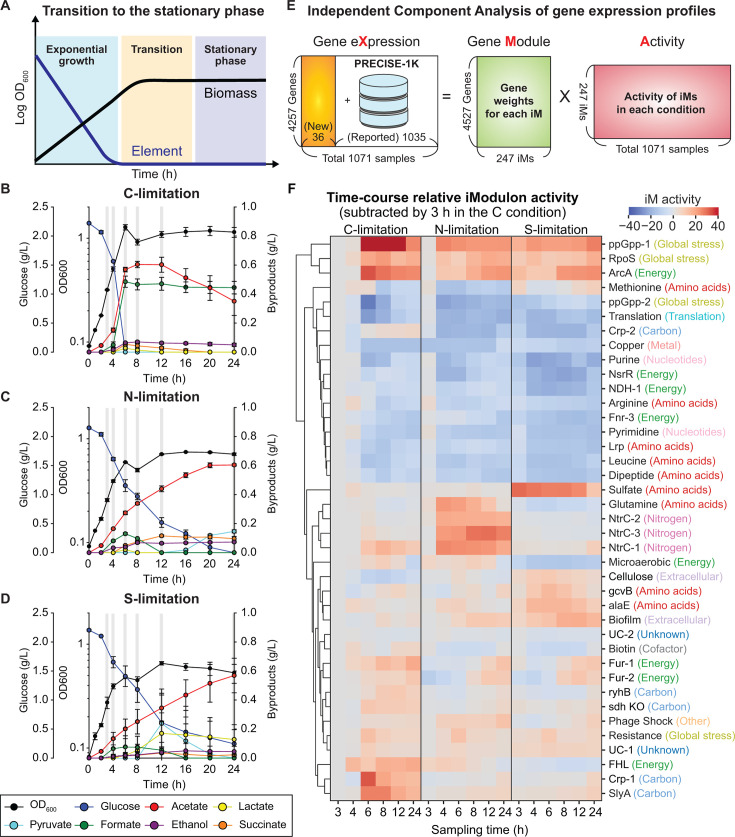
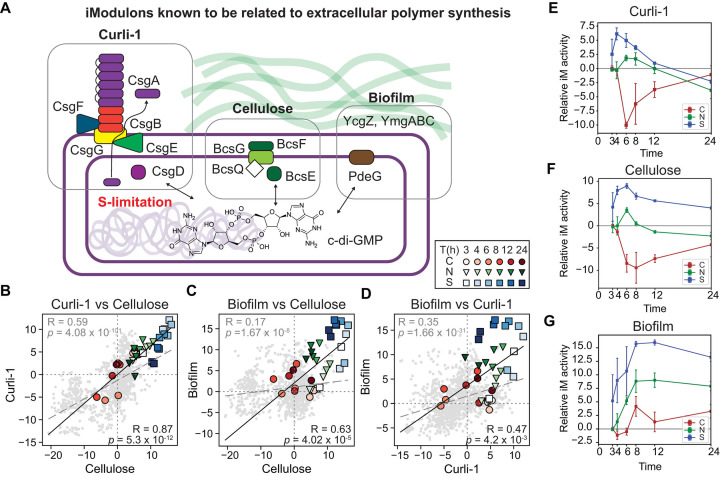
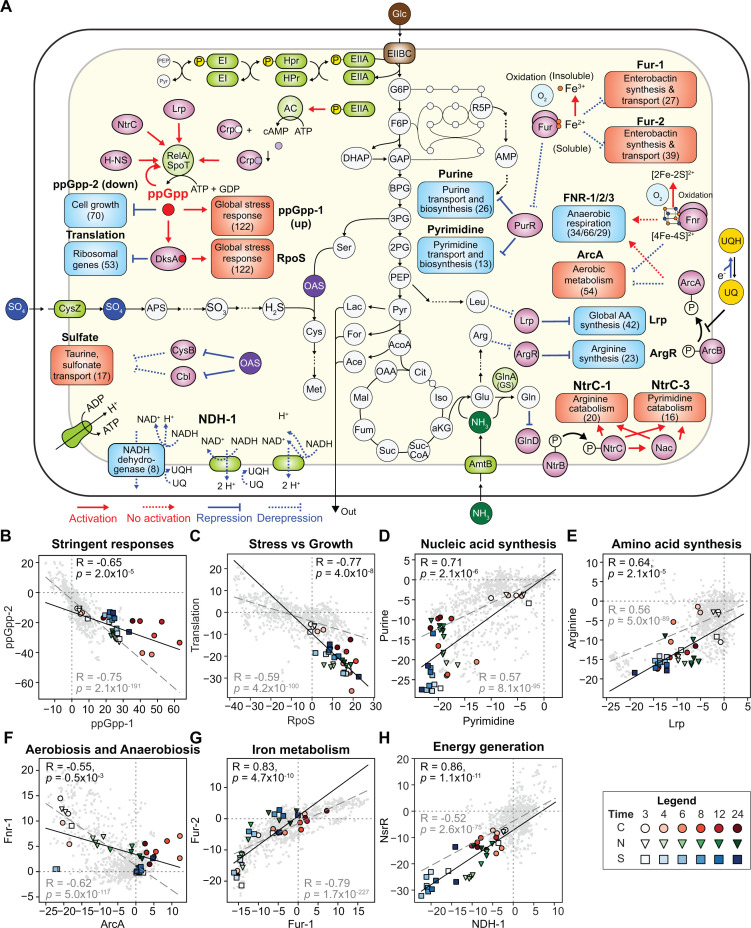
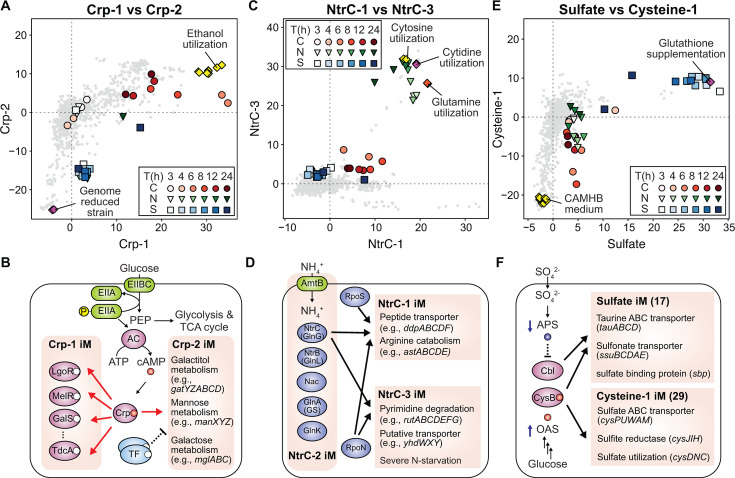
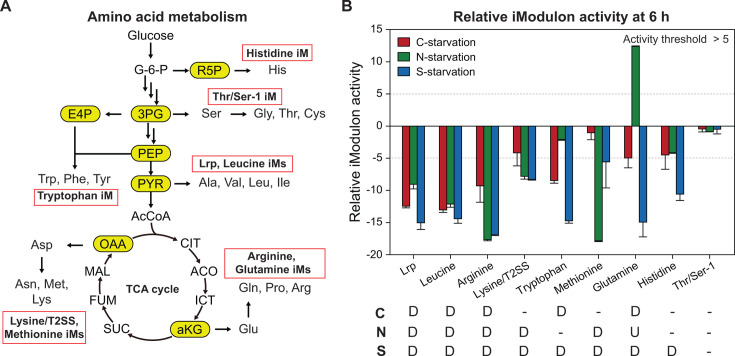
The composition of bacterial transcriptomes is determined by the transcriptional regulatory network (TRN). The TRN regulates the transition from one physiological state to another. Here, we use independent component analysis to monitor the composition of the transcriptome during the transition from the exponential growth phase to the stationary phase. With K-12 MG1655 as a model strain, we trigger the transition using carbon, nitrogen, and sulfur starvation. We find that (i) the transition to the stationary phase accompanies common transcriptome changes, including increased stringent responses and reduced production of cellular building blocks and energy regardless of the limiting element; (ii) condition-specific changes are strongly associated with transcriptional regulators (, Crp, NtrC, CysB, Cbl) responsible for metabolizing the limiting element; and (iii) the shortage of each limiting element differentially affects the production of amino acids and extracellular polymers. This study demonstrates how the combination of genome-scale datasets and new data analytics reveals the fundamental characteristics of a key transition in the life cycle of bacteria.
Nutrient limitations are critical environmental perturbations in bacterial physiology. Despite its importance, a detailed understanding of how bacterial transcriptomes are adjusted has been limited. By utilizing independent component analysis (ICA) to decompose transcriptome data, this study reveals key regulatory events that enable bacteria to adapt to nutrient limitations. The findings not only highlight common responses, such as the stringent response, but also condition-specific regulatory shifts associated with carbon, nitrogen, and sulfur starvation. The insights gained from this work advance our knowledge of bacterial physiology, gene regulation, and metabolic adaptation.
细菌转录组的组成由转录调控网络(TRN)决定。TRN调节从一种生理状态到另一种生理状态的转变。在此,我们使用独立成分分析来监测从指数生长期到稳定期转变过程中转录组的组成。以K-12 MG1655作为模式菌株,我们通过碳、氮和硫饥饿来触发这种转变。我们发现:(i)向稳定期的转变伴随着常见的转录组变化,包括严格反应增加以及细胞结构单元和能量的产生减少,而与限制元素无关;(ii)特定条件下的变化与负责代谢限制元素的转录调节因子(如Crp、NtrC、CysB、Cbl)密切相关;(iii)每种限制元素的短缺对氨基酸和细胞外聚合物的产生有不同影响。这项研究展示了基因组规模数据集与新的数据分析方法相结合如何揭示细菌生命周期中关键转变的基本特征。
营养限制是细菌生理学中关键的环境扰动因素。尽管其很重要,但对细菌转录组如何调整的详细理解一直有限。通过利用独立成分分析(ICA)分解转录组数据,本研究揭示了使细菌能够适应营养限制的关键调控事件。这些发现不仅突出了常见反应,如严格反应,还揭示了与碳、氮和硫饥饿相关的特定条件下的调控转变。从这项工作中获得的见解推进了我们对细菌生理学、基因调控和代谢适应的认识。