Märkl Susanne, Przybilla Frédéric, Rachel Reinhard, Hirsch Thomas, Keller Max, Witzgall Ralph, Mély Yves, Wegener Joachim
Institute for Analytical Chemistry, Chemo- and Biosensors, University of Regensburg, 93053, Regensburg, Germany.
Laboratory of Bioimaging and Pathologies, UMR 7021 CNRS, University of Strasbourg, Strasbourg, 67000, France.
Sci Rep. 2024 Dec 23;14(1):30610. doi: 10.1038/s41598-024-83406-3.
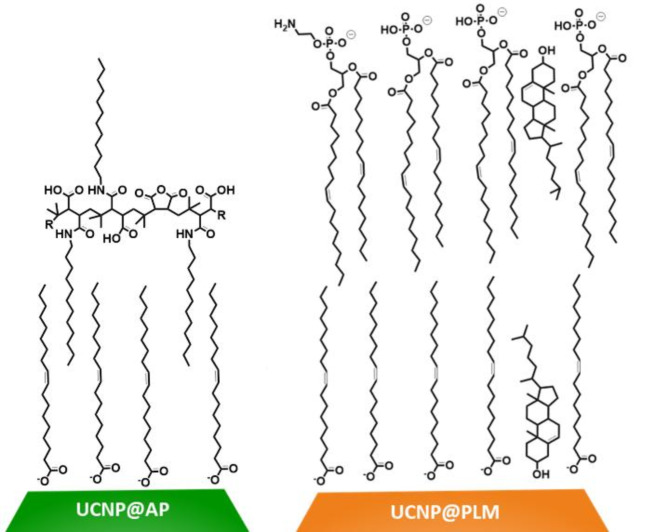
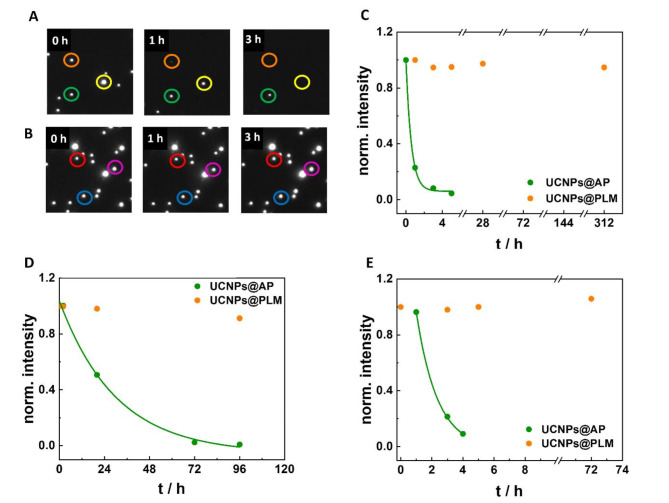
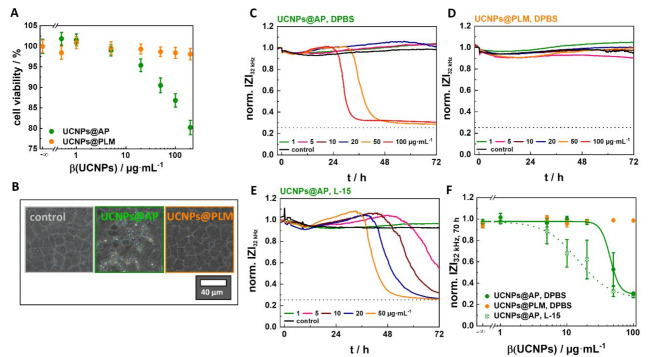
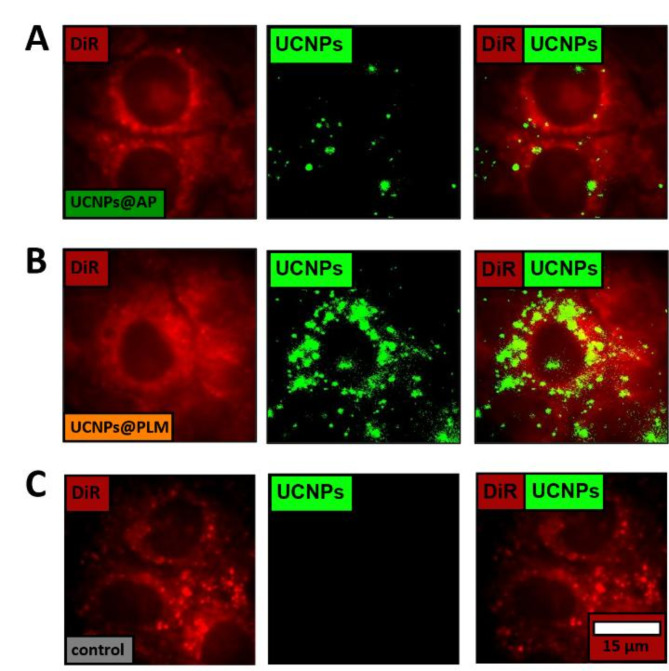
The application of upconversion nanoparticles (UCNPs) for cell and tissue analysis requires a comprehensive understanding of their interactions with biological entities to prevent toxicity or harmful effects. Whereas most studies focus on cancer cells, this work addresses non-cancerous cells with their regular in vitro physiology. Since it is generally accepted that surface chemistry largely determines biocompatibility in general and uptake of nanomaterials in particular, two bilayer surface coatings with different surface shielding properties have been studied: (i) a phospholipid bilayer membrane (PLM) and (ii) an amphiphilic polymer (AP). Both surface modifications are applied to (12-33) nm core-shell UCNPs NaYF(Yb, Er)@NaYF, ensuring colloidal stability in biological media. The impact of UCNPs@AP and UCNPs@PLM on non-cancerous epithelial-like kidney cells in vitro was found to differ significantly. UCNPs@PLM did not exhibit any measurable effect on cell physiology, even with prolonged exposure. In contrast, UCNPs@AP caused changes in cell morphology and induced cell-death after approximately 30 h. These variations in toxicity are attributed to the distinct chemical stability of these particles, which likely influences their intracellular disintegration.
将上转换纳米粒子(UCNPs)应用于细胞和组织分析需要全面了解它们与生物实体的相互作用,以防止产生毒性或有害影响。虽然大多数研究集中在癌细胞上,但这项工作针对的是具有正常体外生理学特性的非癌细胞。由于人们普遍认为表面化学在很大程度上决定了生物相容性,尤其是纳米材料的摄取,因此研究了两种具有不同表面屏蔽特性的双层表面涂层:(i)磷脂双分子层膜(PLM)和(ii)两亲聚合物(AP)。这两种表面修饰都应用于(12 - 33)纳米的核壳型UCNPs NaYF(Yb, Er)@NaYF,以确保其在生物介质中的胶体稳定性。结果发现,UCNPs@AP和UCNPs@PLM对体外非癌性上皮样肾细胞的影响存在显著差异。即使长时间暴露,UCNPs@PLM对细胞生理学也未表现出任何可测量的影响。相比之下,UCNPs@AP在大约30小时后导致细胞形态改变并诱导细胞死亡。这些毒性差异归因于这些粒子不同的化学稳定性,这可能影响它们在细胞内的分解。