Otieno Wills Peter, Ankapong Eunice Abena Kwatemaa, Nomura Kanae, Matsumoto-Takahashi Emilie Louise Akiko
Graduate School of Public Health, St. Luke's International University, CCA 5th Floor, 3-6-2 Tsukiji, Chuo-Ku, Tokyo, 104-0045, Japan.
Department of Tropical Medicine and Malaria, Research Institute, National Center for Global Health and Medicine (NCGM), Tokyo, Japan.
Trop Med Health. 2024 Dec 24;52(1):99. doi: 10.1186/s41182-024-00669-2.
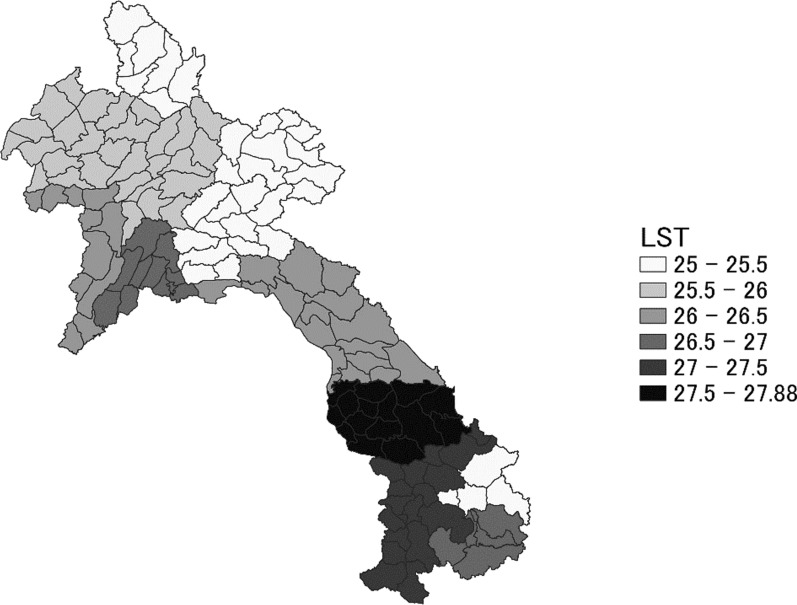
Malaria remains the leading cause of under-five morbidity and mortality in low- and middle-income countries. Sleeping under mosquito nets, especially insecticide-treated nets (ITNs), is one of the best ways to prevent malaria as they form a physical and chemical barrier against mosquitoes. Therefore, the present study aimed to assess not only mosquito net use, but also how environmental factors, specifically land surface temperature, contribute to malaria prevention among households with children under 5 years of age in Lao PDR.
The most recent Multiple Indicator Cluster Survey datasets of Lao PDR 2017 and the Japan Aerospace Exploration Agency (JAXA) Public Health Monitoring and Analysis Platform (JPMAP) were used. Data from 51,948 households were used in the analysis. A bivariate logistic regression analysis was followed by a multivariate logistic regression analysis to determine the factors influencing mosquito net use with children under five.
In this study, 77.8% of all households with children under 5 years of age slept under mosquito nets. Of these, 80.5% were ITNs (Olyset, Permanent, and other brands). Multivariate logistic regression analysis revealed that mosquito net use was significantly associated with the land surface temperature, ethno-linguistic group (Lao-Tai, Mon-Khmer, Hmong-Mien, Chinese-Tibetan, and other), education level of the household head, and wealth index quintile.
The analysis of the present study suggested measures to intensify the use of mosquito nets with an emphasis on ethnic minorities living in hot areas to bring Lao PDR closer to the day that mosquito-borne infections such as malaria can be eliminated.
在低收入和中等收入国家,疟疾仍然是五岁以下儿童发病和死亡的主要原因。睡在蚊帐下,尤其是使用经杀虫剂处理的蚊帐(ITN),是预防疟疾的最佳方法之一,因为它们形成了一道抵御蚊子的物理和化学屏障。因此,本研究旨在评估老挝五岁以下儿童家庭的蚊帐使用情况,以及环境因素,特别是地表温度,对疟疾预防的作用。
使用了老挝2017年最新的多指标类集调查数据集以及日本宇宙航空研究开发机构(JAXA)的公共卫生监测与分析平台(JPMAP)。分析中使用了来自51948户家庭的数据。在进行双变量逻辑回归分析之后,又进行了多变量逻辑回归分析,以确定影响五岁以下儿童家庭蚊帐使用的因素。
在本研究中,所有五岁以下儿童家庭中有77.8%睡在蚊帐下。其中,80.5%是经杀虫剂处理的蚊帐(Olyset、Permanent及其他品牌)。多变量逻辑回归分析显示,蚊帐使用与地表温度、民族语言群体(老泰、孟高棉、苗瑶、汉藏及其他)、户主教育水平和财富指数五分位数显著相关。
本研究分析提出了加强蚊帐使用的措施,重点是生活在炎热地区的少数民族,以使老挝更接近消除疟疾等蚊媒感染的目标。