Dunton John, Bierman-Macke Kaitlin, Little Taylor, Zuk Nicholas, Beyersdorfer Nova, Goade Scott, Johnson Kerry, Stahl Greg, Arnce Robert D
Emergency Medicine, Kansas City University, Kansas City, USA.
Primary Care Medicine, Kansas City University, Joplin, USA.
Cureus. 2024 Nov 23;16(11):e74320. doi: 10.7759/cureus.74320. eCollection 2024 Nov.
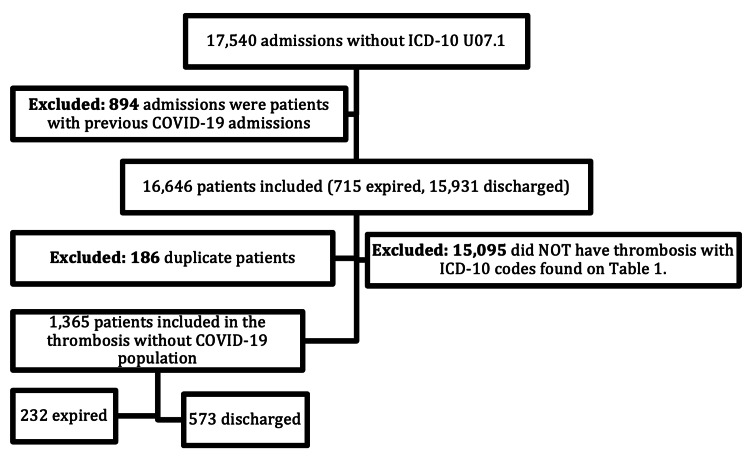
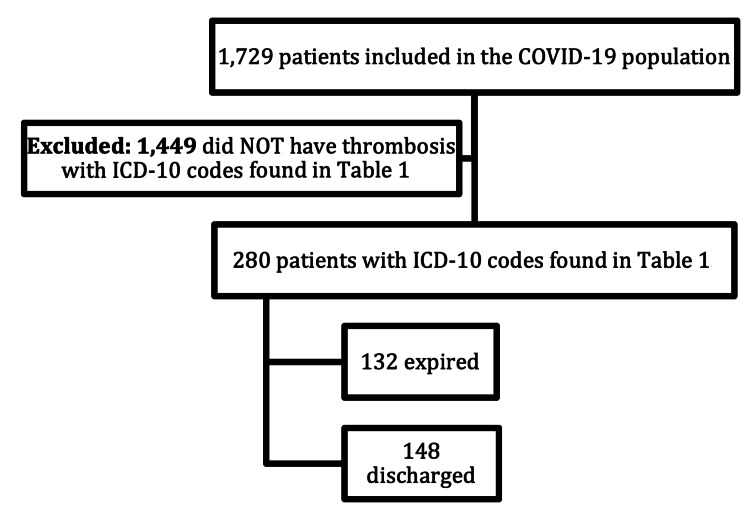
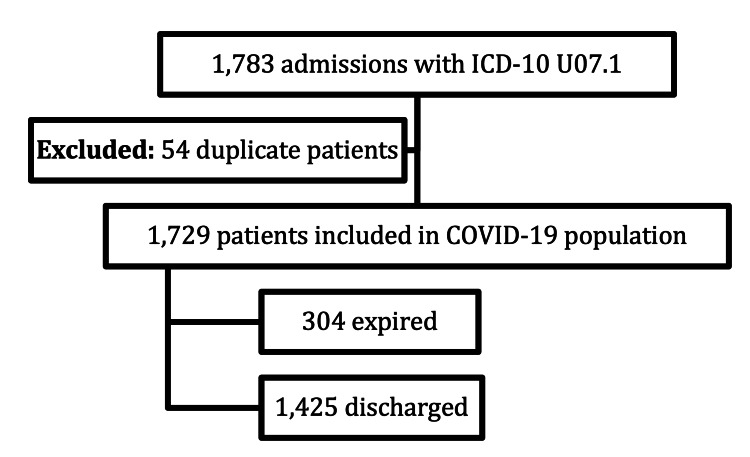
Background COVID-19 disease has caused a major global impact on health and mortality. This infection may predispose patients to thrombotic disease, caused by excessive inflammation, endothelial dysfunction, platelet activation, and stasis. In this study, we compared mortality rates in patients admitted to the hospital with the diagnosis of COVID-19, who also had the additional diagnosis of thrombosis with those who did not have thrombosis as an additional diagnosis. Methods This retrospective observational study compared mortality rates in patients admitted to the hospital with the diagnosis of COVID-19, with and without thrombosis, as well as those patients admitted to the hospital with the diagnosis of thrombosis who did not have COVID-19. The diagnoses were verified using International Classification of Diseases Tenth Revision (ICD-10) codes, a standard among electronic medical records (EMR). The data were taken from the EMR at Freeman Health System in Joplin and Neosho, Missouri, from April 2020 to December 2021. This patient population is representative of not only Southwest Missouri but also the four-state area, including Oklahoma, Arkansas, and Kansas. The ICD-10 codes were used to separate the patient population into three main groups as follows: patients diagnosed with COVID-19 without thrombosis, patients diagnosed with thrombosis without COVID-19, and patients diagnosed with both COVID-19 and thrombosis. These three categories were then subdivided by age and biological sex. Sample proportions were completed using Wald's method, and the two-sample proportion summary hypothesis test with confidence intervals was used for the proportion difference. Results A total of 3,094 patients were included in the study population. Excluded from the study were patients who were previously admitted to a hospital for COVID-19 and duplicate admissions. The mortality rate was highest (0.4714) in patients concurrently diagnosed with COVID-19 and thrombosis (Population 1 {P1}), followed by patients diagnosed with COVID-19 without thrombosis (Population 2 {P2}, 0.1187). Patients diagnosed with thrombosis without COVID-19 (Population 3 {P3}, 0.1216) had the lowest mortality. Two sample proportion hypothesis tests determined confidence intervals (CI) for mortality risk comparing P3 to P1 (95% CI: 0.2888-0.4108, p<0.0001) and P2 to P1 (95% CI: 0.2919-0.4135, p<0.0001). Discussion In this rural, Midwestern population, patients admitted to the hospital with the diagnosis of COVID-19 and thrombosis had significantly increased mortality rates compared to patients admitted with the diagnosis of COVID-19 or thrombosis alone. Conclusion The data from this study indicated that individuals diagnosed with both COVID-19 and thrombosis had a higher likelihood of mortality compared to those diagnosed with COVID-19 without thrombosis and those diagnosed with thrombosis without COVID-19. This information could assist physicians in determining treatment plans for patients diagnosed with COVID-19 and a secondary complication of thrombosis.
新型冠状病毒肺炎(COVID-19)疾病已对全球健康和死亡率造成重大影响。这种感染可能使患者易患血栓形成性疾病,其由过度炎症、内皮功能障碍、血小板活化和血流淤滞引起。在本研究中,我们比较了因COVID-19入院且伴有血栓形成附加诊断的患者与没有血栓形成附加诊断的患者的死亡率。
这项回顾性观察性研究比较了因COVID-19入院且伴有或不伴有血栓形成的患者,以及因血栓形成入院但没有COVID-19的患者的死亡率。诊断使用国际疾病分类第十版(ICD-10)编码进行验证,这是电子病历(EMR)中的一项标准。数据取自密苏里州乔普林和尼奥肖的弗里曼医疗系统的电子病历,时间为2020年4月至2021年12月。该患者群体不仅代表密苏里州西南部,还代表包括俄克拉何马州、阿肯色州和堪萨斯州在内的四州地区。ICD-10编码用于将患者群体分为三个主要组:诊断为COVID-19但无血栓形成的患者、诊断为血栓形成但无COVID-19的患者、诊断为COVID-19和血栓形成的患者。然后根据年龄和生物学性别对这三个类别进行细分。样本比例使用沃尔德方法完成,比例差异采用具有置信区间的两样本比例汇总假设检验。
研究人群共纳入3094例患者。排除曾因COVID-19入院和重复入院的患者。同时诊断为COVID-19和血栓形成的患者(群体1 {P1})死亡率最高(0.4714),其次是诊断为COVID-19但无血栓形成的患者(群体2 {P2},0.1187)。诊断为血栓形成但无COVID-19的患者(群体3 {P3},0.1216)死亡率最低。两样本比例假设检验确定了比较P3与P1(95%置信区间:0.2888 - 0.4108,p < 0.0001)以及P2与P1(95%置信区间:0.2919 - 0.4135,p < 0.0001)的死亡率风险的置信区间(CI)。
在这个中西部农村人群中,与仅诊断为COVID-19或血栓形成的患者相比,因COVID-19和血栓形成入院的患者死亡率显著增加。
本研究数据表明,与诊断为COVID-19但无血栓形成的患者以及诊断为血栓形成但无COVID-19的患者相比,同时诊断为COVID-19和血栓形成的个体死亡可能性更高。这些信息可帮助医生为诊断为COVID-19并伴有血栓形成继发并发症的患者确定治疗方案。