• 文献检索
  • 文档翻译
  • 深度研究
  • 学术资讯
  • Suppr Zotero 插件Zotero 插件
  • 邀请有礼
  • 套餐&价格
  • 历史记录
应用&插件
Suppr Zotero 插件Zotero 插件浏览器插件Mac 客户端Windows 客户端微信小程序
定价
高级版会员购买积分包购买API积分包
服务
文献检索文档翻译深度研究API 文档MCP 服务
关于我们
关于 Suppr公司介绍联系我们用户协议隐私条款
关注我们

Suppr 超能文献

核心技术专利:CN118964589B侵权必究
粤ICP备2023148730 号-1Suppr @ 2026

文献检索

告别复杂PubMed语法,用中文像聊天一样搜索,搜遍4000万医学文献。AI智能推荐,让科研检索更轻松。

立即免费搜索

文件翻译

保留排版,准确专业,支持PDF/Word/PPT等文件格式,支持 12+语言互译。

免费翻译文档

深度研究

AI帮你快速写综述,25分钟生成高质量综述,智能提取关键信息,辅助科研写作。

立即免费体验

作为MZ一代自杀意念危险因素的火病(愤怒综合征):韩国的一项调查研究

Hwa-byung (anger syndrome) as a risk factor for suicidal ideation in MZ generation: a survey study in South Korea.

作者信息

Kwon Chan-Young

机构信息

Department of Oriental Neuropsychiatry, College of Korean Medicine, Dong-Eui University, Busan, Republic of Korea.

出版信息

Front Psychol. 2024 Dec 9;15:1461750. doi: 10.3389/fpsyg.2024.1461750. eCollection 2024.

DOI:10.3389/fpsyg.2024.1461750
PMID:39717473
原文链接:https://pmc.ncbi.nlm.nih.gov/articles/PMC11664736/
Abstract

INTRODUCTION

Suicide is a critical global public health issue, with South Korea exhibiting the highest suicide rate among OECD countries at 24.1 per 100,000 people in 2020. This study focuses on suicidal ideation (SI) within South Korea's Millennials and Generation Z (Generation MZ) by examining the impact of anger and hwa-byung (HB), a culture-bound anger syndrome.

METHODS

The online survey was conducted between June 7 and 12, 2024. The inclusion criteria for this study were the following: (1) generation MZ (i.e., those born between 1980 and 2005); (2) those without a history of mood disorders (i.e., depressive disorders or bipolar disorder); (3) those of Korean nationality and residing in South Korea. Demographic variables and clinical variables including SI, HB, and depression were investigated. The chi-square test or t-test was used to compare the differences between the SI and non-SI groups. Additionally, binary logistic regression analysis was performed to analyze factors associated with the presence of SI. Finally, Pearson's correlation coefficients were calculated to explore HB symptoms that were highly associated with SI.

RESULTS

Total 457 participants were included. The survey revealed an overall prevalence of SI of 38.07%, with 18.82% reporting "much" or more SI and 4.81% reporting "very much" SI. Significant differences were found between the SI and non-SI groups in HB symptoms, depression, anxiety, perceived stress, trait anger, state anger, anger-in, and anger-out (all  < 0.001). Logistic regression analysis identified HB symptoms (odds ratio [OR], 1.05; 95% CI, 1.00-1.11;  = 0.050), depression (OR, 1.41; 95% CI, 1.23-1.62;  < 0.001), and state anger (OR, 1.14; 95% CI, 1.05-1.24;  = 0.002) as significant factors for SI. The mediating factors confirmed the direct and indirect effects of HB symptoms on the presence of SI. Pearson's correlation coefficients between HB symptoms and SI severity ranged from 0.241 to 0.536, with physical symptoms, such as heat sensation and chest pressure, showing high correlations (0.426 to 0.476).

CONCLUSION

These findings highlight the need for mental health policies that integrate Korean medical approaches into suicide prevention. Future research should confirm these results using larger, nationally representative samples to improve generalizability and further explore HB and suicidality in diverse populations.

摘要

引言

自杀是一个严峻的全球公共卫生问题,韩国在经合组织国家中自杀率最高,2020年每10万人中有24.1人自杀。本研究聚焦于韩国千禧一代和Z世代(MZ世代)的自杀意念(SI),通过考察愤怒和火病(HB,一种与文化相关的愤怒综合征)的影响来进行研究。

方法

于2024年6月7日至12日进行了在线调查。本研究的纳入标准如下:(1)MZ世代(即1980年至2005年出生的人);(2)无情绪障碍病史(即抑郁症或双相情感障碍);(3)韩国国籍且居住在韩国。对人口统计学变量以及包括自杀意念、火病和抑郁在内的临床变量进行了调查。采用卡方检验或t检验比较自杀意念组和非自杀意念组之间的差异。此外,进行了二元逻辑回归分析以分析与自杀意念存在相关的因素。最后,计算了皮尔逊相关系数以探究与自杀意念高度相关的火病症状。

结果

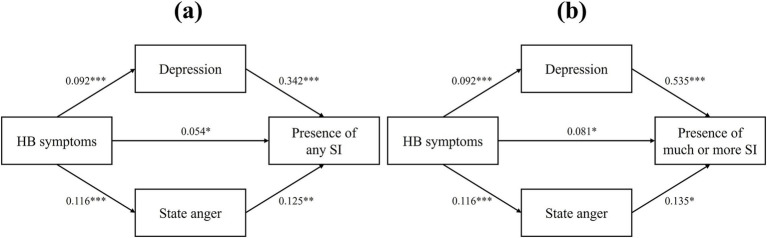
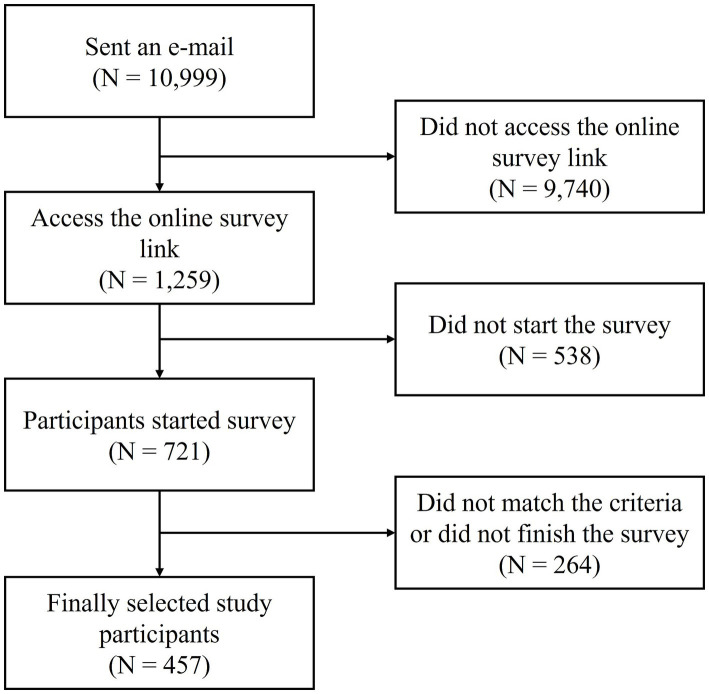
共纳入457名参与者。调查显示自杀意念的总体患病率为38.07%,其中18.82%报告有“较多”或更多的自杀意念,4.81%报告有“非常多”的自杀意念。在火病症状、抑郁、焦虑、感知压力、特质愤怒、状态愤怒、向内愤怒和向外愤怒方面,自杀意念组和非自杀意念组之间存在显著差异(均P<0.001)。逻辑回归分析确定火病症状(比值比[OR],1.05;95%置信区间,1.00 - 1.11;P = 0.050)、抑郁(OR,1.41;95%置信区间,1.23 - 1.62;P<0.001)和状态愤怒(OR,1.14;95%置信区间,1.05 - 1.24;P = 0.002)是自杀意念的重要因素。中介因素证实了火病症状对自杀意念存在的直接和间接影响。火病症状与自杀意念严重程度之间的皮尔逊相关系数在0.241至0.536之间,其中热感和胸部压迫等身体症状显示出高度相关性(0.426至0.476)。

结论

这些发现凸显了将韩国医学方法纳入自杀预防的心理健康政策的必要性。未来的研究应使用更大规模、具有全国代表性的样本证实这些结果,以提高普遍性,并进一步探索不同人群中的火病和自杀倾向。
https://cdn.ncbi.nlm.nih.gov/pmc/blobs/c4f3/11664736/6fa8777ebfbf/fpsyg-15-1461750-g002.jpg
https://cdn.ncbi.nlm.nih.gov/pmc/blobs/c4f3/11664736/c250c960c5a0/fpsyg-15-1461750-g001.jpg
https://cdn.ncbi.nlm.nih.gov/pmc/blobs/c4f3/11664736/6fa8777ebfbf/fpsyg-15-1461750-g002.jpg
https://cdn.ncbi.nlm.nih.gov/pmc/blobs/c4f3/11664736/c250c960c5a0/fpsyg-15-1461750-g001.jpg
https://cdn.ncbi.nlm.nih.gov/pmc/blobs/c4f3/11664736/6fa8777ebfbf/fpsyg-15-1461750-g002.jpg

相似文献

1
Hwa-byung (anger syndrome) as a risk factor for suicidal ideation in MZ generation: a survey study in South Korea.作为MZ一代自杀意念危险因素的火病(愤怒综合征):韩国的一项调查研究
Front Psychol. 2024 Dec 9;15:1461750. doi: 10.3389/fpsyg.2024.1461750. eCollection 2024.
2
Hwa-Byung (Anger Syndrome) in the MZ Generation of Republic of Korea: A Survey.韩国MZ一代中的火病(愤怒综合征):一项调查
J Clin Med. 2024 Nov 6;13(22):6667. doi: 10.3390/jcm13226667.
3
Symptoms to use for diagnostic criteria of hwa-byung, an anger syndrome.用于愤怒综合征(hwa-byung)诊断标准的症状。
Psychiatry Investig. 2009 Mar;6(1):7-12. doi: 10.4306/pi.2009.6.1.7. Epub 2009 Mar 31.
4
Posttraumatic Embitterment Disorder and Hwa-byung in the General Korean Population.韩国普通人群中的创伤后痛苦障碍与火病
Psychiatry Investig. 2017 Jul;14(4):392-399. doi: 10.4306/pi.2017.14.4.392. Epub 2017 Jul 11.
5
Comparative Analysis of Emotional Symptoms in Elderly Koreans with Hwa-Byung and Depression.韩国老年人群中花病与抑郁症患者情感症状的比较分析
Psychiatry Investig. 2017 Nov;14(6):864-870. doi: 10.4306/pi.2017.14.6.864. Epub 2017 Nov 7.
6
The anger syndrome hwa-byung and its comorbidity.愤怒综合征(Hwa-Byung)及其共病。
J Affect Disord. 2010 Jul;124(1-2):211-4. doi: 10.1016/j.jad.2009.10.011. Epub 2009 Nov 1.
7
Differences in temperament and character dimensions of personality between patients with Hwa-byung, an anger syndrome, and patients with major depressive disorder.愤怒综合征 Hwa-byung 患者与重性抑郁症患者的气质和性格维度的人格差异。
J Affect Disord. 2012 Apr;138(1-2):110-6. doi: 10.1016/j.jad.2011.12.014. Epub 2012 Jan 28.
8
Factors affecting suicidal ideation among premenopausal and postmenopausal women.影响绝经前和绝经后女性自杀意念的因素。
J Psychiatr Ment Health Nurs. 2021 Jun;28(3):356-369. doi: 10.1111/jpm.12679. Epub 2020 Aug 12.
9
Effect and safety of acupuncture for Hwa-byung, an anger syndrome: a study protocol of a randomized controlled pilot trial.针刺治疗火郁证(一种愤怒综合征)的疗效与安全性:一项随机对照试验的研究方案
Trials. 2018 Feb 9;19(1):98. doi: 10.1186/s13063-017-2399-0.
10
Effectiveness of mind-body medicine for Hwa-Byung (a Korean cultural diagnosis of suppressed anger): A systematic review of interventional studies.身心医学治疗 Hwa-Byung(一种被压抑的愤怒的韩国文化诊断)的有效性:干预性研究的系统评价。
Complement Ther Med. 2024 Mar;80:103016. doi: 10.1016/j.ctim.2024.103016. Epub 2024 Jan 6.

本文引用的文献

1
Psychometrics of the Korean Version of the screen for adult anxiety related disorders (SCAARED).《成人焦虑相关障碍筛查量表(SCAARED)韩国版的心理测量学研究》。
BMC Psychiatry. 2024 May 30;24(1):383. doi: 10.1186/s12888-024-05800-5.
2
Validity of the Korean Version of the Brief Irritability Test in Psychiatric Patients.《简明易怒测试韩语版在精神科患者中的效度》
Psychiatry Investig. 2024 Apr;21(4):396-402. doi: 10.30773/pi.2023.0284. Epub 2024 Apr 23.
3
The potential role of Korean medicine doctors in Korea's suicide prevention policy: The first web-based survey.
韩医医生在韩国自杀预防政策中的潜在作用:首次基于网络的调查。
Asian J Psychiatr. 2024 Jun;96:104040. doi: 10.1016/j.ajp.2024.104040. Epub 2024 Apr 1.
4
Authenticity: Effective emotional labor strategies on teaching efficacy of university teachers in China.真实性:中国高校教师有效情绪劳动策略对教学效能的影响
PLoS One. 2024 Jan 26;19(1):e0297760. doi: 10.1371/journal.pone.0297760. eCollection 2024.
5
Factors Related to Suicidal Ideation by Gender and Age Group in Korean Adults.韩国成年人中性别和年龄组与自杀意念相关的因素。
J Korean Med Sci. 2023 Dec 18;38(49):e376. doi: 10.3346/jkms.2023.38.e376.
6
Moderating Role of Communication Competence in the Association between Professionalism and Job Satisfaction in Korean Millennial and Generation Z Nurses: A Cross-Sectional Study.沟通能力在韩国千禧一代和Z世代护士的职业素养与工作满意度之间关联中的调节作用:一项横断面研究
Healthcare (Basel). 2023 Sep 14;11(18):2547. doi: 10.3390/healthcare11182547.
7
Occupational Factors Associated With Workers' Depression, Anxiety, and General Fatigue.与工人抑郁、焦虑和一般疲劳相关的职业因素。
J Occup Environ Med. 2023 Dec 1;65(12):e771-e775. doi: 10.1097/JOM.0000000000002976. Epub 2023 Sep 25.
8
Gender Inequalities in Mental Health During the COVID-19 Pandemic: A Population-based Study in Korea.《COVID-19 大流行期间心理健康的性别不平等:韩国一项基于人群的研究》。
J Prev Med Public Health. 2023 Sep;56(5):413-421. doi: 10.3961/jpmph.23.170. Epub 2023 Aug 19.
9
Machine learning models for predicting depression in Korean young employees.用于预测韩国年轻员工抑郁状况的机器学习模型。
Front Public Health. 2023 Jul 12;11:1201054. doi: 10.3389/fpubh.2023.1201054. eCollection 2023.
10
Subjective Perceptions of 'Meaning of Work' of Generation MZ Employees of South Korean NGOs.韩国非政府组织千禧一代员工对“工作意义”的主观认知
Behav Sci (Basel). 2023 Jun 2;13(6):461. doi: 10.3390/bs13060461.