Vissers Eva, Wellens Judith, Giorio Lorenzo, Zadora Ward, Verstockt Bram, Ferrante Marc, Vermeire Séverine, Matthys Christophe, Arnauts Kaline, Sabino João
Department of Chronic Diseases and Metabolism (CHROMETA), Translational Research Center for Gastrointestinal Disorders (TARGID), KU Leuven, Herestraat 49, 3000 Leuven, Belgium.
Department of Gastroenterology and Hepatology, UZ Leuven, Herestraat 49, 3000 Leuven, Belgium.
Inflamm Bowel Dis. 2025 May 12;31(5):1392-1403. doi: 10.1093/ibd/izae306.
The consumption of ultra-processed foods has increased significantly worldwide and is associated with the rise in inflammatory bowel diseases. However, any causative factors and their underlying mechanisms are yet to be identified. This study aimed to further elucidate whether different types of the dietary emulsifier carrageenan (CGN) can alter the permeability and inflammatory state of the intestinal epithelium.
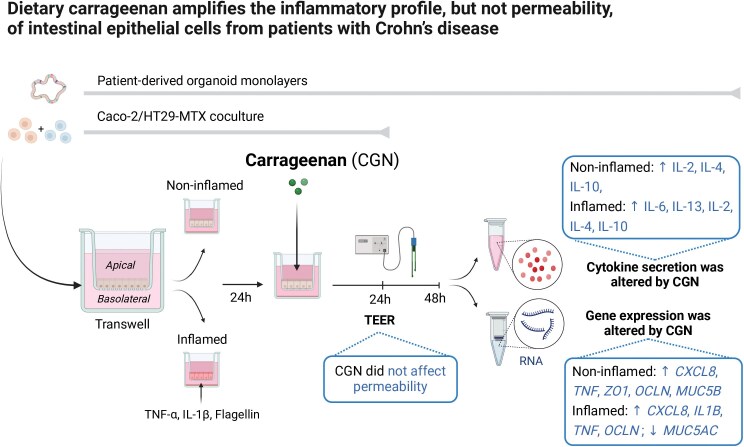
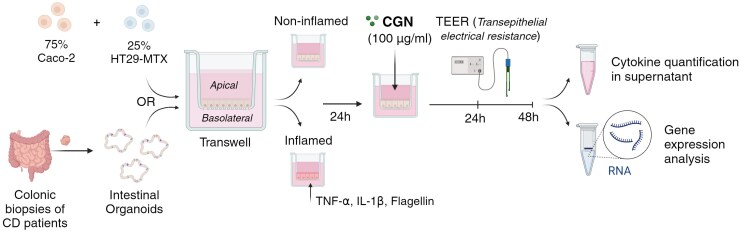
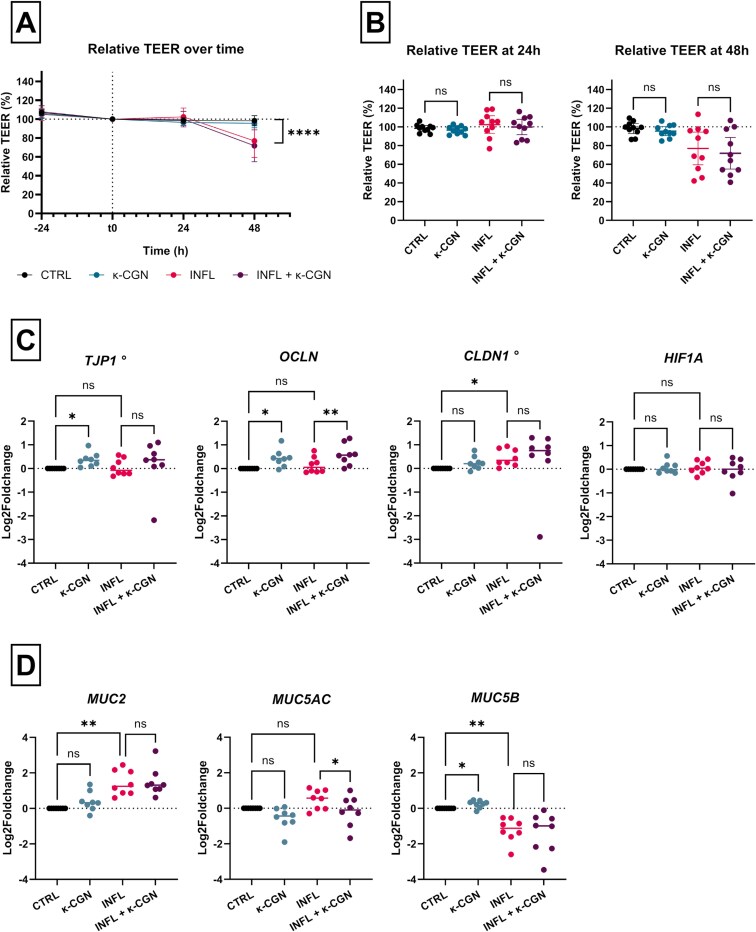
Caco-2/HT29-MTX cocultures (n = 4) were exposed to either κ-, ι-, or λ-CGN (100 µg mL-1) for 24 hours. Organoid-derived monolayers from patients with Crohn's Disease (CD) were exposed to κ-CGN (100 µg mL-1) for 48 hours (n = 10). In both models, an inflamed condition was established by adding a mix of inflammatory stimuli. Changes in permeability were measured by transepithelial electrical resistance (TEER). In the organoid-derived monolayers, cytokines were quantified in the apical and basolateral supernatant and gene expression was analyzed with RT-qPCR.
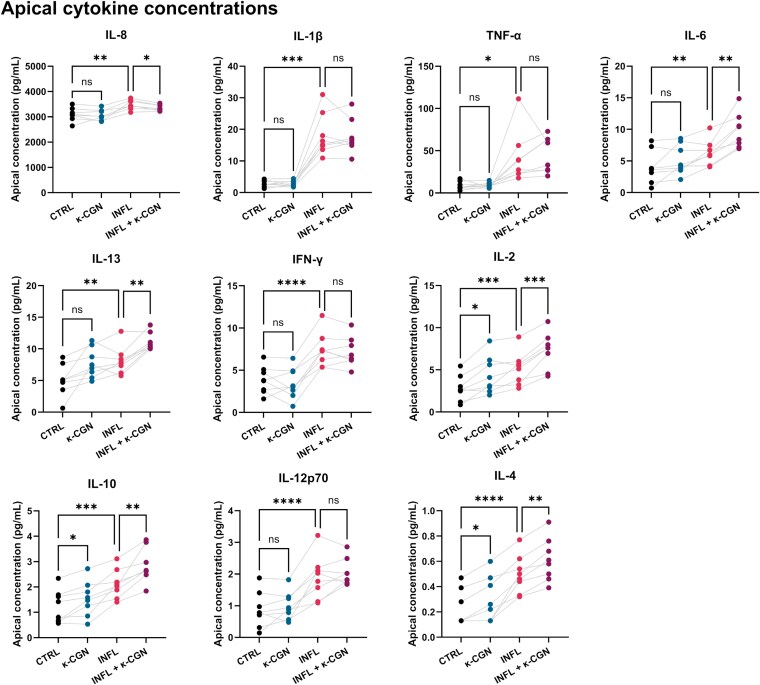
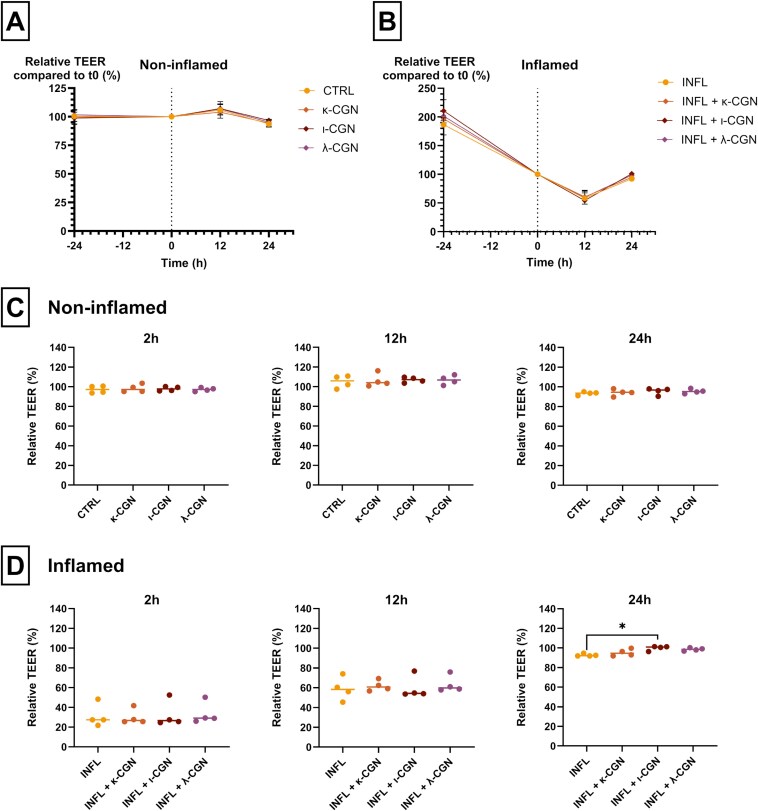
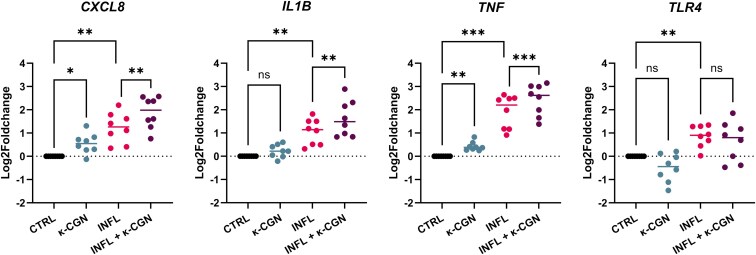
None of the CGN subtypes altered permeability of non-inflamed or inflamed Caco-2/HT29-MTX cocultures. In organoid-derived monolayers, κ-CGN did not affect TEER, but induced alterations in the gene expression of tight junctions and mucus proteins. Expression of TNF, IL8, and IL1B increased upon κ-CGN stimulation, both in inflamed and non-inflamed monolayers. Cytokine release in the supernatant was increased by κ-CGN for IL-6, IL-13, IL-4, IL-2, and IL-10.
Dietary CGN caused upregulation of inflammatory markers and affected cytokine release of intestinal epithelial cells from CD patients, while permeability remained unaltered. When inflammation was already present, this pro-inflammatory effect was more pronounced, suggesting a role for dietary CGN during active CD.
超加工食品在全球范围内的消费量显著增加,且与炎症性肠病的发病率上升有关。然而,任何致病因素及其潜在机制尚未明确。本研究旨在进一步阐明不同类型的膳食乳化剂卡拉胶(CGN)是否会改变肠上皮的通透性和炎症状态。
将Caco-2/HT29-MTX共培养物(n = 4)暴露于κ-、ι-或λ-CGN(100 μg/mL)中24小时。将来自克罗恩病(CD)患者的类器官衍生单层暴露于κ-CGN(100 μg/mL)中48小时(n = 10)。在这两种模型中,通过添加炎症刺激混合物建立炎症状态。通过跨上皮电阻(TEER)测量通透性变化。在类器官衍生单层中,对顶端和基底外侧上清液中的细胞因子进行定量,并通过RT-qPCR分析基因表达。
CGN的任何亚型均未改变未发炎或发炎的Caco-2/HT29-MTX共培养物的通透性。在类器官衍生单层中,κ-CGN不影响TEER,但诱导紧密连接和黏液蛋白的基因表达发生改变。在发炎和未发炎的单层中,κ-CGN刺激后TNF、IL8和IL1B的表达均增加。κ-CGN使IL-6、IL-13、IL-4、IL-2和IL-10的上清液中细胞因子释放增加。
膳食CGN导致炎症标志物上调,并影响CD患者肠上皮细胞的细胞因子释放,而通透性保持不变。当炎症已经存在时,这种促炎作用更为明显,表明膳食CGN在活动性CD中起作用。