Yang Xintian, Li Tongxin, Su Qin, Liu Yaling, Kang Chenxi, Lyu Yong, Zhao Lina, Nie Yongzhan, Pan Yanglin
State Key Laboratory of Holistic Integrative Management of Gastrointestinal Cancers and National Clinical Research Center for Digestive Diseases, Xijing Hospital of Digestive Diseases, Fourth Military Medical University, Xi'an, Shaanxi 710032, China.
Department of Radiotherapy, Xijing Hospital, Fourth Military Medical University, Xi'an, Shaanxi 710032, China.
Chin Med J (Engl). 2025 Jan 20;138(2):130-142. doi: 10.1097/CM9.0000000000003456. Epub 2024 Dec 26.
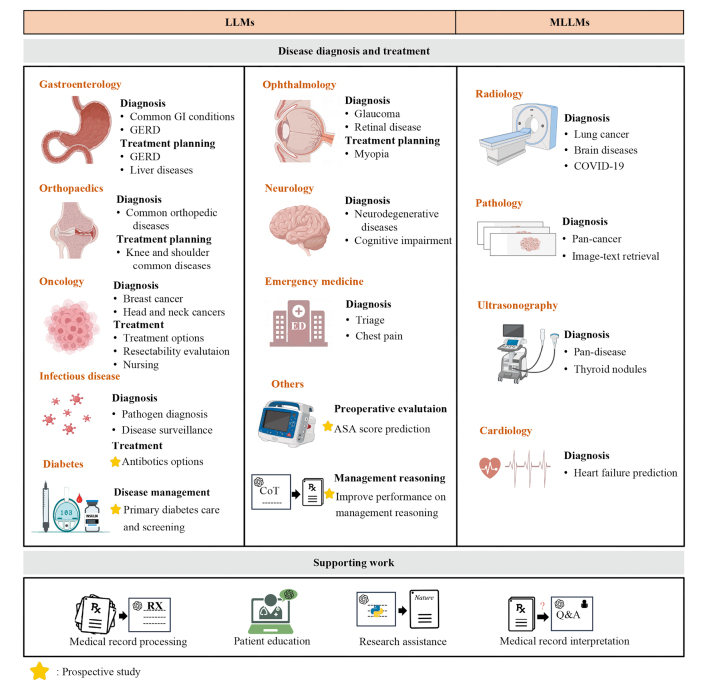
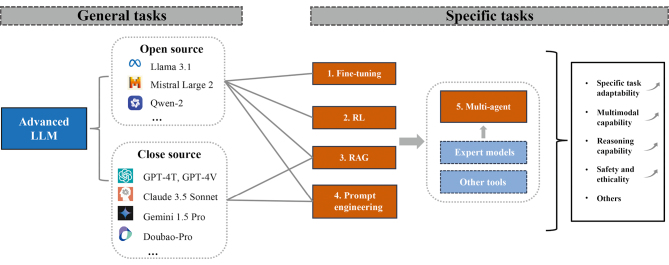
Large language models (LLMs) such as ChatGPT, Claude, Llama, and Qwen are emerging as transformative technologies for the diagnosis and treatment of various diseases. With their exceptional long-context reasoning capabilities, LLMs are proficient in clinically relevant tasks, particularly in medical text analysis and interactive dialogue. They can enhance diagnostic accuracy by processing vast amounts of patient data and medical literature and have demonstrated their utility in diagnosing common diseases and facilitating the identification of rare diseases by recognizing subtle patterns in symptoms and test results. Building on their image-recognition abilities, multimodal LLMs (MLLMs) show promising potential for diagnosis based on radiography, chest computed tomography (CT), electrocardiography (ECG), and common pathological images. These models can also assist in treatment planning by suggesting evidence-based interventions and improving clinical decision support systems through integrated analysis of patient records. Despite these promising developments, significant challenges persist regarding the use of LLMs in medicine, including concerns regarding algorithmic bias, the potential for hallucinations, and the need for rigorous clinical validation. Ethical considerations also underscore the importance of maintaining the function of supervision in clinical practice. This paper highlights the rapid advancements in research on the diagnostic and therapeutic applications of LLMs across different medical disciplines and emphasizes the importance of policymaking, ethical supervision, and multidisciplinary collaboration in promoting more effective and safer clinical applications of LLMs. Future directions include the integration of proprietary clinical knowledge, the investigation of open-source and customized models, and the evaluation of real-time effects in clinical diagnosis and treatment practices.
ChatGPT、Claude、Llama和豆包等大语言模型正作为用于各种疾病诊断和治疗的变革性技术而兴起。凭借其卓越的长上下文推理能力,大语言模型精通临床相关任务,尤其是在医学文本分析和交互式对话方面。它们可以通过处理大量患者数据和医学文献来提高诊断准确性,并已在诊断常见疾病以及通过识别症状和检查结果中的细微模式来促进罕见病的识别方面展示了其效用。基于其图像识别能力,多模态大语言模型在基于X射线摄影、胸部计算机断层扫描(CT)、心电图(ECG)和常见病理图像的诊断方面显示出有前景的潜力。这些模型还可以通过建议基于证据的干预措施来协助治疗规划,并通过对患者记录的综合分析来改进临床决策支持系统。尽管有这些有前景的发展,但在医学中使用大语言模型仍存在重大挑战,包括对算法偏差、幻觉可能性的担忧以及严格临床验证的必要性。伦理考量也强调了在临床实践中保持监督功能的重要性。本文强调了大语言模型在不同医学学科的诊断和治疗应用研究中的快速进展,并强调了政策制定、伦理监督和多学科合作在促进大语言模型更有效、更安全的临床应用方面的重要性。未来的方向包括专有临床知识的整合、开源和定制模型的研究以及临床诊断和治疗实践中实时效果的评估。