Hübner Sebastian, Tambalo Stefano, Novello Lisa, Hilbert Tom, Kober Tobias, Jovicich Jorge
Center for Mind/Brain Sciences-CIMeC, University of Trento, Rovereto, Italy.
Data Science for Health, Fondazione Bruno Kessler, Trento, Italy.
Hum Brain Mapp. 2024 Dec 15;45(18):e70120. doi: 10.1002/hbm.70120.
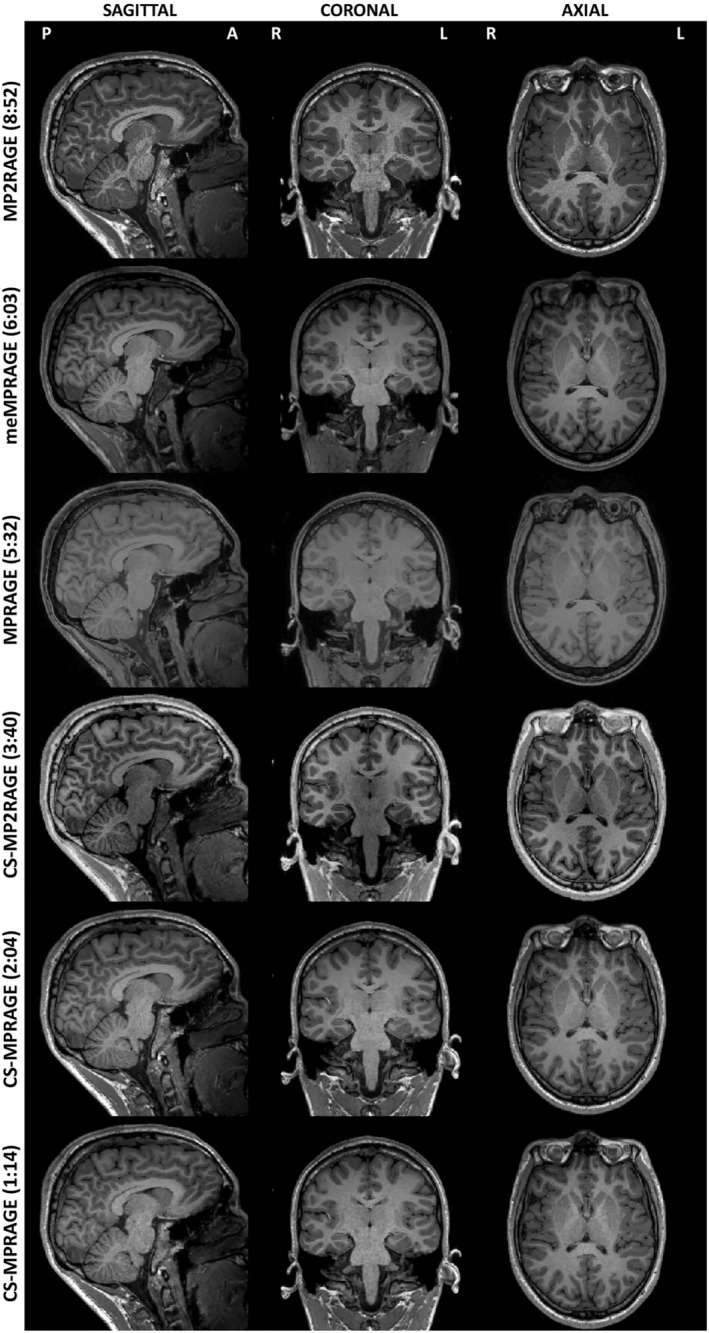
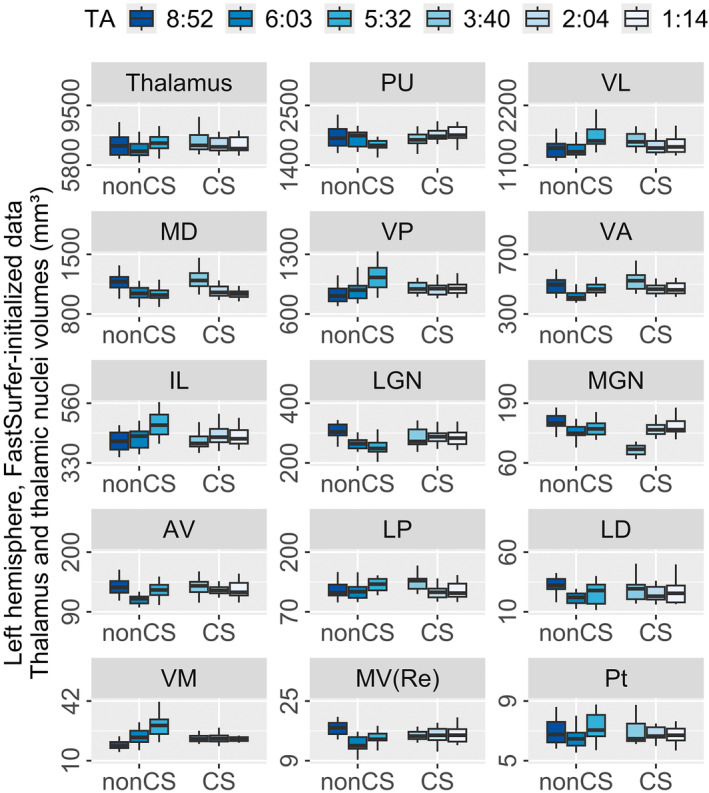
The thalamus is a collection of gray matter nuclei that play a crucial role in sensorimotor processing and modulation of cortical activity. Characterizing thalamic nuclei non-invasively with structural MRI is particularly relevant for patient populations with Parkinson's disease, epilepsy, dementia, and schizophrenia. However, severe head motion in these populations poses a significant challenge for in vivo mapping of thalamic nuclei. Recent advancements have leveraged the compressed sensing (CS) framework to accelerate structural MRI acquisition times in MPRAGE sequence variants, while fast segmentation tools like FastSurfer have reduced processing times in neuroimaging research. In this study, we evaluated thalamic nuclei segmentations derived from six different MPRAGE variants with varying degrees of CS acceleration (from about 9 to about 1-min acquisitions). Thalamic segmentations were initialized from either FastSurfer or FreeSurfer, and the robustness of the thalamic nuclei segmentation tool to different initialization inputs was evaluated. Our findings show minimal sequence effects with no systematic bias, and low volume variability across sequences for the whole thalamus and major thalamic nuclei. Notably, CS-accelerated sequences produced less variable volumes compared to non-CS sequences. Additionally, segmentations of thalamic nuclei initialized from FastSurfer and FreeSurfer were highly comparable. We provide the first evidence supporting that a good segmentation quality of thalamic nuclei with CS T1-weighted image acceleration in a clinical 3T MRI system is possible. Our findings encourage future applications of fast T1-weighted MRI to study deep gray matter. CS-accelerated sequences and rapid segmentation methods are promising tools for future studies aiming to characterize thalamic nuclei in vivo at 3T in both healthy individuals and clinical populations.
丘脑是一组灰质核团,在感觉运动处理和皮层活动调节中起关键作用。利用结构磁共振成像(MRI)对丘脑核团进行无创性特征描述,对于帕金森病、癫痫、痴呆和精神分裂症患者群体尤为重要。然而,这些人群中的严重头部运动对丘脑核团的活体图谱绘制构成了重大挑战。最近的进展利用了压缩感知(CS)框架来加速MPRAGE序列变体中的结构MRI采集时间,而像FastSurfer这样的快速分割工具则减少了神经影像学研究中的处理时间。在本研究中,我们评估了来自六种不同MPRAGE变体的丘脑核团分割结果,这些变体具有不同程度的CS加速(采集时间从约9分钟到约1分钟)。丘脑分割从FastSurfer或FreeSurfer初始化,并评估丘脑核团分割工具对不同初始化输入的稳健性。我们的研究结果显示,序列效应极小,无系统偏差,整个丘脑和主要丘脑核团在不同序列间的体积变异性较低。值得注意的是,与非CS序列相比,CS加速序列产生的体积变异性更小。此外,从FastSurfer和FreeSurfer初始化的丘脑核团分割结果具有高度可比性。我们提供了首个证据,支持在临床3T MRI系统中通过CS T1加权图像加速实现良好的丘脑核团分割质量是可行的。我们的研究结果鼓励未来应用快速T1加权MRI来研究深部灰质。CS加速序列和快速分割方法是未来旨在在3T条件下对健康个体和临床群体的丘脑核团进行活体特征描述的研究中有前景的工具。