Amsterdam UMC, Vrije Universiteit Amsterdam, Department of Psychiatry, Department of Anatomy & Neurosciences, Amsterdam, The Netherlands.
Department of Psychiatry, Graduate School of Medical Science, Kyoto Prefectural University of Medicine, Kyoto, Japan.
Transl Psychiatry. 2022 Feb 21;12(1):70. doi: 10.1038/s41398-022-01823-2.
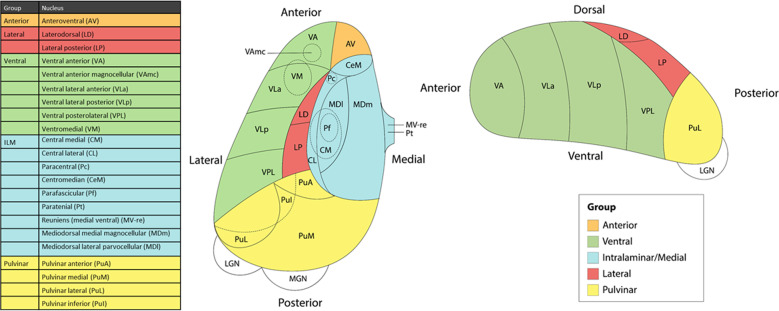
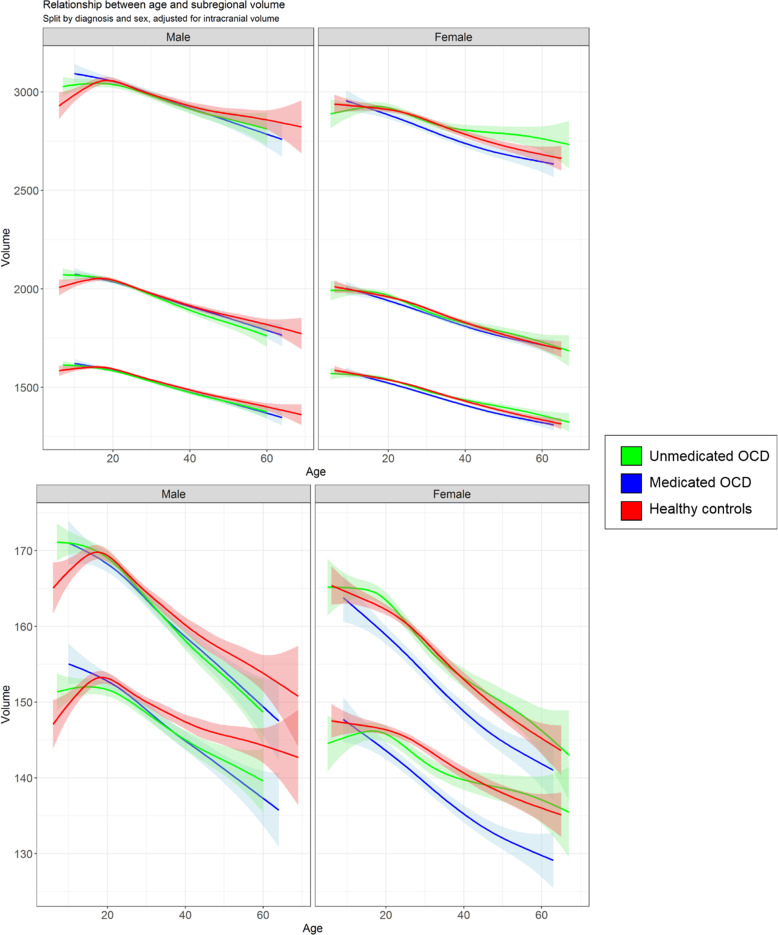
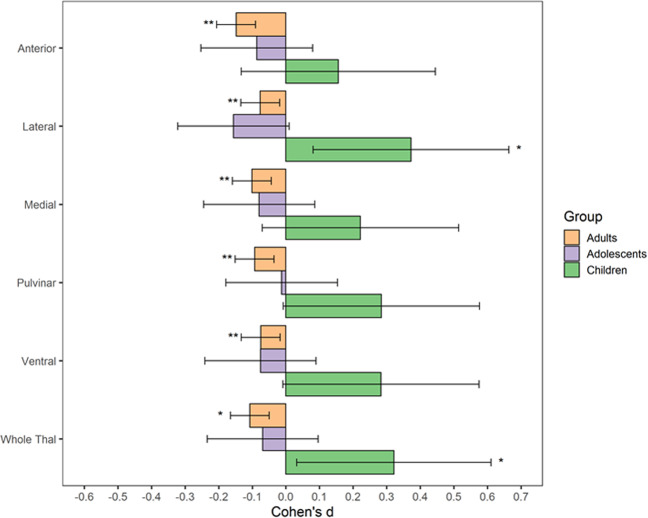
Larger thalamic volume has been found in children with obsessive-compulsive disorder (OCD) and children with clinical-level symptoms within the general population. Particular thalamic subregions may drive these differences. The ENIGMA-OCD working group conducted mega- and meta-analyses to study thalamic subregional volume in OCD across the lifespan. Structural T-weighted brain magnetic resonance imaging (MRI) scans from 2649 OCD patients and 2774 healthy controls across 29 sites (50 datasets) were processed using the FreeSurfer built-in ThalamicNuclei pipeline to extract five thalamic subregions. Volume measures were harmonized for site effects using ComBat before running separate multiple linear regression models for children, adolescents, and adults to estimate volumetric group differences. All analyses were pre-registered ( https://osf.io/73dvy ) and adjusted for age, sex and intracranial volume. Unmedicated pediatric OCD patients (<12 years) had larger lateral (d = 0.46), pulvinar (d = 0.33), ventral (d = 0.35) and whole thalamus (d = 0.40) volumes at unadjusted p-values <0.05. Adolescent patients showed no volumetric differences. Adult OCD patients compared with controls had smaller volumes across all subregions (anterior, lateral, pulvinar, medial, and ventral) and smaller whole thalamic volume (d = -0.15 to -0.07) after multiple comparisons correction, mostly driven by medicated patients and associated with symptom severity. The anterior thalamus was also significantly smaller in patients after adjusting for thalamus size. Our results suggest that OCD-related thalamic volume differences are global and not driven by particular subregions and that the direction of effects are driven by both age and medication status.
较大的丘脑体积已在强迫症(OCD)儿童和一般人群中具有临床水平症状的儿童中发现。特定的丘脑亚区可能会导致这些差异。ENIGMA-OCD 工作组进行了 mega分析和荟萃分析,以研究整个生命周期中 OCD 患者的丘脑亚区体积。使用内置的 FreeSurfer ThalamicNuclei 管道从 29 个地点(50 个数据集)的 2649 名 OCD 患者和 2774 名健康对照者的结构 T 加权脑磁共振成像(MRI)扫描中提取五个丘脑亚区。使用 ComBat 对来自 50 个数据集的 29 个站点的扫描进行处理,以消除个体站点对体积测量的影响,然后为儿童、青少年和成人运行单独的多元线性回归模型,以估计体积组差异。所有分析均已预先注册(https://osf.io/73dvy),并根据年龄、性别和颅内体积进行了调整。未经治疗的儿科 OCD 患者(<12 岁)在未调整的 p 值<0.05 时,外侧(d=0.46)、丘脑枕(d=0.33)、腹侧(d=0.35)和整个丘脑(d=0.40)体积较大。青少年患者没有体积差异。与对照组相比,成年 OCD 患者在所有亚区(前侧、外侧、丘脑枕、内侧和腹侧)和整个丘脑体积(d=-0.15 至-0.07)均较小,经多次比较校正后,这主要是由服药患者引起的,并与症状严重程度相关。在前丘脑体积在调整了丘脑大小后,患者也明显较小。我们的研究结果表明,与 OCD 相关的丘脑体积差异是全球性的,而不是由特定的亚区驱动的,并且效应的方向既受年龄又受药物状态的影响。