Rezaei Farzaneh, Burg Vanessa, Pfister Stephan, Hellweg Stefanie, Roshandel Ramin
Department of Energy Engineering Sharif University of Technology Tehran Iran.
Institute of Environmental Engineering ETH Zürich Zürich Switzerland.
J Ind Ecol. 2024 Dec;28(6):1507-1523. doi: 10.1111/jiec.13543. Epub 2024 Aug 13.
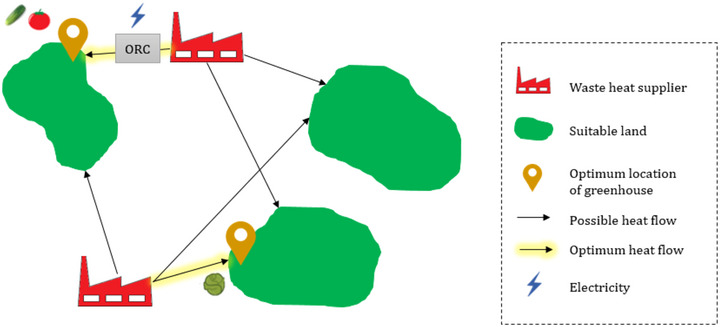
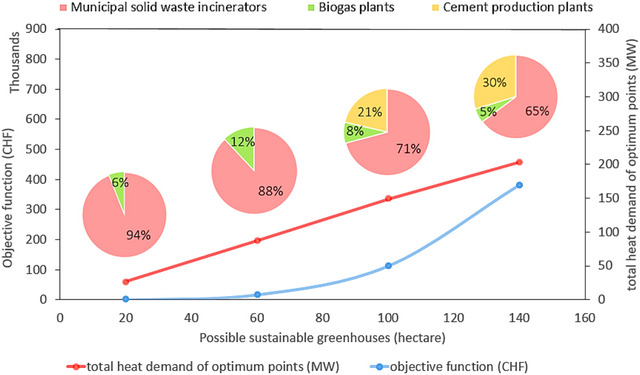
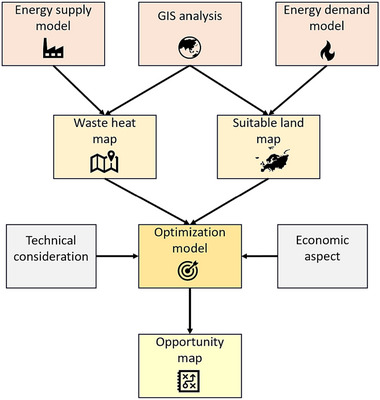
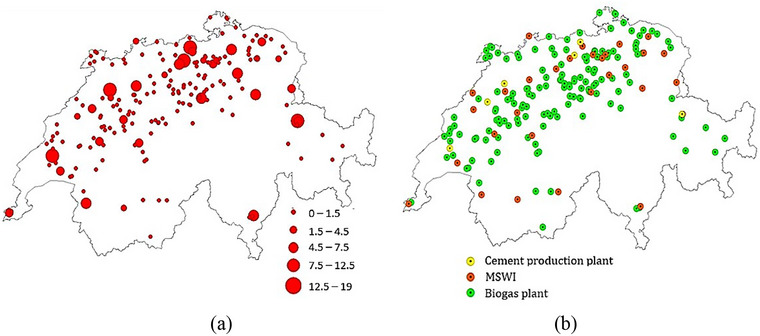
Despite the many benefits of greenhouses, it is challenging to meet their heating demand, as greenhouses belong to the most energy-intensive production systems in the agriculture sector. Industrial symbiosis can bring an effective solution by utilizing waste heat from other industries to meet the greenhouse heat demand. This study proposes an optimization framework by which optimum symbiotic relationships can be identified. For this aim, the spatial analysis is integrated into an optimization model, in which geographical, technical, and economic parameters are considered simultaneously to identify the optimal location for developing new agricultural greenhouses. The objective function is to minimize the heating costs, that is, the investment cost of piping and electricity cost for pumping heat-carrying fluid from supplier to demand. The model is applied to the case study of Switzerland, and currently existing municipal solid waste incinerators, cement production plants, and biogas plants are considered potential waste heat sources. Results show that the import of tomato, cucumber, and lettuce to Switzerland can theoretically be replaced by vegetable production in new waste-heat supplied greenhouses (zero import scenarios). Accounting for the economy of scale for pipeline investment costs leads to selecting large-scale greenhouses with a cost reduction of 37%. The optimization results suggest that 10% of the greenhouses needed to satisfy the total domestic demand for lettuce, tomato, and cucumber could be placed on a suitable land plot in the direct vicinity of a waste heat source, with low costs of waste heat supply.
尽管温室有诸多益处,但满足其供热需求具有挑战性,因为温室属于农业部门中能源密集型最高的生产系统。产业共生可以通过利用其他行业的废热来满足温室供热需求,从而带来有效的解决方案。本研究提出了一个优化框架,通过该框架可以确定最佳的共生关系。为此,将空间分析集成到一个优化模型中,在该模型中同时考虑地理、技术和经济参数,以确定开发新的农业温室的最佳位置。目标函数是使供热成本最小化,即管道投资成本以及将载热流体从供应商输送到需求方的电力成本。该模型应用于瑞士的案例研究,目前现有的城市固体废弃物焚烧厂、水泥厂和沼气厂被视为潜在的废热源。结果表明,理论上瑞士进口的番茄、黄瓜和生菜可以由新的利用废热供热的温室中的蔬菜生产来替代(零进口情景)。考虑管道投资成本的规模经济会导致选择大规模温室,成本降低37%。优化结果表明,满足国内对生菜、番茄和黄瓜总需求所需的温室中有10%可以建在废热源附近合适的地块上,废热供应成本较低。