Shirol Santosh B, Saboor Riyaz Ahmed, Müller Thomas
Global Medical Affairs, Viatris, Bangalore, India.
Department of Product Safety and Risk Management, Viatris, Hyderabad, India.
Degener Neurol Neuromuscul Dis. 2024 Dec 21;14:131-141. doi: 10.2147/DNND.S484306. eCollection 2024.
Multiple sclerosis (MS) is a neurological disorder affecting almost 2.8 million people globally, approximately 80-85% of whom have the relapsing-remitting form of the disease (RRMS). There are several autoinjectors available for the administration of injectable disease-modifying therapies for the treatment of MS. The objective of the current study was to gain an understanding of factors related to patients' and nurses' autoinjector preferences, and to evaluate two autoinjectors for glatiramer acetate (MyJECT™ and CSYNC™) against those preferences.
Patients with RRMS and nurses experienced in training patients with an autoinjector were recruited from 12 health centers in Germany. Surveys were administered to patients and nurses and their answers to 13 questions over five categories (participants' characteristics, important autoinjector attributes, autoinjector performance, satisfaction with the autoinjector devices and demographics) were scored, where appropriate, using a 5-point Likert scale.
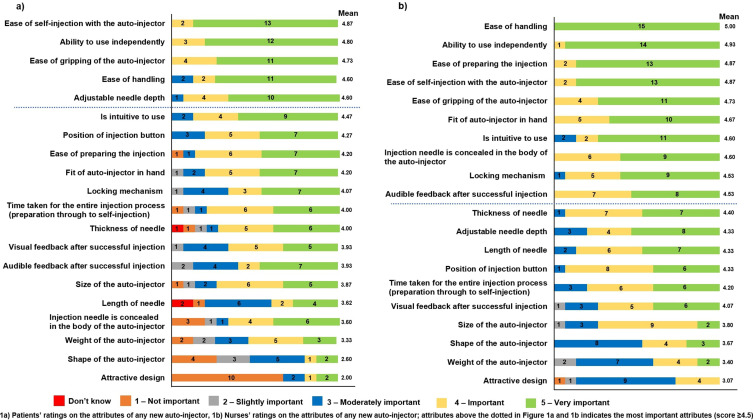
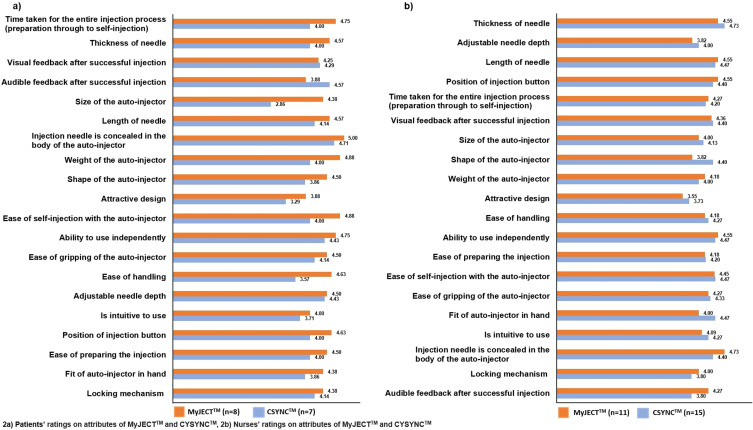
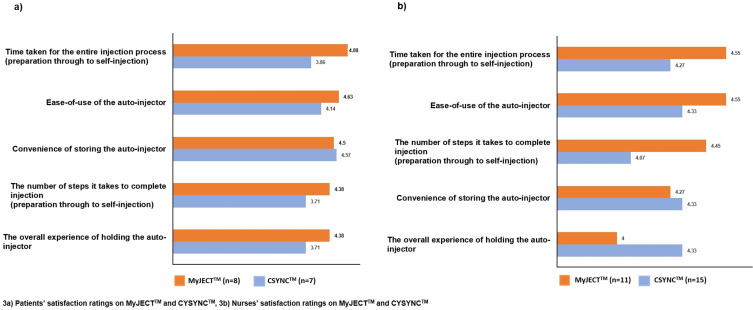
A total of 15 patients and 15 nurses were included in the study. Overall, the top four most important attributes, for both nurses and patients, were ease of handling, ability to use independently, ease of gripping the autoinjector and ease of self-injection. MyJECT™ received a mean score of at least 4.5 (out of 5) on more attributes than CSYNC™ and satisfaction with both autoinjectors was high.
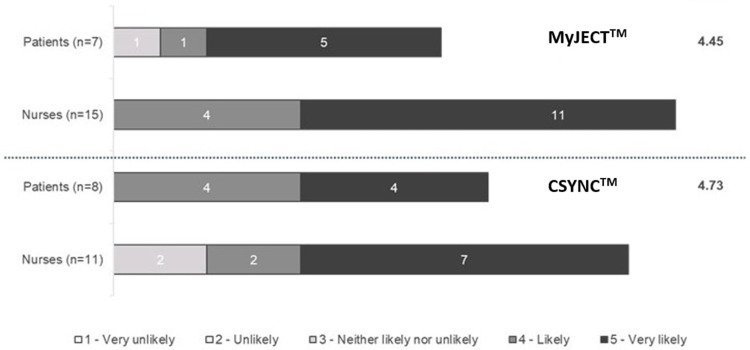
Nurses and patients with RRMS were highly satisfied with both the MyJECT™ and CSYNC™ autoinjectors, with scores suggesting that MyJECT™ performs better on the attributes they identified as most important. All patients currently using the MyJECT™ were likely or highly likely to recommend it to another patient with RRMS.
多发性硬化症(MS)是一种影响全球近280万人的神经系统疾病,其中约80 - 85%为复发缓解型疾病(RRMS)。有几种自动注射器可用于注射疾病修饰疗法来治疗MS。本研究的目的是了解与患者和护士自动注射器偏好相关的因素,并根据这些偏好评估两种醋酸格拉替雷自动注射器(MyJECT™和CSYNC™)。
从德国12个健康中心招募RRMS患者以及有使用自动注射器培训患者经验的护士。对患者和护士进行调查,并对他们在五个类别(参与者特征、自动注射器重要属性、自动注射器性能、对自动注射器设备的满意度和人口统计学)的13个问题的回答,在适当情况下使用5点李克特量表进行评分。
本研究共纳入15名患者和15名护士。总体而言,对护士和患者来说,最重要的四个属性是操作简便、能够独立使用、易于握持自动注射器和易于自我注射。MyJECT™在更多属性上的平均得分至少为4.5(满分5分),高于CSYNC™,并且对两种自动注射器的满意度都很高。
RRMS患者和护士对MyJECT™和CSYNC™自动注射器都高度满意,评分表明MyJECT™在他们认为最重要的属性上表现更好。所有目前使用MyJECT™的患者都很可能或极有可能向另一位RRMS患者推荐它。