Habekost Thomas, Ovesen Jacob, Madsen Jes Buster
Department of Psychology, University of Copenhagen, Copenhagen, Denmark.
F. C. Copenhagen, Copenhagen, Denmark.
Front Psychol. 2024 Dec 11;15:1477262. doi: 10.3389/fpsyg.2024.1477262. eCollection 2024.
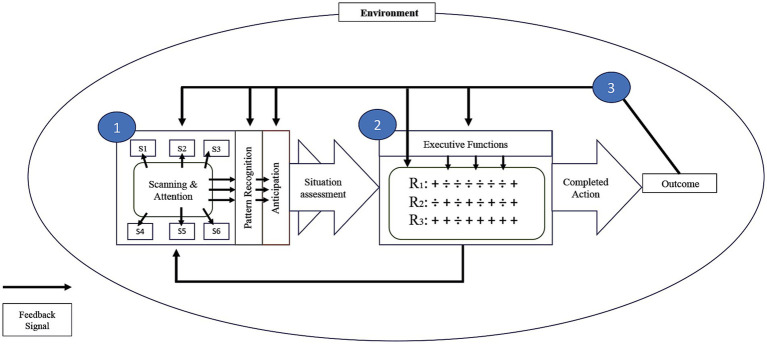
This paper presents a general model of the cognitive processes involved in each play situation of soccer at the elite level. Theoretically the model draws on general frameworks from cognitive psychology and neuroscience, in particular the affordance competition hypothesis and the reward prediction error theory. The model includes three functional stages: situational assessment, action selection and execution, and outcome assessment. The three stages form a perception-action cycle that corresponds to a single play situation. The cognitive processes operating at each functional stage are described and related to soccer research by a review of 52 empirical studies. The review covers the main cognitive processes that have been studied in soccer research: visual orientation and attention, pattern recognition, anticipation, working memory, action selection and decision making, executive control processes, as well as behavioral and cognitive learning. The model accommodates the wide variety of findings in the empirical literature and provides a general organizing frame for cognitive soccer research at the elite level. The influence of emotional and stress-related factors on cognition are also discussed. Four general limitations of the existing soccer research are identified, and suggestions for future studies include development of more naturalistic and interventional study designs. By specifying the different cognitive processes in soccer and their dynamic interactions the model has many applied perspectives for soccer training at the professional level. Overall, the paper presents the first integrated process model of cognition in elite soccer players with implications for both research and practice.
本文提出了一个涉及精英水平足球比赛中每种比赛情境的认知过程的通用模型。从理论上讲,该模型借鉴了认知心理学和神经科学的一般框架,特别是可供性竞争假说和奖励预测误差理论。该模型包括三个功能阶段:情境评估、动作选择与执行以及结果评估。这三个阶段形成一个对应于单个比赛情境的感知 - 动作循环。通过对52项实证研究的综述,描述了在每个功能阶段运行的认知过程,并将其与足球研究相关联。该综述涵盖了足球研究中已被研究的主要认知过程:视觉定向与注意力、模式识别、预期、工作记忆、动作选择与决策、执行控制过程以及行为和认知学习。该模型容纳了实证文献中的各种发现,并为精英水平的认知足球研究提供了一个总体的组织框架。还讨论了情绪和压力相关因素对认知的影响。确定了现有足球研究的四个一般局限性,对未来研究的建议包括开发更自然主义和干预性的研究设计。通过明确足球中不同的认知过程及其动态相互作用,该模型在职业水平的足球训练中有许多应用前景。总体而言,本文提出了首个针对精英足球运动员的认知综合过程模型,对研究和实践均有启示意义。