Faggiano Antongiulio, Russo Flaminia, Zamponi Virginia, Sesti Franz, Puliani Giulia, Modica Roberta, Malandrino Pasqualino, Ferraù Francesco, Rinzivillo Maria, Di Muzio Marco, Di Simone Emanuele, Panattoni Nicolò, Dolce Pasquale, Lauretta Rosa, Di Iasi Gianfranco, Prinzi Antonio, Alessi Ylenia, Feola Tiziana, Mazzilli Rossella, Appetecchia Marialuisa, Giannetta Elisa, Panzuto Francesco, Colao Annamaria
Endocrinology Unit, Department of Clinical and Molecular Medicine, European Neuroendocrine Tumor Society (ENETS) Center of Excellence, Sant'Andrea University Hospital, Sapienza University of Rome, Rome, Italy.
Department of Experimental Medicine, Sapienza University of Rome, Rome, Italy.
J Neuroendocrinol. 2025 Feb;37(2):e13485. doi: 10.1111/jne.13485. Epub 2024 Dec 26.
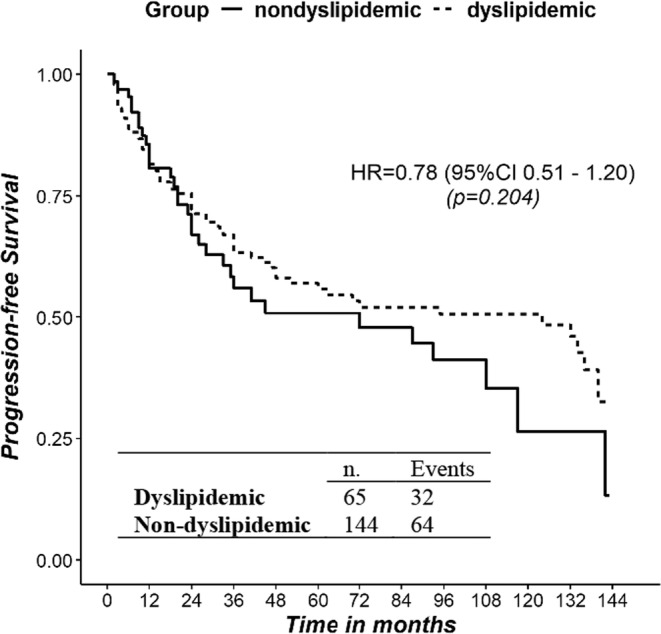
Dyslipidemia is a potential unfavorable prognostic factor in neuroendocrine tumors (NETs); conversely, statins proved to have antiproliferative effects in NET cell lines and could be a helpful therapeutic strategy for these patients. The main objective of this observational cohort retrospective study is to explore the associations between dyslipidemia and NET progression and evaluate the potential influence of statins in this context. 393 patients with histologically confirmed gastroenteropancreatic or bronchopulmonary NETs from six Italian centres didicated to NET diagnosis and therapy were included. The cohort included 123 patients with dyslipidemia, 81 of which were taking statins. Clinicopathological data, including patient demographics, tumor characteristics, and treatment details as well as the prevalence, timing of dyslipidemia and hypolipemic therapy were collected. The main outcome measure used is progression-free survival (PFS). Among the 393 patients, 123 (31.3%) had dyslipidemia. Statins were used by 81 (65.8%) dyslipidemic patients, mostly atorvastatin. Median PFS was 87 months overall, 124 months in non-dyslipidemic patients, and 72 months in dyslipidemic patients (p = .268). Dyslipidemic patients on statins had a significantly better median PFS (108 months) than those not on statins (26 months; p = .024). Recurrence-free survival (RFS) was also evaluated, but no significant differences were found. In conclusion, while PFS was lower in dyslipidemic patients compared to non-dyslipidemic patients, the difference was not statistically significant. Statin therapy was associated with improved PFS among dyslipidemic patients, suggesting a potential antiproliferative effect of statins in NETs. These findings warrant further investigation to substantiate the role of statins in the management of NETs.
血脂异常是神经内分泌肿瘤(NETs)潜在的不良预后因素;相反,他汀类药物已被证明对NET细胞系具有抗增殖作用,可能是这些患者的一种有用治疗策略。这项观察性队列回顾性研究的主要目的是探讨血脂异常与NET进展之间的关联,并评估他汀类药物在此背景下的潜在影响。研究纳入了来自意大利六个致力于NET诊断和治疗中心的393例经组织学确诊的胃肠胰或支气管肺NET患者。该队列包括123例血脂异常患者,其中81例正在服用他汀类药物。收集了临床病理数据,包括患者人口统计学、肿瘤特征、治疗细节以及血脂异常和降脂治疗的患病率、时间。使用的主要结局指标是无进展生存期(PFS)。在393例患者中,123例(31.3%)有血脂异常。81例(65.8%)血脂异常患者使用了他汀类药物,主要是阿托伐他汀。总体中位PFS为87个月,非血脂异常患者为124个月,血脂异常患者为72个月(p = 0.268)。服用他汀类药物的血脂异常患者的中位PFS(108个月)明显优于未服用他汀类药物的患者(26个月;p = 0.024)。还评估了无复发生存期(RFS),但未发现显著差异。总之,虽然血脂异常患者的PFS低于非血脂异常患者,但差异无统计学意义。他汀类药物治疗与血脂异常患者PFS的改善相关,提示他汀类药物在NETs中可能具有抗增殖作用。这些发现值得进一步研究以证实他汀类药物在NETs管理中的作用。