Wang Youxin, Shen Fangjing, Zhang Pingping, Xu Miao, Qiu Danqi, Wang Hui, Li Li
Department of Endocrinology and Metabolism, The First Affiliated Hospital of Ningbo University, Ningbo, Zhejiang, China.
Department of Maternal and Child Health, School of Public Health, Peking University, Beijing, China.
Front Pediatr. 2024 Dec 12;12:1514535. doi: 10.3389/fped.2024.1514535. eCollection 2024.
Understanding children's eating behaviors is crucial for elucidating the etiology of childhood obesity. However, the relationship between these behaviors and abdominal fat accumulation remains poorly understood. This study aims to investigate this association in primary school children.
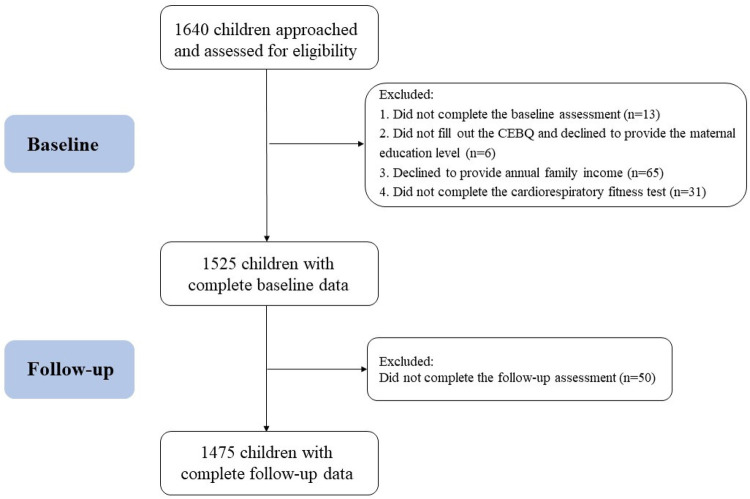
This study included 1,475 children aged 8-10 years in Ningbo, China. Body composition was measured both at baseline (September 2022) and after 9 months of follow-up (June 2023). Primary caregivers completed the Children's Eating Behavior Questionnaire (CEBQ). A mixed-effects linear model was applied to analyze the relationships between children's eating behaviors and body composition.
Greater visceral fat area (VFA) was associated with greater slowness in eating [β = 0.25 (0.02, 0.49)], greater food responsiveness [β = 0.29 (0.14, 0.43)], increased emotional undereating [β = 0.35 (0.17, 0.54)], and more emotional overeating [β = 0.21 (0.02, 0.39)]. Children with greater trunk fat mass (TrFM) tended to have greater food responsiveness [β = 0.02 (0.01, 0.03)] and greater enjoyment of food [β = 0.01 (0.00, 0.03)], increased emotional undereating [β = 0.02 (0.01, 0.03)] and emotional overeating [β = 0.02 (0.00, 0.03)]. Prospectively, positive correlations were observed between VFA and food responsiveness [β = 0.18 (0.02, 0.35)], as were emotional undereating [β = 0.31 (0.10, 0.52)] and emotional overeating [β = 0.24 (0.03, 0.46)]. Similarly, TrFM was positively correlated with food responsiveness [β = 0.02 (0.00, 0.03)], enjoyment of food [β = 0.02 (0.00, 0.04)], emotional undereating [β = 0.02 (0.01, 0.04)] and emotional overeating [β = 0.02 (0.01, 0.04)].
Our findings suggest that eating behaviors are significantly associated with abdominal fat accumulation in primary school children. Addressing specific eating behaviors may be crucial in mitigating abdominal fat and its related health risks.
了解儿童的饮食行为对于阐明儿童肥胖的病因至关重要。然而,这些行为与腹部脂肪堆积之间的关系仍知之甚少。本研究旨在调查小学儿童中的这种关联。
本研究纳入了中国宁波的1475名8至10岁的儿童。在基线时(2022年9月)和随访9个月后(2023年6月)测量身体成分。主要照料者完成儿童饮食行为问卷(CEBQ)。应用混合效应线性模型分析儿童饮食行为与身体成分之间的关系。
更高的内脏脂肪面积(VFA)与进食速度更慢[β = 0.25(0.02,0.49)]、食物反应性更高[β = 0.29(0.14,0.43)]、情绪性进食不足增加[β = 0.35(0.17,0.54)]以及更多的情绪性暴饮暴食[β = 0.21(0.02,0.39)]相关。躯干脂肪量(TrFM)更高的儿童往往具有更高的食物反应性[β = 0.02(0.01,0.03)]和对食物的更高喜爱度[β = 0.01(0.00,0.03)]、情绪性进食不足增加[β = 0.02(0.01,0.03)]和情绪性暴饮暴食[β = 0.02(0.00,0.03)]。前瞻性地,观察到VFA与食物反应性[β = 0.18(0.02,0.35)]、情绪性进食不足[β = 0.31(0.10,0.52)]和情绪性暴饮暴食[β = 0.24(0.03,0.46)]之间存在正相关。同样,TrFM与食物反应性[β = 0.02(0.00,0.03)]、对食物的喜爱度[β = 0.02(0.00,0.04)]、情绪性进食不足[β = 0.02(0.01,0.04)]和情绪性暴饮暴食[β = 0.02(0.01,0.04)]呈正相关。
我们的研究结果表明,饮食行为与小学儿童的腹部脂肪堆积显著相关。解决特定的饮食行为可能对减轻腹部脂肪及其相关健康风险至关重要。