Wu Dandan, Chen Shujin, Lin Shuang, Huang Rong, Li Rong, Huang Yiyang, Chen Mengying, Li Xiaonan
Department of Children Health Care, Children's Hospital of Nanjing Medical University, Nanjing, 210008, China.
Heliyon. 2023 Feb 10;9(3):e13641. doi: 10.1016/j.heliyon.2023.e13641. eCollection 2023 Mar.
Adverse eating behaviors and a high rate of obesity have been identified among children diagnosed with attention deficit hyperactivity disorder (ADHD). In this study, we investigate the relationships between eating behaviors and body fat mass among children with ADHD.
All participants were recruited from the Children's Health Care Department of the Children's Hospital of Nanjing Medical University from June 2019 to June 2020. ADHD was diagnosed according to the diagnostic criteria of the 5th edition of the Diagnostic and Statistical Manual of Mental Disorders (DSM-5) by psychiatrists. Core ADHD symptoms defined by the DSM-5 were inattention and hyperactivity/impulsivity. The anthropomorphic indices defined by the World Health Organization (WHO) were utilized in this study (body mass index [BMI], underweight, normal body mass, overweight, obesity, short stature). Body fat mass, fat mass percentage (FM%), skeletal muscle mass, skeletal muscle mass percentage (SMM%) were tested via body composition meter, and eating behaviors were assessed by parents using the Chinese version of the Children's Eating Behavior Questionnaire (CEBQ). The CEBQ was comprised of subscales related to food avoidant behaviors (satiety responsiveness, slowness in eating, fussiness, and emotional undereating) and food approach behaviors (food responsiveness, enjoyment of Food, desire to drink, and emotional overeating). The associations among ADHD, obesity and adverse eating behavior were tested through correlation analysis, and a mediating effect model was established to explore the effect of eating behaviors.
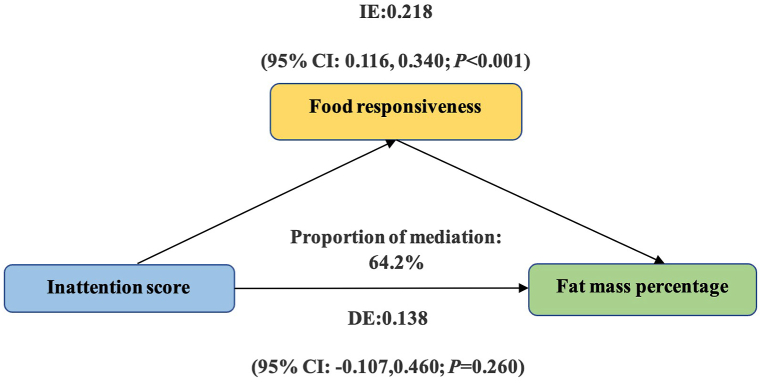
A total of 548 participants aged 4-12 years were recruited. Among them, 396 were diagnosed with ADHD, with the remaining 152 enrolled in a control group. Compared with the control group, the ADHD group had higher incidences of overweight (22.5% vs. 14.5%) and obesity (13.4% vs. 8.6%) (p < 0.05). The ADHD group was more likely to display "slowness in eating" (11.01 ± 3.32 vs. 9.74 ± 2.95), "fussiness" (15.61 ± 3.54 vs. 15.03 ± 2.84), "food responsiveness" (11.96 ± 4.81 vs. 9.88 ± 3.71) and "desire to drink" (8.34 ± 3.46 vs. 6.58 ± 2.72) (p < 0.05). Moreover, The FM% of children with ADHD was positively correlated with inattention ( = 0.336, 95% : 0.001 to 0.673) and "food responsiveness" ( = 0.509, 95% : 0.352 to 0.665) in the multiple linear regression model. The mediation effect model showed that "food responsiveness" accounted for a significant portion (64.2%) of the mediating effect.
Children with ADHD had higher prevalence of overweight and obesity. As an important risk factor, food responsiveness may connect core symptoms of ADHD with obesity.
在被诊断患有注意力缺陷多动障碍(ADHD)的儿童中,已发现存在不良饮食行为和高肥胖率。在本研究中,我们调查了ADHD儿童的饮食行为与体脂量之间的关系。
所有参与者均于2019年6月至2020年6月从南京医科大学附属儿童医院儿童保健科招募。ADHD由精神科医生根据《精神疾病诊断与统计手册》第5版(DSM-5)的诊断标准进行诊断。DSM-5定义的ADHD核心症状为注意力不集中和多动/冲动。本研究采用世界卫生组织(WHO)定义的人体测量指标(体重指数[BMI]、体重过轻、正常体重、超重、肥胖、身材矮小)。通过人体成分仪检测体脂量、体脂百分比(FM%)、骨骼肌量、骨骼肌量百分比(SMM%),并由父母使用中文版儿童饮食行为问卷(CEBQ)评估饮食行为。CEBQ由与食物回避行为(饱腹感反应、进食缓慢、挑食和情绪性进食不足)和食物趋近行为(食物反应性、食物享受、饮水欲望和情绪性暴饮暴食)相关的分量表组成。通过相关性分析检验ADHD、肥胖与不良饮食行为之间的关联,并建立中介效应模型以探讨饮食行为的影响。
共招募了548名4至12岁的参与者。其中,396名被诊断为ADHD,其余152名纳入对照组。与对照组相比,ADHD组超重(22.5%对14.5%)和肥胖(13.4%对8.6%)的发生率更高(p<0.05)。ADHD组更易表现出“进食缓慢”(11.01±3.32对9.74±2.95)、“挑食”(15.61±3.54对15.03±2.84)、“食物反应性”(11.96±4.81对9.88±3.71)和“饮水欲望”(8.34±3.46对6.58±2.72)(p<0.05)。此外,在多元线性回归模型中,ADHD儿童的FM%与注意力不集中(=0.336,95%:0.001至0.673)和“食物反应性”(=0.509,95%:0.352至0.665)呈正相关。中介效应模型显示,“食物反应性”占中介效应的很大一部分(64.2%)。
ADHD儿童超重和肥胖的患病率较高。作为一个重要的危险因素,食物反应性可能将ADHD的核心症状与肥胖联系起来。
