Zhang Tao, Zhang Yiqun, Leng Xiaofei
Department of Gastric and Colorectal Surgery, General Surgery Center, The First Hospital of Jilin University, Changchun, Jilin, China.
Department of Gynecology, Taihe Hospital, Hubei University of Medicine, Shiyan, Hubei, China.
Front Oncol. 2024 Dec 12;14:1468488. doi: 10.3389/fonc.2024.1468488. eCollection 2024.
Gastric cancer (GC) is a common malignancy of the digestive system, with significant geographical variation in its disease burden.
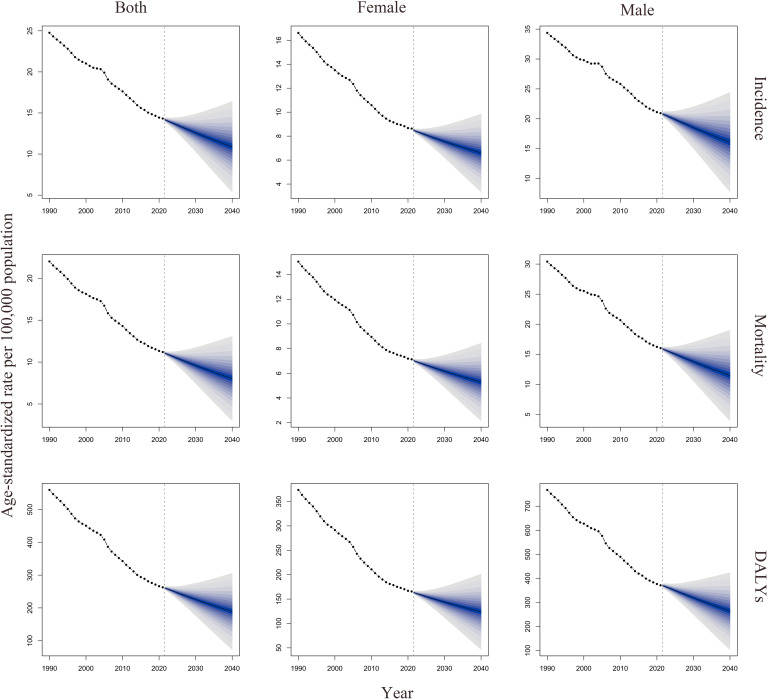
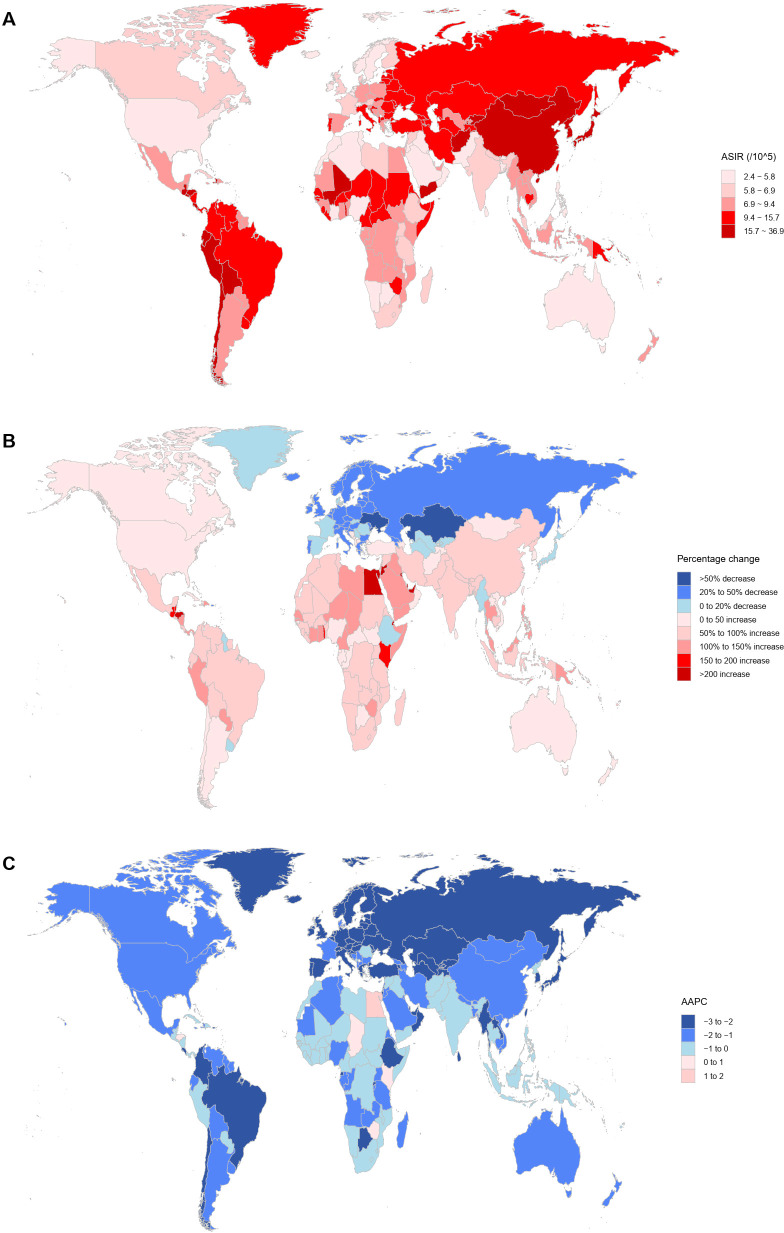
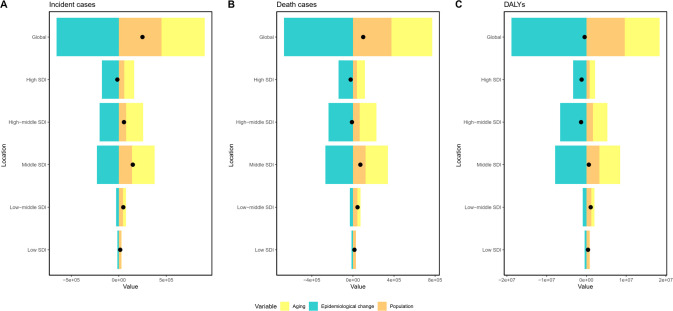
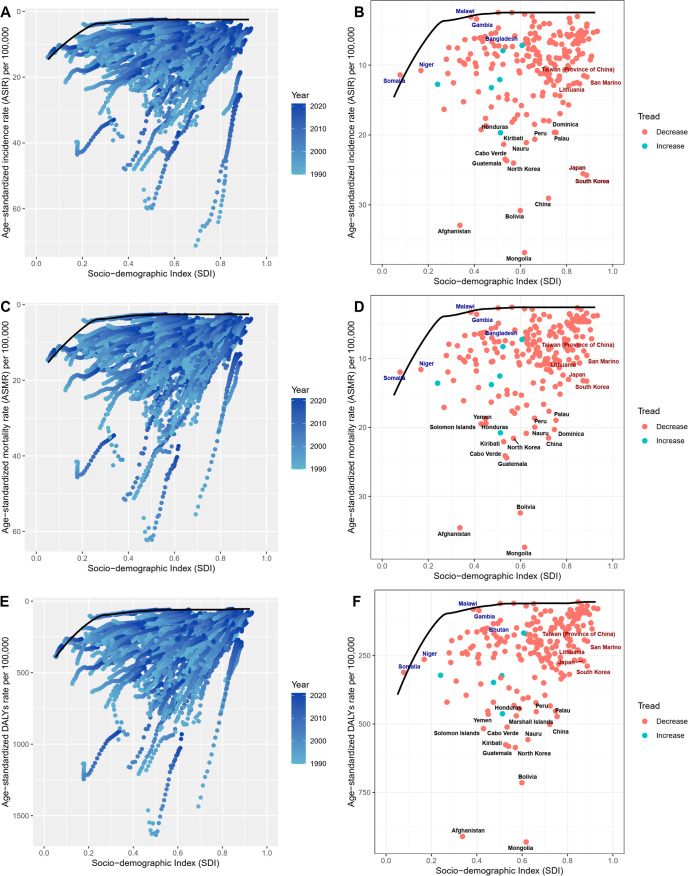
This study used data from the Global Burden of Diseases, Injuries, and Risk Factors Study 2021 to analyze three key indicators: incidence, mortality, and disability-adjusted life years (DALYs). Initially, a detailed analysis of the GC burden was conducted from global, regional, national, gender, and age perspectives. Subsequently, the percentage change and average annual percent change (AAPC) of GC were calculated to understand the trends in disease burden. Decomposition analysis and frontier analysis were then performed. Finally, the Bayesian age-period-cohort model was used to predict the trends in age-standardized rates (ASRs) of GC up to 2040.
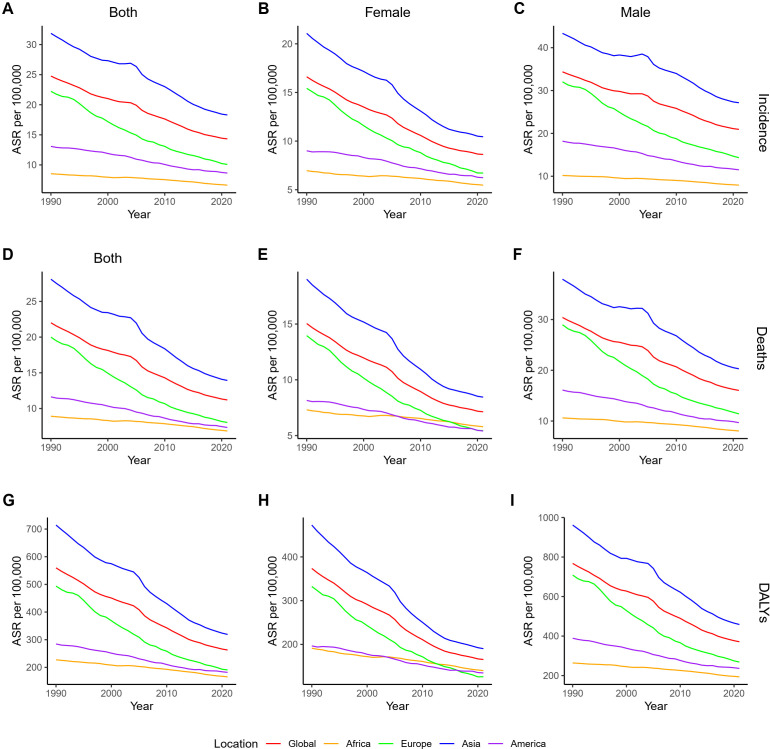
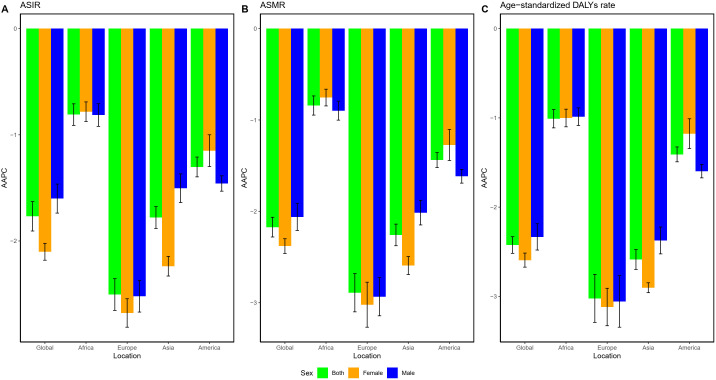
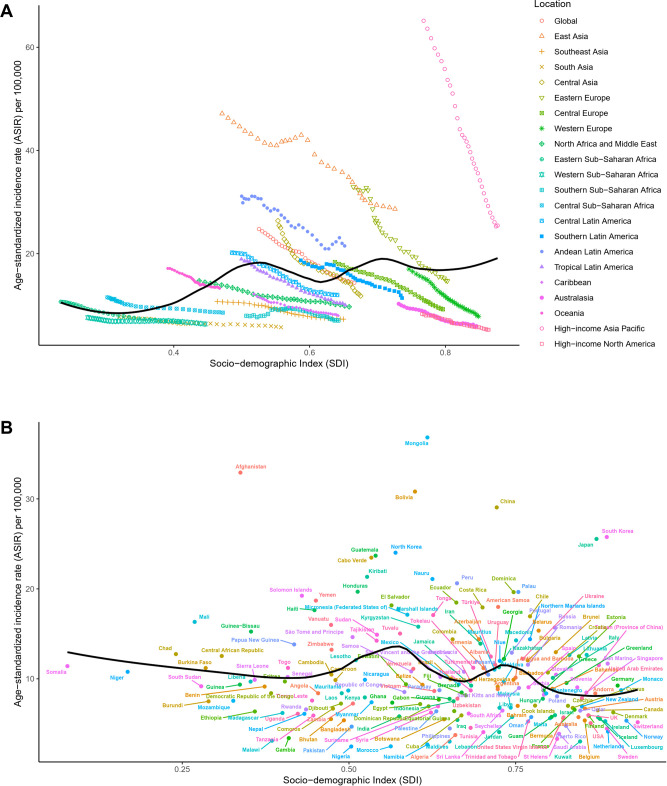
In 2021, there were 1.23 million (95% UI: 1.05-1.41 million) new cases of GC globally, with 0.95 million (95% UI: 0.82-1.10million) deaths and 22.79 million (95% UI: 19.58-26.12 million) DALYs. Compared to 1990, the global ASRs of GC has declined, but new cases and deaths have increased. For females, age-standardized incidence rate, age-standardized mortality rate, and age-standardized DALYs rate were 8.6, 7.1, and 165.6 per 100,000, with AAPCs of -2.1, -2.4, and -2.6. For males, they were 20.9, 16.0, and 371.2 per 100,000, with AAPCs of -1.6, -2.1, and -2.3. ASRs fluctuated with increasing Socio-demographic Index (SDI), being higher in middle and high-middle SDI regions. Decomposition analysis indicated negative effects from epidemiological trends on GC burden, while population growth and aging had positive effects. Frontier analysis showed that middle and high-middle SDI regions had more potential for reducing ASRs. Predictions indicate a continued decline in ASRs for both genders by 2040.
Despite progress in controlling GC, the number of new cases and deaths globally is rising due to population growth and aging. This highlights the need for effective prevention and control strategies.
胃癌是消化系统常见的恶性肿瘤,其疾病负担在地域上存在显著差异。
本研究使用了《2021年全球疾病、伤害及风险因素负担研究》的数据,分析了三个关键指标:发病率、死亡率和伤残调整生命年(DALYs)。首先,从全球、区域、国家、性别和年龄角度对胃癌负担进行了详细分析。随后,计算了胃癌的百分比变化和年均百分比变化(AAPC),以了解疾病负担的趋势。接着进行了分解分析和前沿分析。最后,使用贝叶斯年龄-时期-队列模型预测了到2040年胃癌年龄标准化率(ASRs)的趋势。
2021年,全球胃癌新发病例123万例(95%不确定区间:105万 - 141万例),死亡95万例(95%不确定区间:82万 - 110万例),伤残调整生命年2279万例(95%不确定区间:1958万 - 2612万例)。与1990年相比,全球胃癌年龄标准化率有所下降,但新发病例和死亡人数有所增加。女性的年龄标准化发病率、年龄标准化死亡率和年龄标准化伤残调整生命年率分别为每10万人8.6例、7.1例和165.6例,年均百分比变化分别为 -2.1、 -2.4和 -2.6。男性的相应数据分别为每10万人20.9例、16.0例和371.2例,年均百分比变化分别为 -1.6、 -2.1和 -2.3。年龄标准化率随着社会人口指数(SDI)的增加而波动,在中等和中高SDI地区较高。分解分析表明,流行病学趋势对胃癌负担有负面影响,而人口增长和老龄化有正面影响。前沿分析表明,中等和中高SDI地区在降低年龄标准化率方面有更大潜力。预测显示,到2040年,两性的年龄标准化率将持续下降。
尽管在控制胃癌方面取得了进展,但由于人口增长和老龄化,全球新发病例和死亡人数仍在上升。这凸显了有效防控策略的必要性。