Altahla Ruba, Alshorman Jamal, Ali-Shah Sayed Zulfiqar, Nasb Mohammad, Tao Xu
Department of Rehabilitation, Tongji Medical College, Huazhong University of Science and Technology, Wuhan, Hubei, China.
Orthopedic Department, Xianning Medical College, The Second Affiliated Hospital of Hubei University of Science and Technology, Xianning, Hubei, China.
PeerJ. 2024 Dec 23;12:e18709. doi: 10.7717/peerj.18709. eCollection 2024.
Differentiating between traumatic and non-traumatic spinal cord injuries (NT-SCI) is critical, as these classifications may significantly impact patients' health outcomes and overall well-being, potentially resulting in differences in treatment protocols and therapeutic efficacy.
This study aims to compare the quality of life (QoL) and satisfaction with life (SWL) among individuals with traumatic spinal cord injuries (T-SCI), NT-SCI, and the healthy population in China.
A quantitative, cross-sectional survey was conducted between July and December 2020 in the Rehabilitation and Physiotherapy Department of Tongji Hospital, Hubei University of Science and Technology. The World Health Organization Quality of Life Brief Version (WHOQOL-BREF) and the Satisfaction with Life Scale (SWLS) were administered to evaluate QoL and subjective well-being (SWB). An independent t-test was performed to assess differences within the SCI population, while Pearson's correlation coefficient was utilized to explore relationships between the WHOQOL-BREF domains and the SWLS. Multiple linear regression analysis was applied to identify key determinants influencing World Health Organization Quality of Life (WHOQOL) domain scores and overall SWLS score.
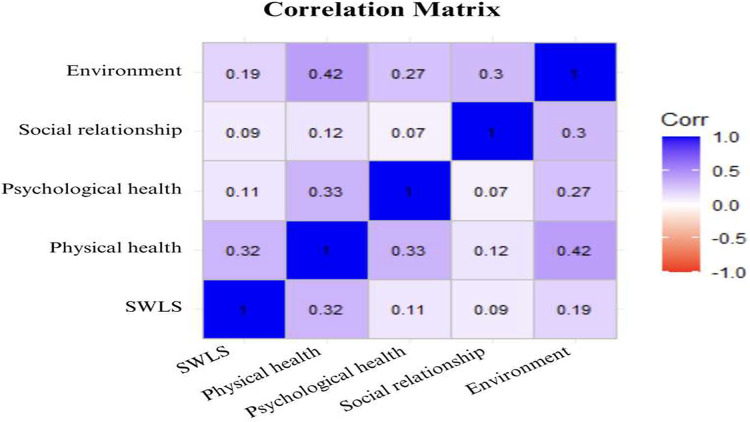
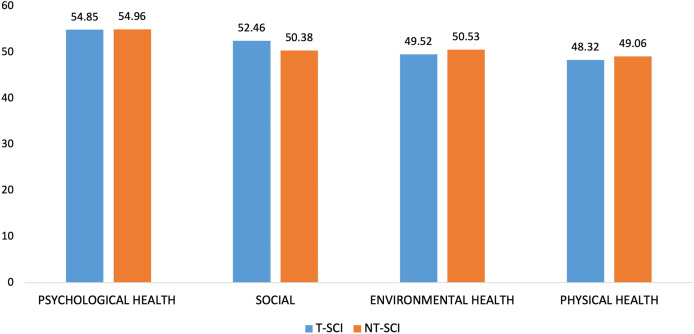
Participants with NT-SCI exhibited significant differences in overall health as measured by the WHOQOL-BREF domains compared to those with T-SCI ( < 0.05). Both the NT-SCI and T-SCI groups demonstrated lower mean scores across all four WHOQOL-BREF domains compared to healthy individuals. No significant differences were observed between the NT-SCI and T-SCI groups in the SWLS, although both groups scored lower than the healthy population. Additionally, SWB was moderately positively correlated with QoL ( < 0.01). Collectively, the predictor variables explained 22.28% of the variance in physical health, 6.43% in psychological health, 28.67% in social health, and 25.68% in environmental health. Furthermore, the independent variables accounted for approximately 22.67% of the variance in the SWLS.
Individuals with NT-SCI experience significantly worse overall health outcomes compared to those with T-SCI, although both groups report QoL and life satisfaction than healthy individuals. No significant differences in life satisfaction were found between two groups. Additionally, SWB shows a moderate positive correlation with QoL, highlighting the close relationship between mental and physical health in SCI populations.
区分创伤性和非创伤性脊髓损伤(NT-SCI)至关重要,因为这些分类可能会显著影响患者的健康结局和整体幸福感,可能导致治疗方案和治疗效果的差异。
本研究旨在比较中国创伤性脊髓损伤(T-SCI)、NT-SCI患者以及健康人群的生活质量(QoL)和生活满意度(SWL)。
2020年7月至12月在湖北科技大学附属同济医院康复理疗科进行了一项定量横断面调查。采用世界卫生组织生活质量简表(WHOQOL-BREF)和生活满意度量表(SWLS)来评估生活质量和主观幸福感(SWB)。进行独立t检验以评估脊髓损伤人群内部的差异,同时使用Pearson相关系数来探讨WHOQOL-BREF各领域与SWLS之间的关系。应用多元线性回归分析来确定影响世界卫生组织生活质量(WHOQOL)领域得分和总体SWLS得分的关键决定因素。
与T-SCI患者相比,NT-SCI患者在WHOQOL-BREF领域所衡量的总体健康状况存在显著差异(<0.05)。与健康个体相比,NT-SCI组和T-SCI组在WHOQOL-BREF的所有四个领域的平均得分均较低。NT-SCI组和T-SCI组在SWLS方面未观察到显著差异,尽管两组得分均低于健康人群。此外,SWB与QoL呈中度正相关(<0.01)。总体而言,预测变量解释了身体健康方面22.28%的方差、心理健康方面6.43%的方差、社会健康方面28.67%的方差以及环境健康方面25.68%的方差。此外,自变量约占SWLS方差的22.67%。
与T-SCI患者相比,NT-SCI患者的总体健康结局明显更差,尽管两组报告的生活质量和生活满意度均低于健康个体。两组之间在生活满意度方面未发现显著差异。此外,SWB与QoL呈中度正相关,突出了脊髓损伤人群中心理健康与身体健康之间的密切关系。