Yang Shuo, Li Wenhui, Li Kaiyue, Huang Ping, Zhuo Yuquan, Liu Keyan, Yang Ziwen, Han Donglai
School of Materials Science and Engineering, Changchun University, Changchun 130022, China.
Laboratory of Materials Design and Quantum Simulation College of Science, Changchun University, Changchun 130022, China.
Nanomaterials (Basel). 2024 Dec 21;14(24):2048. doi: 10.3390/nano14242048.
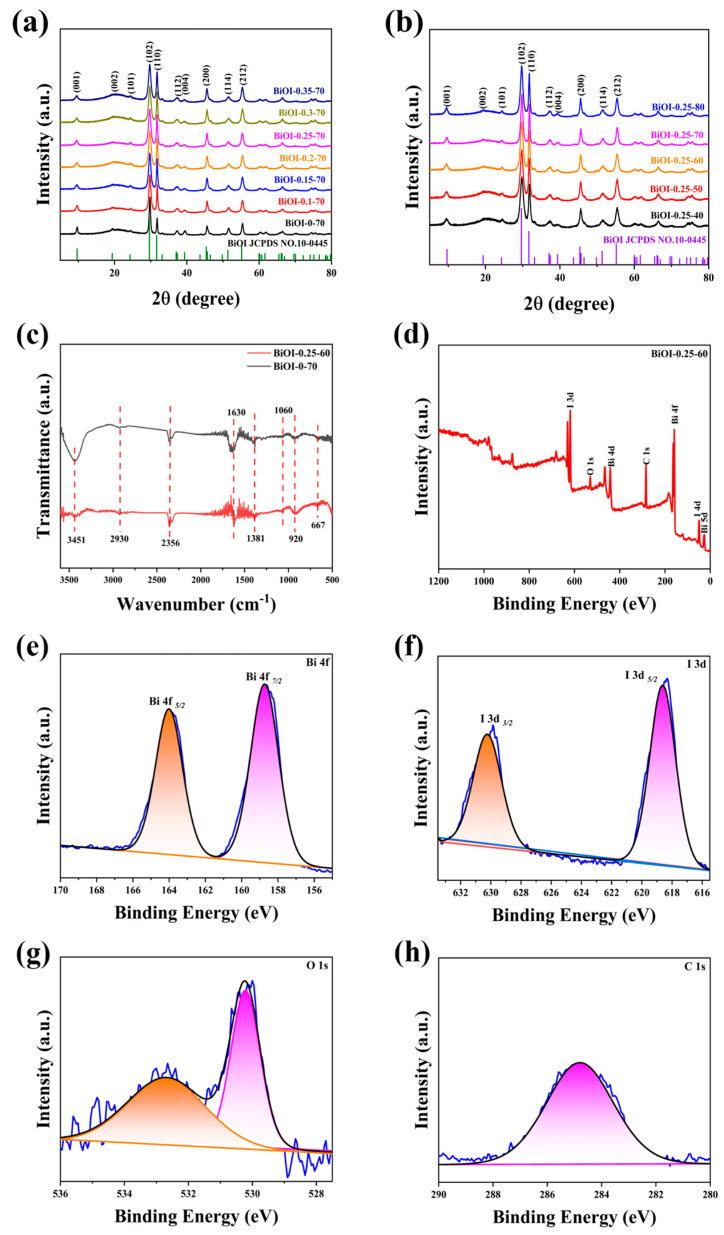
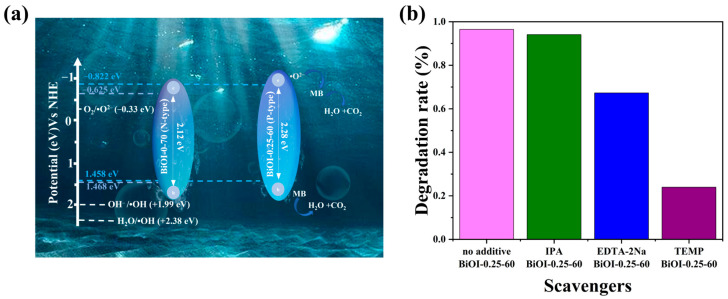
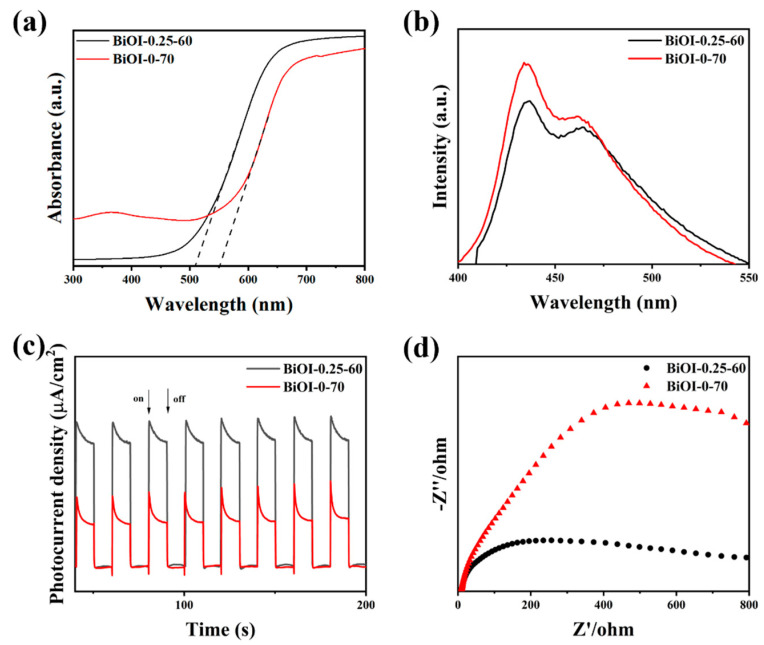
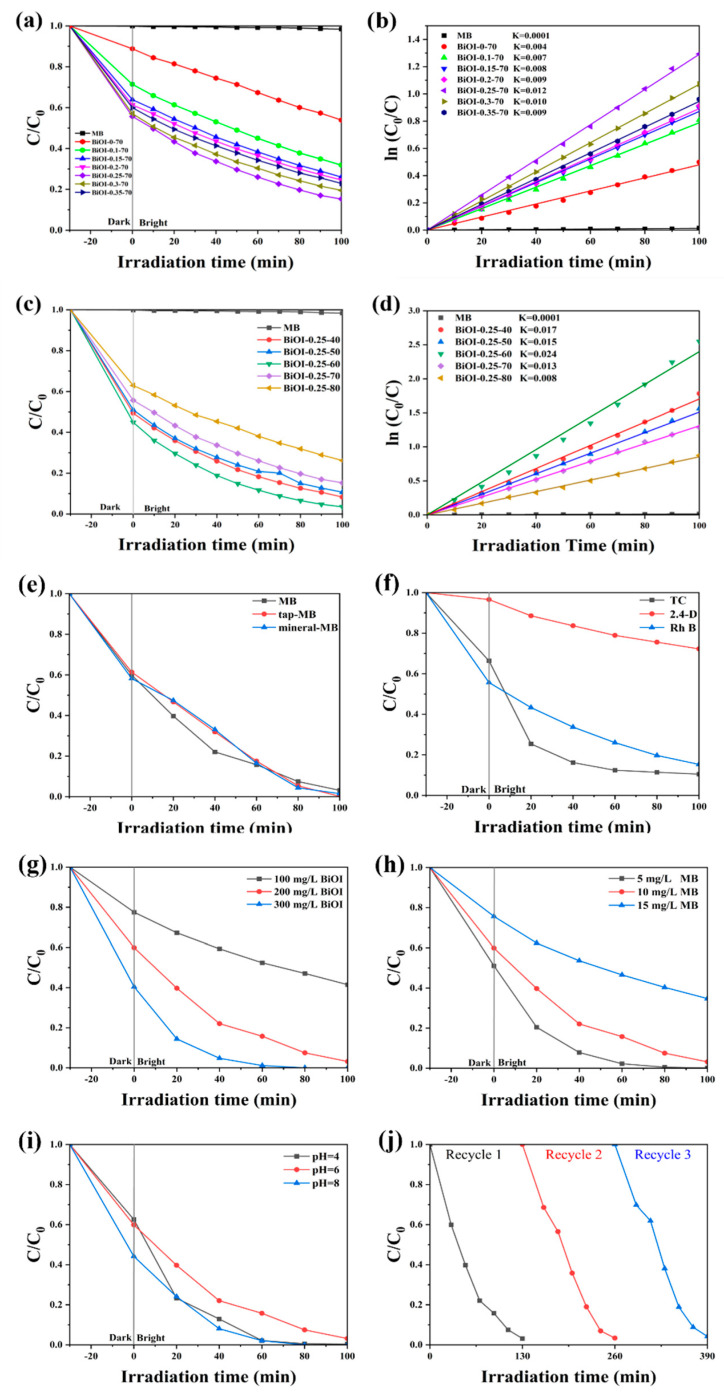
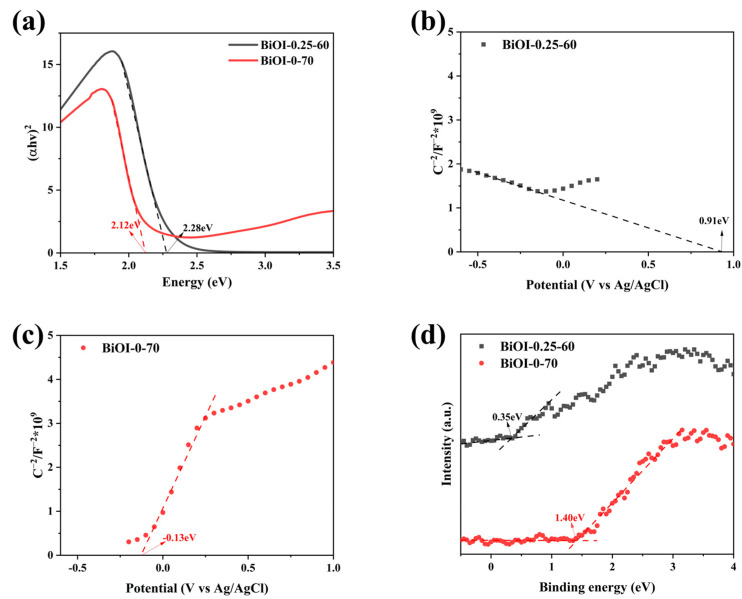
Photocatalytic technology holds significant promise for sustainable development and environmental protection due to its ability to utilize renewable energy sources and degrade pollutants efficiently. In this study, BiOI nanosheets (NSs) were synthesized using a simple water bath method with varying amounts of mannitol and reaction temperatures to investigate their structural, morphological, photoelectronic, and photocatalytic properties. Notably, the introduction of mannitol played a critical role in inducing a transition in BiOI from an n-type to a p-type semiconductor, as evidenced by Mott-Schottky (M-S) and band structure analyses. This transformation enhanced the density of holes (h) as primary charge carriers and resulted in the most negative conduction band (CB) position (-0.822 V vs. NHE), which facilitated the generation of superoxide radicals (·O) and enhanced photocatalytic activity. Among the samples, the BiOI-0.25-60 NSs (synthesized with 0.25 g of mannitol at 60 °C) exhibited the highest performance, characterized by the largest specific surface area (24.46 m/g), optimal band gap energy (2.28 eV), and efficient photogenerated charge separation. Photocatalytic experiments demonstrated that BiOI-0.25-60 NSs achieved superior methylene blue (MB) degradation efficiency of 96.5% under simulated sunlight, 1.14 times higher than BiOI-0-70 NSs. Additionally, BiOI-0.25-60 NSs effectively degraded tetracycline (TC), 2,4-dichlorophenol (2,4-D), and rhodamine B (Rh B). Key factors such as photocatalyst concentration, MB concentration, and solution pH were analyzed, and the BiOI-0.25-60 NSs demonstrated excellent recyclability, retaining over 94.3% of their activity after three cycles. Scavenger tests further identified ·O and h as the dominant active species driving the photocatalytic process. In this study, the pivotal role of mannitol in modulating the semiconductor characteristics of BiOI nanomaterials is underscored, particularly in promoting the n-type to p-type transition and enhancing photocatalytic efficiency. These findings provide a valuable strategy for designing high-performance p-type photocatalysts for environmental remediation applications.
光催化技术因其能够利用可再生能源并高效降解污染物,在可持续发展和环境保护方面具有巨大潜力。在本研究中,采用简单的水浴法,通过改变甘露醇的用量和反应温度合成了BiOI纳米片(NSs),以研究其结构、形态、光电子和光催化性能。值得注意的是,Mott-Schottky(M-S)和能带结构分析表明,甘露醇的引入在诱导BiOI从n型半导体转变为p型半导体方面起到了关键作用。这种转变增加了作为主要电荷载流子的空穴(h)密度,并导致了最负的导带(CB)位置(相对于标准氢电极,为-0.822 V),这有利于超氧自由基(·O)的产生并增强了光催化活性。在这些样品中,BiOI-0.25-60 NSs(在60℃下用0.25 g甘露醇合成)表现出最高的性能,其特征在于最大比表面积(24.46 m/g)、最佳带隙能量(2.28 eV)和有效的光生电荷分离。光催化实验表明,BiOI-0.25-60 NSs在模拟阳光下对亚甲基蓝(MB)的降解效率高达96.5%,比BiOI-0-70 NSs高1.14倍。此外,BiOI-0.25-60 NSs有效地降解了四环素(TC)、2,4-二氯苯酚(2,4-D)和罗丹明B(Rh B)。分析了光催化剂浓度、MB浓度和溶液pH等关键因素,BiOI-0.25-60 NSs表现出优异的可回收性,在三个循环后仍保留超过94.3%的活性。清除剂测试进一步确定·O和h是驱动光催化过程的主要活性物种。在本研究中,强调了甘露醇在调节BiOI纳米材料半导体特性方面的关键作用,特别是在促进n型到p型转变和提高光催化效率方面。这些发现为设计用于环境修复应用的高性能p型光催化剂提供了有价值的策略。