Zhou Xing, Han Jiashu, Zuo Anning, Ba Yuhao, Liu Shutong, Xu Hui, Zhang Yuyuan, Weng Siyuan, Zhou Zhaokai, Liu Long, Luo Peng, Cheng Quan, Zhang Chuhan, Chen Yukang, Shan Dan, Liu Benyu, Yang Shuaixi, Han Xinwei, Deng Jinhai, Liu Zaoqu
Department of Interventional Radiology, The First Affiliated Hospital of Zhengzhou University, Zhengzhou, Henan, 450052, China.
Interventional Institute of Zhengzhou University, Zhengzhou, Henan, 450052, China.
Mol Cancer. 2024 Dec 28;23(1):282. doi: 10.1186/s12943-024-02180-y.
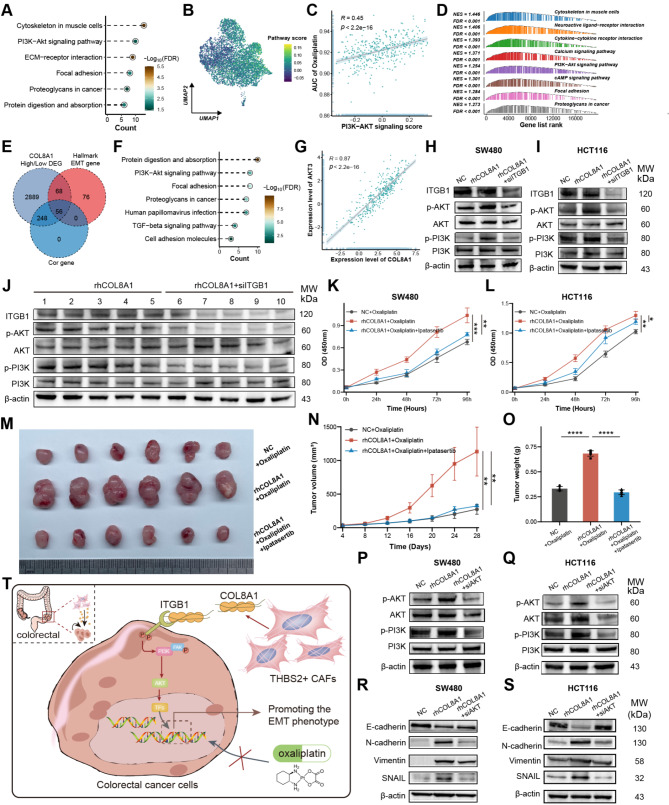
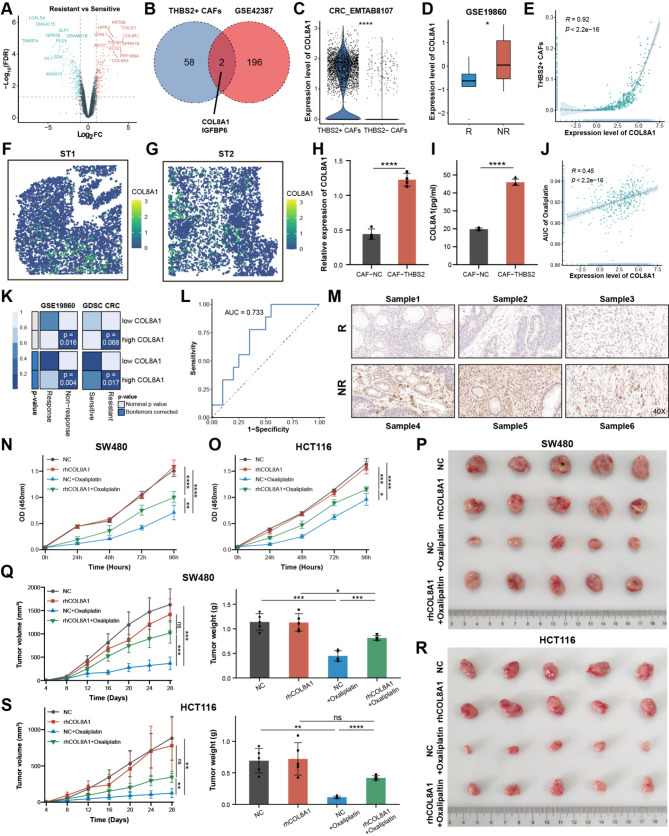
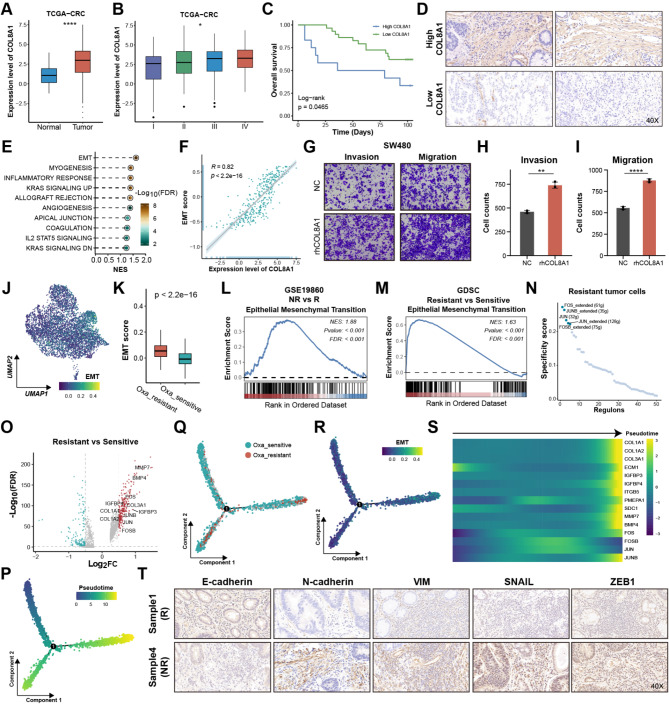
Cancer-associated fibroblasts (CAFs) exert multiple tumor-promoting functions and are key contributors to drug resistance. The mechanisms by which specific subsets of CAFs facilitate oxaliplatin resistance in colorectal cancer (CRC) have not been fully explored. This study found that THBS2 is positively associated with CAF activation, epithelial-mesenchymal transition (EMT), and chemoresistance at the pan-cancer level. Together with single-cell RNA sequencing and spatial transcriptomics analyses, we identified THBS2 specifically derived from subsets of CAFs, termed THBS2 + CAFs, which could promote oxaliplatin resistance by interacting with malignant cells via the collagen pathway in CRC. Mechanistically, COL8A1 specifically secreted from THBS2 + CAFs directly interacts with the ITGB1 receptor on resistant malignant cells, activating the PI3K-AKT signaling pathway and promoting EMT, ultimately leading to oxaliplatin resistance in CRC. Moreover, elevated COL8A1 promotes EMT and contributes to CRC oxaliplatin resistance, which can be mitigated by ITGB1 knockdown or AKT inhibitor. Collectively, these results highlight the crucial role of THBS2 + CAFs in promoting oxaliplatin resistance of CRC by activating EMT and provide a rationale for a novel strategy to overcome oxaliplatin resistance in CRC.
癌症相关成纤维细胞(CAFs)发挥多种促肿瘤功能,是耐药性的关键促成因素。CAFs的特定亚群促进结直肠癌(CRC)对奥沙利铂耐药的机制尚未得到充分探索。本研究发现,在泛癌水平上,THBS2与CAF激活、上皮-间质转化(EMT)和化疗耐药呈正相关。结合单细胞RNA测序和空间转录组学分析,我们鉴定出THBS2特异性来源于CAFs亚群,称为THBS2+CAFs,其可通过CRC中的胶原途径与恶性细胞相互作用来促进奥沙利铂耐药。机制上,THBS2+CAFs特异性分泌的COL8A1直接与耐药恶性细胞上的ITGB1受体相互作用,激活PI3K-AKT信号通路并促进EMT,最终导致CRC对奥沙利铂耐药。此外,COL8A1升高促进EMT并导致CRC对奥沙利铂耐药,ITGB1敲低或AKT抑制剂可减轻这种耐药。总体而言,这些结果突出了THBS2+CAFs通过激活EMT促进CRC奥沙利铂耐药中的关键作用,并为克服CRC奥沙利铂耐药的新策略提供了理论依据。