Wu Qianjie, Guo Zitao, Zhang Na, Dong Dake
Wuxi Medical College, Jiangnan University, Wuxi, China.
School of Food and Biological Engineering, Jiangsu University, Zhenjiang, 212013, China.
Sci Rep. 2024 Dec 28;14(1):31270. doi: 10.1038/s41598-024-82723-x.
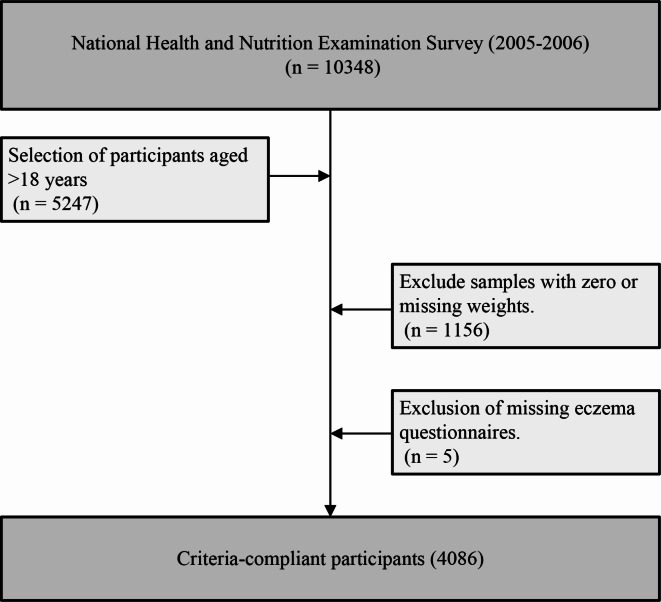
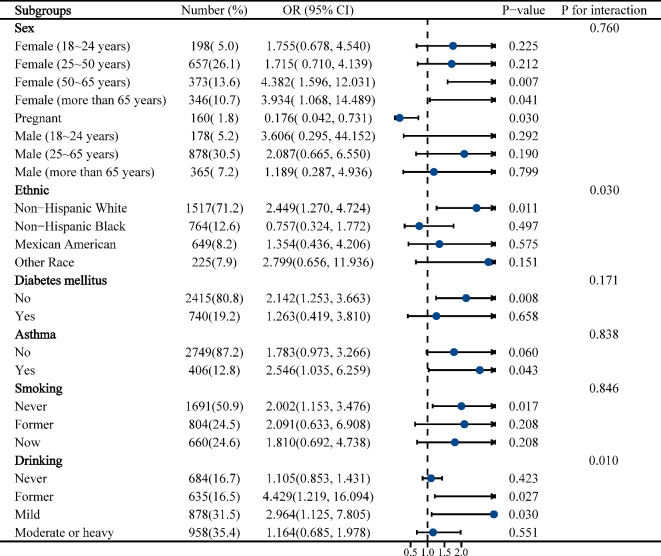
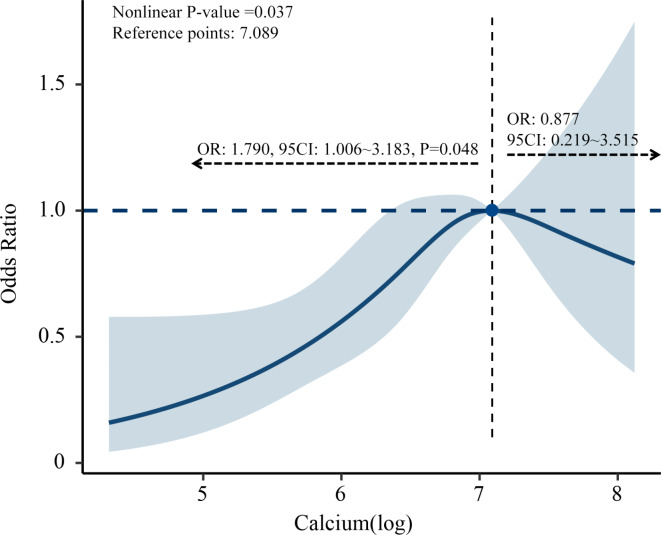
Eczema is a common chronic skin condition. Previous studies indicated the dietary factors, such as calcium intake, might influence the onset and progression of eczema in the population of gravidas and infants. However, there was no studies on the correlation between dietary calcium and the adult population. In this study, we aim to investigate the correlation between dietary calcium intake and the prevalence of eczema in adults. The characteristics of adults (≥ 18 years) were collected from the National Health and Nutrition Examination Survey (NHANES) 2005-2006 database. Dietary calcium intake was assessed using the 24-hour dietary recall method. The prevalence of eczema was determined through an allergy questionnaire. Logistic regression modeling was applied to analyze the correlation between dietary calcium intake and eczema prevalence. Restricted cubic spline (RCS) was used to investigate the nonlinear relationship between calcium intake and eczema. A two-stage linear regression model was used to calculate the critical effect of calcium intake on the prevalence of eczema by smoothed curve fitting. Subgroup analyses were performed to explore the effect of different demographic characteristics on the relationship between dietary calcium intake and eczema. Results In this cross-sectional study, we collected 4086 adult samples. There were 1930 males (46.9%) and 2156 females (53.1%), at the average age of 46.7 years, and 266 participants (7.6%) were diagnosed with eczema. Logistic regression results showed there was a significant difference between the third quartile group and eczema compared to the 1st quartile group of dietary calcium (OR: 1.913, 95% CI: 1.024-3.576, P = 0.043). The RCS showed an inverted U-shaped correlation between dietary calcium intake and eczema prevalence (non-linear P-value < 0.05). An increase in calcium intake was associated with an increase in eczema prevalence when the logarithmic value of dietary calcium intake was below 7.089 (OR: 1.790, 95% CI: 1.006-3.183, P = 0.048). These data indicated there was an inverted U-shaped correlation between dietary calcium intake and the prevalence of eczema, which suggested moderate reduction of calcium intake might be beneficial in the incidence of eczema. Further prospective studies are needed to explore causal relationships and optimal calcium intake levels to prevent eczema.
湿疹是一种常见的慢性皮肤病。以往研究表明,饮食因素,如钙摄入量,可能会影响孕妇和婴儿人群中湿疹的发病和进展。然而,尚无关于饮食钙与成年人群之间相关性的研究。在本研究中,我们旨在调查饮食钙摄入量与成人湿疹患病率之间的相关性。从2005 - 2006年国家健康与营养检查调查(NHANES)数据库中收集成年人(≥18岁)的特征信息。采用24小时饮食回顾法评估饮食钙摄入量。通过过敏问卷确定湿疹患病率。应用逻辑回归模型分析饮食钙摄入量与湿疹患病率之间的相关性。使用受限立方样条(RCS)研究钙摄入量与湿疹之间的非线性关系。采用两阶段线性回归模型通过平滑曲线拟合计算钙摄入量对湿疹患病率的临界效应。进行亚组分析以探讨不同人口统计学特征对饮食钙摄入量与湿疹之间关系的影响。结果 在这项横断面研究中,我们收集了4086个成人样本。其中男性1930名(46.9%),女性2156名(53.1%),平均年龄46.7岁,266名参与者(7.6%)被诊断患有湿疹。逻辑回归结果显示,饮食钙的第三四分位数组与湿疹之间与第一四分位数组相比存在显著差异(比值比:1.913,95%置信区间:1.024 - 3.576,P = 0.043)。RCS显示饮食钙摄入量与湿疹患病率之间呈倒U形相关性(非线性P值<0.05)。当饮食钙摄入量的对数值低于7.089时,钙摄入量增加与湿疹患病率增加相关(比值比:1.790,95%置信区间:1.006 - 3.183,P = 0.048)。这些数据表明饮食钙摄入量与湿疹患病率之间呈倒U形相关性,这表明适度减少钙摄入量可能对湿疹发病率有益。需要进一步的前瞻性研究来探索因果关系和预防湿疹的最佳钙摄入量水平。