Heub Angelina, Schaller Andrea, Lange Martin
Department of Fitness and Health, IST University of Applied Sciences, Düsseldorf, Germany.
Department of Human Science, Institute of Sport Science, University of the Bundeswehr Munich, Neubiberg, Germany.
Front Public Health. 2024 Dec 13;12:1463868. doi: 10.3389/fpubh.2024.1463868. eCollection 2024.
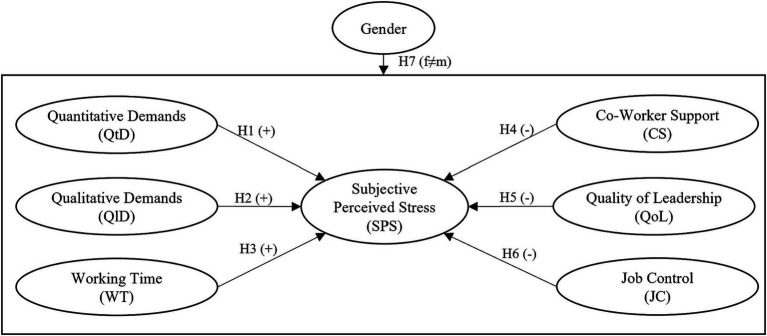
Stress is an extensive issue in modern society, affecting men and women differently. A better understanding of these patterns is required within the work context. Therefore, this study aimed to identify gender differences in the effects of stressors (quantitative demands, qualitative demands, working time) and resources (job control, quality of leadership, co-worker support) on subjective perceived stress across occupational groups.
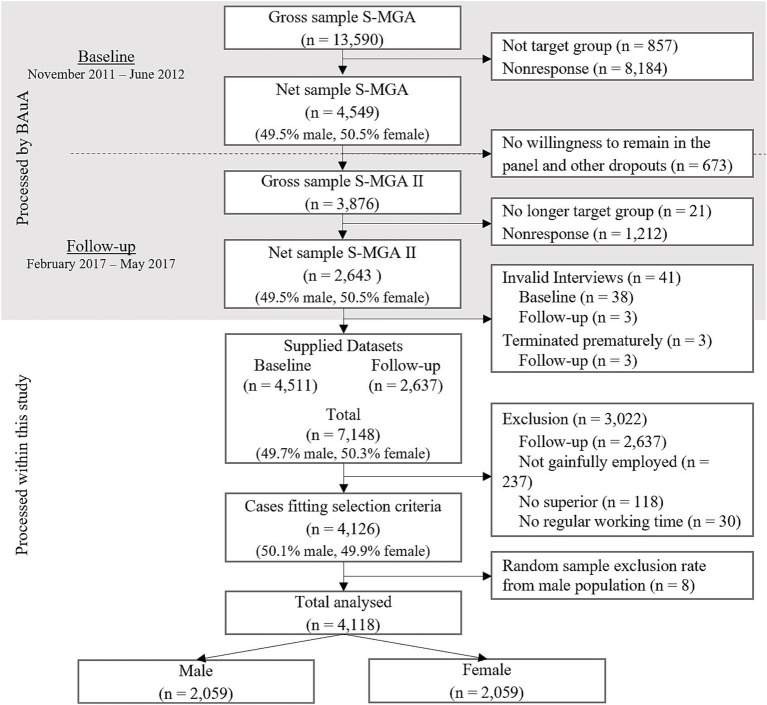
This study was conducted as a secondary data analysis based on the 'German Study on Mental Health at Work' data. The national representative cross-sectional sample included 4,118 employees. The data were analyzed using structural equation modeling.
Correlations between quantitative demands, working time, co-worker support, quality of leadership, job control, and subjective perceived stress were first confirmed for a total sample of employees. Gender differences in these interactions were then analyzed using multi-group equation modeling and a gender-stratified sample. Men and women showed an increase in subjective perceived stress for high quantitative demands. This increase was more prominent for men. Women further showed an increase in subjective perceived stress in response to long working time. High co-worker support, quality of leadership, and job control had stress-reducing effects but did not result in significant gender differences. No association was found between qualitative demands and subjective perceived stress.
The results underline that not all working conditions significantly impact stress for both genders and gender differences exist only within the stressors. Hence, gendered strategies may only be required in some constellations. However, specific contexts require integrating gendered approaches in research and operational practice.
压力是现代社会中一个普遍存在的问题,对男性和女性的影响有所不同。在工作环境中,需要更好地理解这些模式。因此,本研究旨在确定压力源(数量需求、质量需求、工作时间)和资源(工作控制、领导质量、同事支持)对不同职业群体主观感知压力影响的性别差异。
本研究是基于“德国工作心理健康研究”数据进行的二次数据分析。全国代表性的横断面样本包括4118名员工。数据采用结构方程模型进行分析。
首先在全体员工样本中确认了数量需求、工作时间、同事支持、领导质量、工作控制与主观感知压力之间的相关性。然后使用多组方程模型和按性别分层的样本分析了这些相互作用中的性别差异。对于高数量需求,男性和女性的主观感知压力均有所增加。这种增加在男性中更为显著。女性因长时间工作,主观感知压力也会进一步增加。高同事支持、领导质量和工作控制具有减轻压力的作用,但未导致显著的性别差异。未发现质量需求与主观感知压力之间存在关联。
结果强调并非所有工作条件都会对两性的压力产生显著影响,且性别差异仅存在于压力源之中。因此,可能仅在某些情况下需要针对性别的策略。然而,特定背景下需要在研究和实践操作中纳入针对性别的方法。