Chen Hui Min, Shen Kuo, Ji Ling, McGrath Colman, Chen Hui
Division of Restorative Dental Sciences, Faculty of Dentistry, The University of Hong Kong, Hong Kong SAR, PR China.
Faculty of Dentistry, The University of Hong Kong, Hong Kong SAR, PR China.
Int Dent J. 2025 Apr;75(2):735-743. doi: 10.1016/j.identj.2024.11.022. Epub 2024 Dec 31.
Edentulism's impact on overall well-being is widely recognized, but there is limited information on regional and sex disparities in its global burden. This study aims to fill this gap by providing an updated picture of edentulism's burden by region and sex and predicting its global trend for the next 2 decades.
This study analyzed and reported Global Burden of Disease (GBD) data on the prevalence, incidence, and disability adjusted life years (DALYs) of edentulism, with a breakdown by sex and sociodemographic index (SDI). Epidemiological trends from 1990 to 2021 were characterized using Joinpoint regression analysis. An Autoregressive Integrated Moving Average (ARIMA) model was used to forecast edentulism prevalence trends from 2022 to 2040.
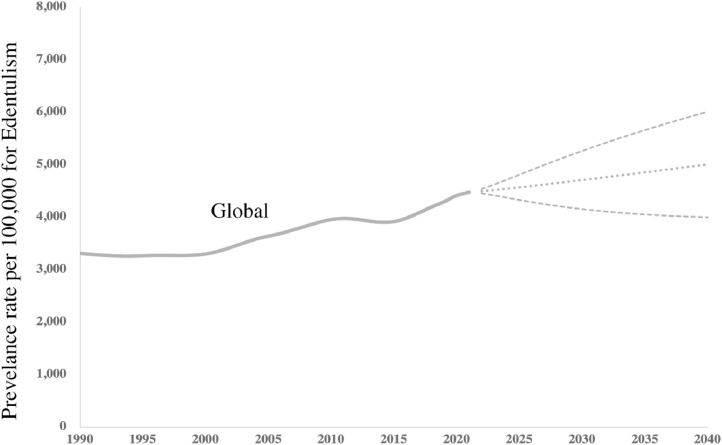
A double increase was found in the number of people with edentulism during the last 30 years. A decrease in the incidence rate of edentulism was found in younger age groups, and a shift in the peak age of prevalence from 70-74 in 1990 to 75-79 in 2021. Females had a higher prevalence rate of edentulism than males globally, with a disproportionate burden in regions of high SDI countries. The global prevalence rate is projected to increase to 5,004 individuals per 100,000 in 2040.
These results indicate that edentulism continues to be a significant global public health concern, particularly as its prevalence is expected to rise with the aging population.
Public and clinical preventative measures against edentulism is imperative for the welling being of the population, especially in female group.
无牙颌对整体健康的影响已得到广泛认可,但关于其全球负担的地区和性别差异的信息有限。本研究旨在通过提供按地区和性别划分的无牙颌负担的最新情况,并预测其未来20年的全球趋势来填补这一空白。
本研究分析并报告了全球疾病负担(GBD)数据,内容包括无牙颌的患病率、发病率和伤残调整生命年(DALYs),并按性别和社会人口学指数(SDI)进行了细分。使用Joinpoint回归分析对1990年至2021年的流行病学趋势进行了描述。采用自回归积分移动平均(ARIMA)模型预测2022年至2040年的无牙颌患病率趋势。
在过去30年中,无牙颌患者数量出现了双重增长。在较年轻年龄组中发现无牙颌发病率有所下降,患病率的峰值年龄从1990年的70 - 74岁转移到了2021年的75 - 79岁。全球范围内,女性无牙颌患病率高于男性,在高SDI国家地区负担不均衡。预计到2040年,全球患病率将增至每10万人中有5004人。
这些结果表明,无牙颌仍然是一个重大的全球公共卫生问题,特别是随着人口老龄化其患病率预计还会上升。
针对无牙颌的公共和临床预防措施对于民众的健康至关重要,尤其是在女性群体中。