Li Shengzhican, Yiminijiang Ashanjiang, Li Ruoxuan, Wu Mandi, Long Mingxiu, Yang Peizhi, He Shubin
College of Grassland Agriculture, Northwest A&F University, Yangling, 712100, China.
BMC Plant Biol. 2025 Jan 2;25(1):2. doi: 10.1186/s12870-024-06011-6.
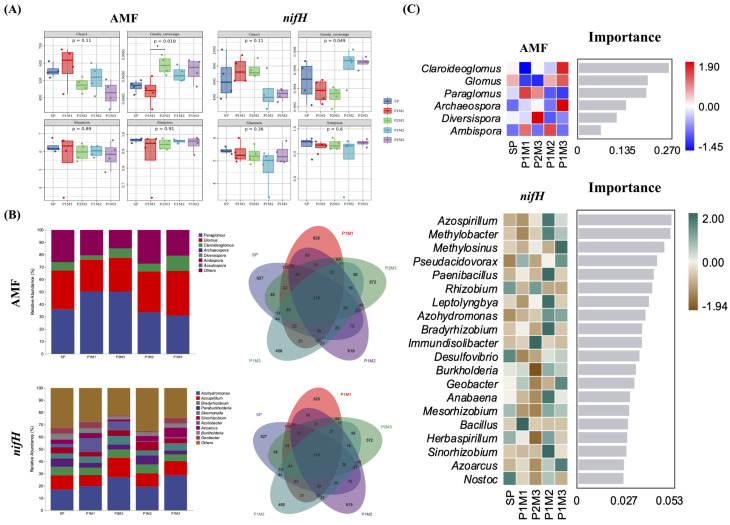
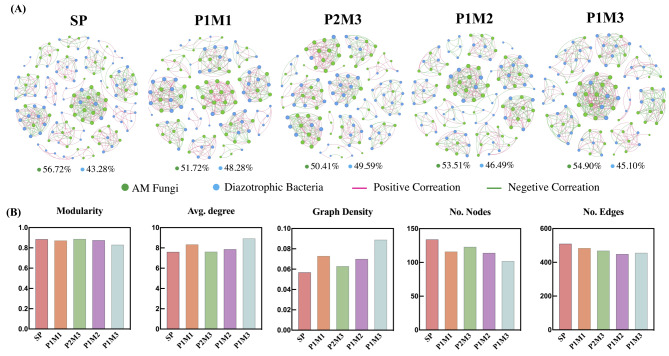
To investigate the effects of row ratio configurations on intercropping advantages and related rhizosphere microbial communities, a field experiment involving five treatments of different rows of broomcorn millet, i.e., P1M1 (1 row of broomcorn millet intercropped with 1 row of alfalfa), P2M3, P1M2, P1M3 and broomcorn millet alone (SP), was conducted on the Loess Plateau of China. We analyzed the yield, nutritional content of broomcorn millet, the soil nutrient availability and the diversity and community composition of AMF (arbuscular mycorrhizal fungi) and diazotrophs in the rhizosphere of broomcorn millet. The results showed that compared with monocultures, alfalfa-millet intercropping system under different row ratio configurations significantly increased the yield of broomcorn millet and the absorption of PTP and PTK (total phosphorus and potassium of broomcorn millet). In addition, the broomcorn millet-alfalfa intercropping system also improved soil nutrition, with the decrease of the row ratio of broomcorn millet, the changes of TN, NH-N and microbial biomass in the rhizosphere of broomcorn millet were consistent, which was opposite to NO-N. Moreover, co-occurrence network and PLS-PM (partial least squares path modelling) analysis showed alfalfa-broomcorn millet intercropping system changed the community diversity and composition of soil microorganisms, increased the improvement of soil nutrition (TN, NH-N and microbial biomass), and promoted the absorption of different nutrients by plants (N, P and K) mainly through the negative regulation of AMF and the synergistic effect of AMF on diazotrophs, and finally increased crop yield. This shows that broomcorn millet-alfalfa intercropping can increase plant nutrient content by adjusting soil nutrients and soil microbial activities, thereby increasing yield. Furthermore, we found that 1P2M was the best ratio of alfalfa-millet intercropping system, which may provide reliable suggestions and selection basis for future agricultural production practices.
为研究行比配置对间作优势及相关根际微生物群落的影响,在中国黄土高原开展了一项田间试验,设置了五种不同黍稷行数的处理,即P1M1(1行黍稷与1行紫花苜蓿间作)、P2M3、P1M2、P1M3以及单作黍稷(SP)。我们分析了黍稷的产量、营养成分、土壤养分有效性以及黍稷根际丛枝菌根真菌(AMF)和固氮菌的多样性及群落组成。结果表明,与单作相比,不同行比配置下的紫花苜蓿 - 黍稷间作系统显著提高了黍稷产量以及黍稷对总磷(PTP)和总钾(PTK)的吸收。此外,黍稷 - 紫花苜蓿间作系统还改善了土壤养分,随着黍稷行比的降低,黍稷根际全氮(TN)、铵态氮(NH₄⁺ - N)和微生物生物量的变化趋势一致,与硝态氮(NO₃⁻ - N)相反。而且,共现网络和偏最小二乘路径模型(PLS - PM)分析表明,紫花苜蓿 - 黍稷间作系统改变了土壤微生物的群落多样性和组成,提高了土壤养分(TN、NH₄⁺ - N和微生物生物量)的改善程度,并主要通过丛枝菌根真菌的负调控以及丛枝菌根真菌对固氮菌的协同作用促进了植物对不同养分(氮、磷和钾)的吸收,最终提高了作物产量。这表明黍稷 - 紫花苜蓿间作可通过调节土壤养分和土壤微生物活性来增加植物养分含量,从而提高产量。此外,我们发现1P2M是紫花苜蓿 - 黍稷间作系统的最佳比例,这可能为未来农业生产实践提供可靠的建议和选择依据。