Leung Miguel Ricardo, Sun Chen, Zeng Jianwei, Anderson Jacob R, Niu Qingwei, Huang Wei, Noteborn Willem E M, Brown Alan, Zeev-Ben-Mordehai Tzviya, Zhang Rui
Structural Biochemistry Group, Bijvoet Centre for Biomolecular Research, Utrecht University, Utrecht, the Netherlands.
Hubrecht Institute-KNAW & University Medical Center Utrecht, Utrecht, the Netherlands.
Nature. 2025 Jan;637(8048):1170-1177. doi: 10.1038/s41586-024-08337-5. Epub 2025 Jan 1.
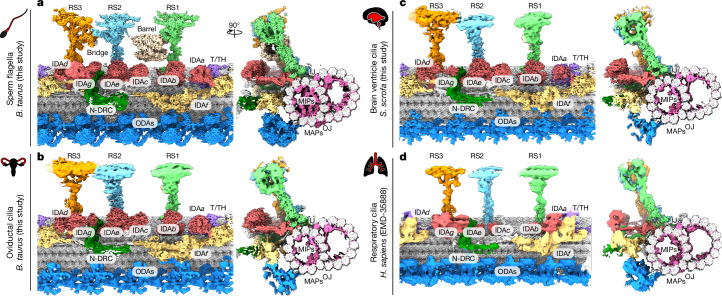
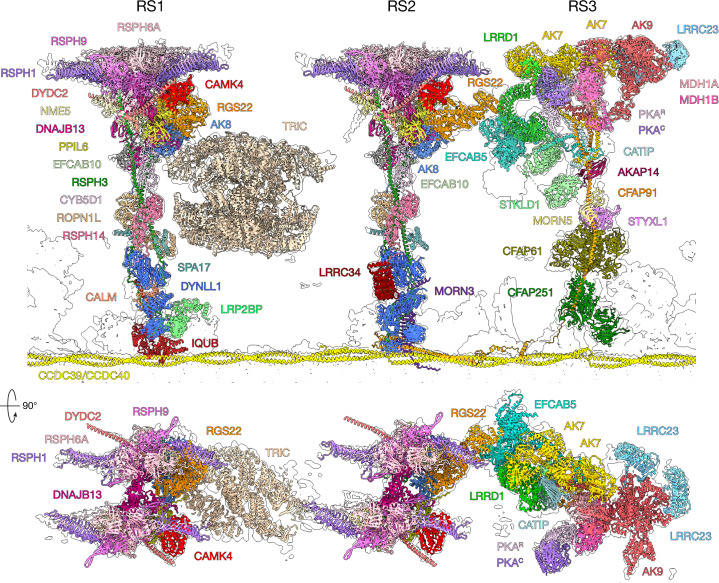
Reproduction, development and homeostasis depend on motile cilia, whose rhythmic beating is powered by a microtubule-based molecular machine called the axoneme. Although an atomic model of the axoneme is available for the alga Chlamydomonas reinhardtii, structures of mammalian axonemes are incomplete. Furthermore, we do not fully understand how molecular structures of axonemes vary across motile-ciliated cell types in the body. Here we use cryoelectron microscopy, cryoelectron tomography and proteomics to resolve the 96-nm modular repeat of axonemal doublet microtubules (DMTs) from both sperm flagella and epithelial cilia of the oviduct, brain ventricles and respiratory tract. We find that sperm DMTs are the most specialized, with epithelial cilia having only minor differences across tissues. We build a model of the mammalian sperm DMT, defining the positions and interactions of 181 proteins including 34 newly identified proteins. We elucidate the composition of radial spoke 3 and uncover binding sites of kinases associated with regeneration of ATP and regulation of ciliary motility. We discover a sperm-specific, axoneme-tethered T-complex protein ring complex (TRiC) chaperone that may contribute to construction or maintenance of the long flagella of mammalian sperm. We resolve axonemal dyneins in their prestroke states, illuminating conformational changes that occur during ciliary movement. Our results illustrate how elements of chemical and mechanical regulation are embedded within the axoneme, providing valuable resources for understanding the aetiology of ciliopathy and infertility, and exemplifying the discovery power of modern structural biology.
生殖、发育和体内平衡依赖于运动性纤毛,其有节奏的摆动由一种名为轴丝的基于微管的分子机器提供动力。尽管莱茵衣藻的轴丝原子模型已可得,但哺乳动物轴丝的结构尚不完整。此外,我们尚未完全了解轴丝的分子结构在体内不同运动性纤毛细胞类型之间是如何变化的。在这里,我们使用冷冻电子显微镜、冷冻电子断层扫描和蛋白质组学来解析来自精子鞭毛以及输卵管、脑室和呼吸道上皮纤毛的轴丝双联微管(DMT)的96纳米模块化重复结构。我们发现精子DMT最为特殊,而上皮纤毛在不同组织之间只有细微差异。我们构建了哺乳动物精子DMT的模型,确定了181种蛋白质的位置和相互作用,其中包括34种新鉴定的蛋白质。我们阐明了辐条3的组成,并揭示了与ATP再生和纤毛运动调节相关的激酶的结合位点。我们发现了一种精子特异性的、与轴丝相连的T复合蛋白环复合物(TRiC)伴侣蛋白,它可能有助于构建或维持哺乳动物精子的长鞭毛。我们解析了轴丝动力蛋白的冲程前状态,揭示了纤毛运动过程中发生的构象变化。我们的结果说明了化学和机械调节元件是如何嵌入轴丝中的,为理解纤毛病和不孕症的病因提供了宝贵资源,并例证了现代结构生物学的发现能力。