Ghosh Pallab K, Chaudhry Ahmed, Campbell Janis E, Kim Myongjin, Smith Kyle, Demir Firat, Zhao Junying
Department of Economics, University of Oklahoma, Norman, OK, United States.
Department of Biostatistics and Epidemiology, University of Oklahoma Health Sciences Center, Oklahoma, OK, United States.
Front Public Health. 2024 Dec 18;12:1464685. doi: 10.3389/fpubh.2024.1464685. eCollection 2024.
As one type of vaccine policy, the effectiveness and spillover effects of the US CDC vaccine recommendations are inadequately evaluated. This study aims to fully evaluate its impacts on male adults, in addition to children, using better data.
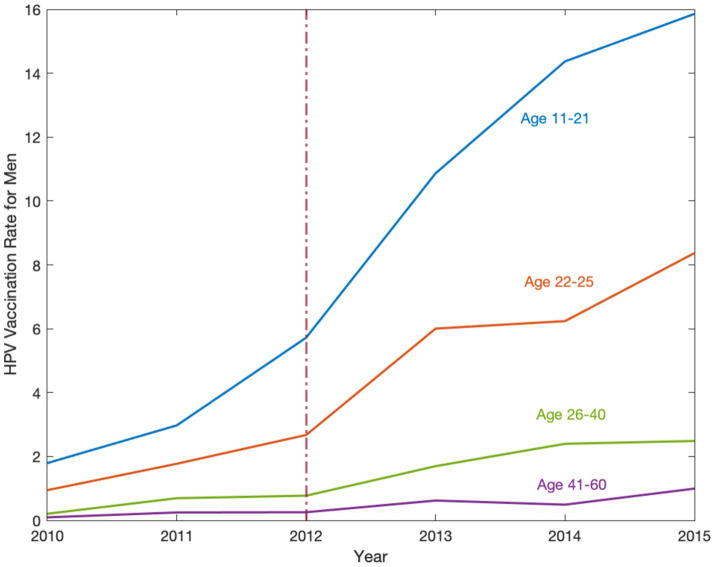
A before-after study design to examine the CDC's 2011 HPV vaccine recommendation for men aged 11-21.
Individual-level data included the 2010-2015 US National Health Interview Survey full sample of 7,000 male children aged 11-18, younger adults aged 19-21 and 22-25, and older adults aged 26-60. Pooled cross-sectional surveys contained individual-level vaccination, socioeconomic, and demographic information. Outcome variable is an individual HPV vaccination status, measured as individual probability of HPV vaccination. Dummy regressions were estimated by a Linear Probability Model (LPM) with fixed effects for target and non-target age groups.
The policy was significantly associated with a 14.8% ( < 0.001) increased individual likelihood of HPV vaccination for men aged 11-21. It was also associated with a modest spillover effect, a 5.6% ( < 0.001) increased individual likelihood for men aged 22-25 and marginally for men aged 26-60. African American men and men with poor health were 2.7 and 15.4% less likely to uptake HPV vaccines than white men and men with good or fair health, respectively.
This study complements the existing policy evaluation literature on HPV vaccine recommendation among male children by including adults and using better data. Findings offer comprehensive evidence of the effectiveness and spillover effects of this recommendation type of federal-level policy, provide policy lessons for other vaccines, and identify vulnerable subpopulations as targets for future policies.
作为一种疫苗政策类型,美国疾病控制与预防中心(CDC)的疫苗建议的有效性和溢出效应尚未得到充分评估。本研究旨在使用更完善的数据,全面评估其对男性成年人以及儿童的影响。
一项前后对照研究设计,以考察CDC在2011年针对11至21岁男性的人乳头瘤病毒(HPV)疫苗建议。
个体层面的数据包括2010 - 2015年美国国家健康访谈调查的完整样本,涵盖7000名11至18岁的男性儿童、19至21岁和22至25岁的年轻成年人以及26至60岁的年长成年人。汇总的横断面调查包含个体层面的疫苗接种、社会经济和人口统计学信息。结果变量是个体HPV疫苗接种状况,以HPV疫苗接种的个体概率来衡量。通过线性概率模型(LPM)对目标年龄组和非目标年龄组进行固定效应估计,得出虚拟回归结果。
该政策与11至21岁男性HPV疫苗接种的个体可能性显著增加14.8%(<0.001)相关。它还与适度的溢出效应相关,22至25岁男性的个体可能性增加5.6%(<0.001),26至60岁男性的增加幅度较小。非裔美国男性和健康状况较差的男性接种HPV疫苗的可能性分别比白人男性以及健康状况良好或中等的男性低2.7%和15.4%。
本研究通过纳入成年人并使用更完善的数据,对现有的关于男性儿童HPV疫苗建议的政策评估文献进行了补充。研究结果为这类联邦层面政策建议的有效性和溢出效应提供了全面证据,为其他疫苗提供了政策经验教训,并确定了易受影响的亚人群作为未来政策的目标对象。