Agnor Benjamin K, Knio Ziyad O, Zuo Zhiyi
School of Medicine, University of Virginia, Charlottesville, VA, United States of America.
Department of Anesthesiology, University of Virginia Health, Charlottesville, VA, United States of America.
PLoS One. 2025 Jan 2;20(1):e0316024. doi: 10.1371/journal.pone.0316024. eCollection 2025.
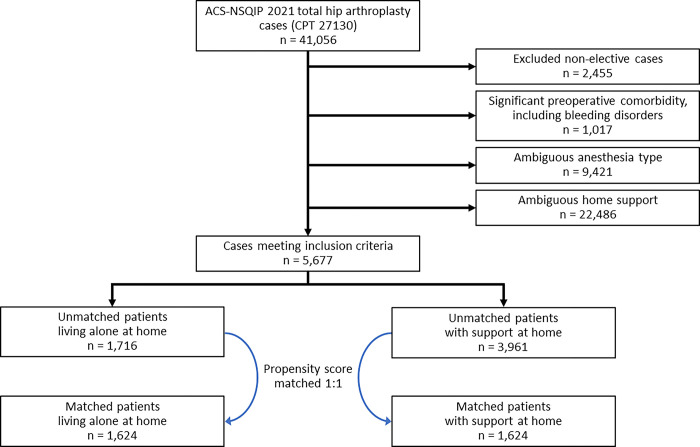
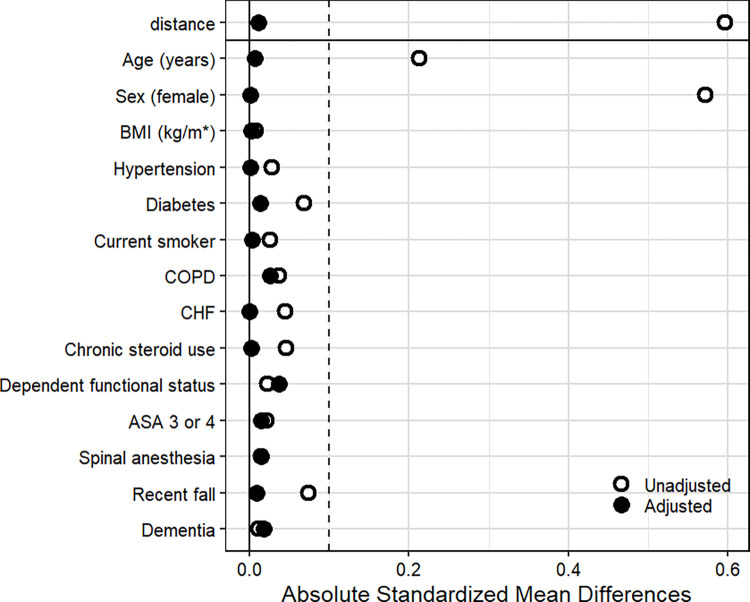
The impact of home support and interaction with family members on recovery and perioperative outcomes remains unclear. We determined whether living alone was predictive of discharge disposition following total hip arthroplasty (THA). Data were from American College of Surgeons National Surgical Quality Improvement Program participating hospitals in 2021. The primary endpoint was discharging disposition. A total of 1716 patients living alone and 3961 with others at home were identified. The 1:1 propensity-matched cohort included 3248 total patients (1624 in each group). On univariate analysis, living alone was associated with non-home discharge (22.0% [358/1624] vs. 10.5% [170/1623]; odds ratio [OR], 2.42 [95% CI, 1.98 to 2.94]; P < .001), need for services in those returning home (63.1% [799/1266] vs. 57.7% [839/1453]; OR, 1.25 [95% CI, 1.07 to 1.46]; P = .004), and increased length of hospital stay (2.05 vs. 1.72 days; mean difference, 0.34 [95% CI, 0.18 to 0.49]; P < .001). On multivariable analysis, living alone remained an independent predictor of non-home discharge (adjusted odds ratio, 2.84 [95% CI, 2.30 to 3.54]; c = 0.734). Thus, compared to propensity-matched THA patients with others at home, those living alone experience a much greater rate of non-home discharge and need for support.
家庭支持以及与家庭成员的互动对康复和围手术期结局的影响仍不明确。我们确定了独居是否可预测全髋关节置换术(THA)后的出院去向。数据来自2021年参与美国外科医师学会国家外科质量改进计划的医院。主要终点是出院去向。共确定了1716名单独生活的患者和3961名家中有其他人陪伴的患者。1:1倾向匹配队列包括3248名患者(每组1624名)。单因素分析显示,独居与非回家出院相关(22.0%[358/1624]对10.5%[170/1623];优势比[OR],2.42[95%CI,1.98至2.94];P<.001),回家患者对服务的需求(63.1%[799/1266]对57.7%[839/1453];OR,1.25[95%CI,1.07至1.46];P = .004),以及住院时间延长(2.05天对1.72天;平均差异,0.34[95%CI,0.18至0.49];P<.001)。多因素分析显示,独居仍然是非回家出院的独立预测因素(调整后优势比,2.84[95%CI,2.30至3.54];c = 0.734)。因此,与倾向匹配的家中有其他人陪伴的THA患者相比,独居患者非回家出院率和对支持的需求要高得多。