Wang Wenkang, Shuai Yunyan, Zeng Min, Fan Wei, Li Min
School of Computer Science and Engineering, Central South University, Changsha, 410083, China.
Nuffield Department of Women's and Reproductive Health, University of Oxford, Oxford, OX39DU, UK.
Nat Commun. 2025 Jan 2;16(1):70. doi: 10.1038/s41467-024-54816-8.
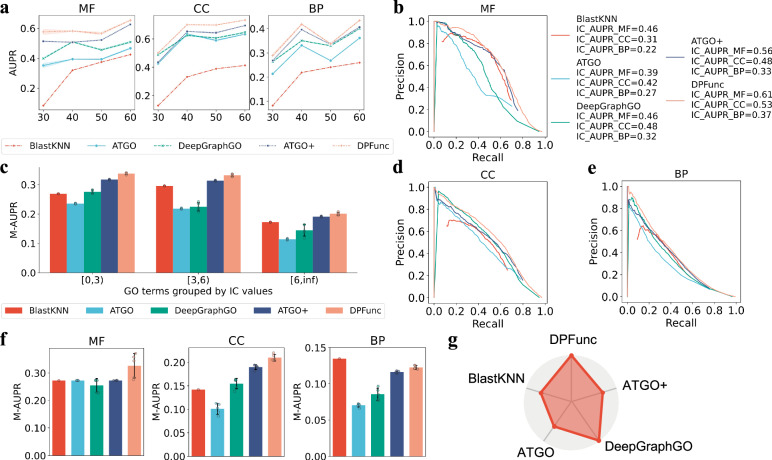
Computational methods for predicting protein function are of great significance in understanding biological mechanisms and treating complex diseases. However, existing computational approaches of protein function prediction lack interpretability, making it difficult to understand the relations between protein structures and functions. In this study, we propose a deep learning-based solution, named DPFunc, for accurate protein function prediction with domain-guided structure information. DPFunc can detect significant regions in protein structures and accurately predict corresponding functions under the guidance of domain information. It outperforms current state-of-the-art methods and achieves a significant improvement over existing structure-based methods. Detailed analyses demonstrate that the guidance of domain information contributes to DPFunc for protein function prediction, enabling our method to detect key residues or regions in protein structures, which are closely related to their functions. In summary, DPFunc serves as an effective tool for large-scale protein function prediction, which pushes the border of protein understanding in biological systems.
预测蛋白质功能的计算方法对于理解生物学机制和治疗复杂疾病具有重要意义。然而,现有的蛋白质功能预测计算方法缺乏可解释性,使得难以理解蛋白质结构与功能之间的关系。在本研究中,我们提出了一种基于深度学习的解决方案,名为DPFunc,用于利用结构域引导的结构信息进行准确的蛋白质功能预测。DPFunc可以在蛋白质结构中检测到显著区域,并在结构域信息的引导下准确预测相应功能。它优于当前的最先进方法,并且相对于现有的基于结构的方法有显著改进。详细分析表明,结构域信息的引导有助于DPFunc进行蛋白质功能预测,使我们的方法能够检测到蛋白质结构中与其功能密切相关的关键残基或区域。总之,DPFunc是大规模蛋白质功能预测的有效工具,推动了生物系统中蛋白质理解的边界。