Kim Eun-Kyung, Kwon Yong-Seok, Kim Sena, Lee Jin-Young, Park Young Hee
National Institute of Agricultural Sciences, Rural Development Administration, Wanju, Republic of Korea.
Front Nutr. 2024 Dec 19;11:1505771. doi: 10.3389/fnut.2024.1505771. eCollection 2024.
The objective of this study was to compare the dietary and health-related quality of life of young adults according to their household income and food security status.
To conduct this study, 10,224 young adults aged 19-34 years who participated in the 2008-2018 Korea National Health and Nutrition Examination Survey (KNHANES) were selected. Subjects were categorized into four groups based on household income and food security: 'food secure and high income,' 'food insecure and high income,' 'food secure and low income,' and 'food insecure and low income'. General characteristics, daily diet, and dietary quality were compared among the four groups.
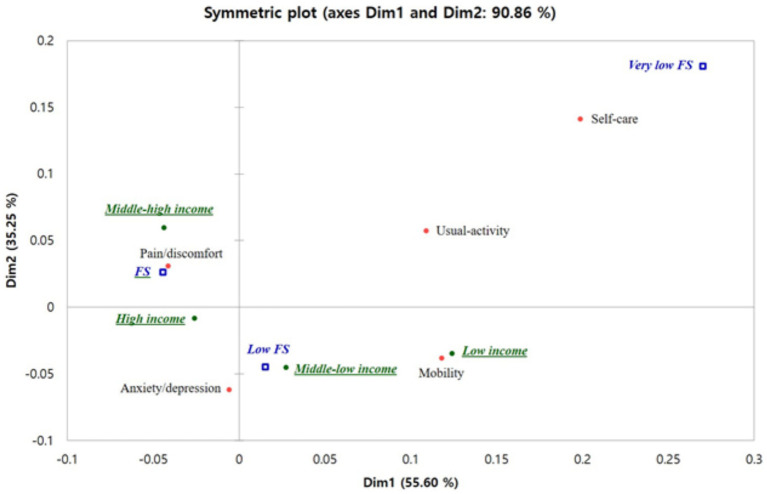
The proportion of participants consuming a daily diet below the estimated average requirements for protein, vitamins A, B, and B, niacin, vitamin C, calcium, phosphorus, and iron increased in the 'food insecure and low income' group. Among the most commonly consumed foods, instant noodles and Sprite ranked relatively high in the 'food insecure and low income' group, while apples and beef ranked relatively high in the 'food secure and high income' group. The food insecure and low income group exhibited significantly increased rates of mobility problems [OR = 1.55(95% CI = 1.05-2.29)] and anxiety/depression [OR = 1.33(95% CI = 1.07-1.64)] in comparison with the food secure and high income group.
Food insecurity was positively associated with poor diet quality and was associated with health-related quality of life, mobility, and anxiety/depression, especially among young adults.
本研究的目的是根据家庭收入和粮食安全状况比较年轻成年人的饮食及与健康相关的生活质量。
为开展本研究,选取了10224名年龄在19 - 34岁之间、参与2008 - 2018年韩国国民健康与营养检查调查(KNHANES)的年轻成年人。受试者根据家庭收入和粮食安全状况分为四组:“粮食安全且高收入”、“粮食不安全且高收入”、“粮食安全且低收入”以及“粮食不安全且低收入”。对这四组人群的一般特征、日常饮食和饮食质量进行了比较。
在“粮食不安全且低收入”组中,每日饮食中蛋白质、维生素A、B、B族维生素、烟酸、维生素C、钙、磷和铁摄入量低于估计平均需求量的参与者比例有所增加。在最常食用的食物中,方便面和雪碧在“粮食不安全且低收入”组中的排名相对较高,而苹果和牛肉在“粮食安全且高收入”组中的排名相对较高。与“粮食安全且高收入”组相比,“粮食不安全且低收入”组出现行动问题[比值比(OR)= 1.55(95%置信区间(CI)= 1.05 - 2.29)]和焦虑/抑郁[OR = 1.33(95% CI = 1.07 - 1.64)]的比率显著增加。
粮食不安全与不良饮食质量呈正相关,并且与健康相关生活质量、行动能力以及焦虑/抑郁有关,尤其是在年轻成年人中。