Li Mingming, Xu Xinxin
Department of Economics and Business, Central European University, Vienna, Austria.
Doctoral School of International Relations and Political Science, Corvinus University of Budapest, Budapest, Hungary.
Front Psychol. 2022 May 19;13:883317. doi: 10.3389/fpsyg.2022.883317. eCollection 2022.
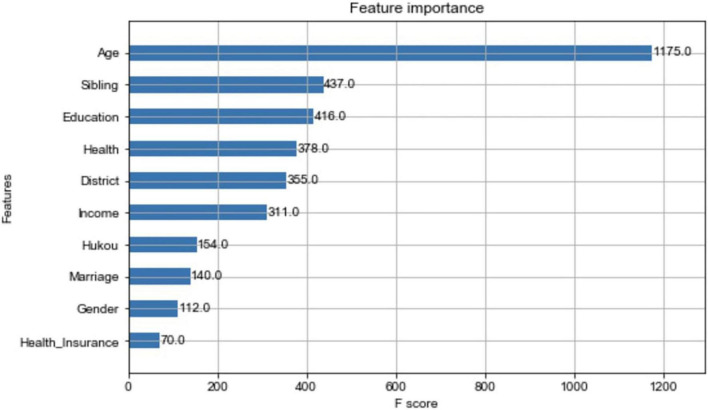
Although the Chinese government has shifted from a one-child policy to a two-child policy (allowing a couple to have up to two children) since 2016 in response to the aging population, the policy results have been unsatisfactory. This is the first paper to systematically investigate the factors influencing residents' intentions to have a second child. The research focuses on the perspective of individual, family, and social characteristics based on the Chinese General Social Survey (CGSS) from 2017 to 2018. Three machine learning methods are used in conjunction with logistic regression to reveal that the intention of having a second child increases heavily with age, more siblings in the family of origin, and better health. The family income, which is currently the focus of the literature and is statistically significant, is only sixth most important. This study further reveals differences between genders: Women with a lower level of education and religious beliefs prefer to have a second child, whereas for men, non-agricultural hukou and marriage are the position factors. The results of this study also illustrate the importance of future research focusing on the relationship of individuals to their family of origin and districts.
尽管中国政府自2016年起为应对人口老龄化,已从独生子女政策转变为二孩政策(允许一对夫妻生育至多两个孩子),但政策效果并不理想。本文首次系统研究了影响居民生育二孩意愿的因素。该研究基于2017年至2018年的中国综合社会调查(CGSS),从个人、家庭和社会特征的角度展开。研究结合三种机器学习方法和逻辑回归,揭示出二孩生育意愿会随着年龄增长、原生家庭中有更多兄弟姐妹以及健康状况改善而大幅增加。目前文献关注的家庭收入虽具有统计学意义,但在影响因素中仅排第六位。本研究还进一步揭示了性别差异:受教育程度较低且有宗教信仰的女性更倾向于生育二孩,而对于男性来说,非农业户口和婚姻状况是影响因素。本研究结果还表明了未来研究关注个体与其原生家庭及地区关系的重要性。