Meier Clément, Wieczorek Maud, Aschwanden Damaris, Ihle Andreas, Kliegel Matthias, Maurer Jürgen
Faculty of Business and Economics (HEC), University of Lausanne, Lausanne, Switzerland.
Swiss Centre of Expertise in the Social Sciences (FORS), University of Lausanne, Lausanne, Switzerland.
Eur J Public Health. 2025 Feb 1;35(1):134-140. doi: 10.1093/eurpub/ckae209.
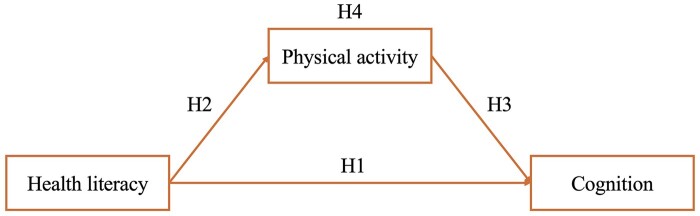
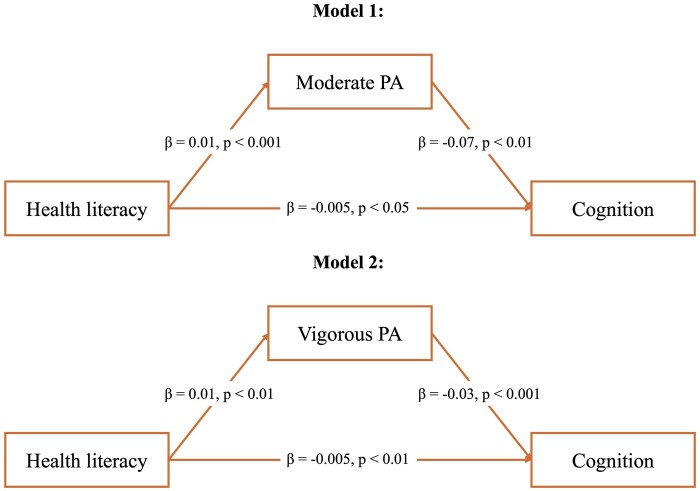
Individuals' health literacy (HL) is positively associated with healthy behaviors and global cognitive functioning. Current evidence also suggests that physical activity may prevent or delay cognitive decline and dementia. This study examines the potential mediating role of physical activity in the association between HL and cognition in a population-based sample of adults aged 58+ in Switzerland. We used data from 1645 respondents to Wave 8 (2019/2020) of the Survey on Health, Ageing, and Retirement in Europe in Switzerland. HL was assessed using the HLS-EU-Q16 questionnaire. Mild cognitive impairment (MCI) was defined as a 1.5 SD below the mean of age- and education-specific global cognition score. The frequency of moderate and vigorous physical activity was self-reported. The associations were assessed using probit regression models, controlling for social, health, and regional characteristics. Structural equation modeling was used to test the mediation hypothesis. Higher HL was associated with a higher likelihood of being engaged in moderate (P < .001) and vigorous (P < .01) physical activity and with a lower likelihood of having MCI (P < .05). In addition, both moderate (P < .05) and vigorous (P < .01) physical activity were associated with a lower probability of having MCI. Mediation analysis indicated that the association between HL and MCI was partially mediated by both moderate (12.9%) and vigorous (6.7%) physical activity. Given that physical activity may partially mediate the association between HL and MCI, improving HL in older adults could potentially foster engagement in physical activity, which could, in turn, act as a protective factor against MCI.
个体的健康素养(HL)与健康行为和整体认知功能呈正相关。目前的证据还表明,体育活动可能预防或延缓认知衰退和痴呆症。本研究在瑞士58岁及以上成年人的基于人群的样本中,考察了体育活动在HL与认知之间关联中的潜在中介作用。我们使用了来自瑞士欧洲健康、老龄化和退休调查第8波(2019/2020)的1645名受访者的数据。HL使用HLS-EU-Q16问卷进行评估。轻度认知障碍(MCI)被定义为比年龄和教育程度特定的整体认知得分均值低1.5个标准差。中等强度和剧烈强度体育活动的频率通过自我报告获得。使用概率回归模型评估关联,并控制社会、健康和区域特征。采用结构方程模型来检验中介假设。较高的HL与从事中等强度(P <.001)和剧烈强度(P <.01)体育活动的较高可能性以及患有MCI的较低可能性(P <.05)相关。此外,中等强度(P <.05)和剧烈强度(P <.01)体育活动均与患有MCI的较低概率相关。中介分析表明,HL与MCI之间的关联部分由中等强度(12.9%)和剧烈强度(6.7%)体育活动介导。鉴于体育活动可能部分介导HL与MCI之间的关联,提高老年人的HL可能会促进他们参与体育活动,而这反过来又可以作为预防MCI的保护因素。