Gréa Corinna, Dittmann Anna, Wolff David, Haidar Hanna, Roser Silvia, Merz Benedikt, Genannt Bonsmann Stefan Storcksdieck
Department of Nutritional Behaviour, Max Rubner-Institut (MRI) - Federal Research Institute of Nutrition and Food, Haid-und-Neu-Straße 9, 76131, Karlsruhe, Germany.
Department of Physiology and Biochemistry of Nutrition, Max Rubner-Institut (MRI) - Federal Research Institute of Nutrition and Food, Haid-und-Neu-Straße 9, 76131, Karlsruhe, Germany.
BMC Public Health. 2025 Jan 4;25(1):36. doi: 10.1186/s12889-024-21102-7.
The reformulation of commonly consumed foods towards less sugar, fat, and salt is an important public health strategy to improve food choices of consumers and thus address the high prevalence of overweight and obesity. Front-of-pack nutrition labels like the Nutri-Score may drive reformulation and support nutritionally favourable food choices. Breakfast cereals are of special interest in that they tend to be high in sugar and are relatively often targeted at children. This study therefore aimed to evaluate the German breakfast cereal market in terms of reformulation efforts and to what extent these would show in a better Nutri-Score.
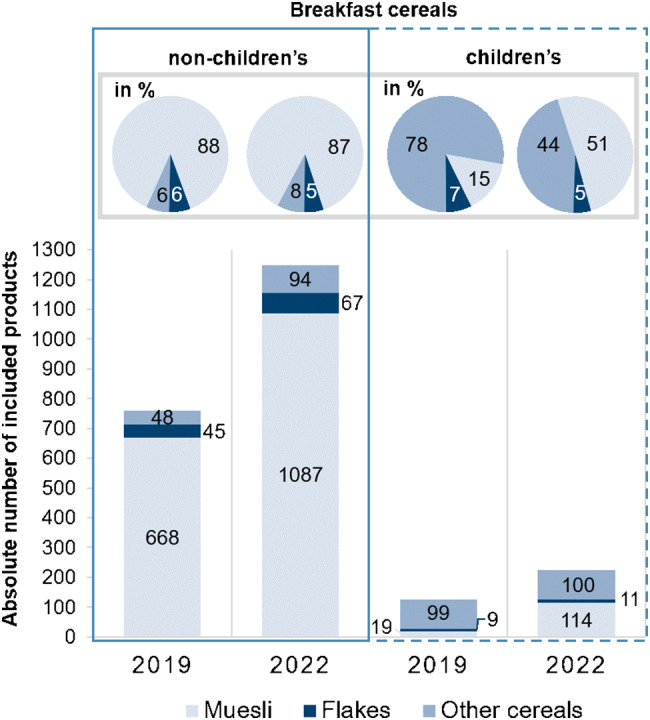
Using data from the German monitoring of packaged foods, changes in energy and nutrient content and the final nutritional score (FNS) of breakfast cereals, differentiated into children's and non-children's products, between 2019 (n = 888) and 2022 (n = 1473) were evaluated (Mann-Whitney test for two independent samples). Reformulation efforts were analysed in a subsample of paired products available in both years (n = 424). The Nutri-Score was calculated using the 2023 algorithm.
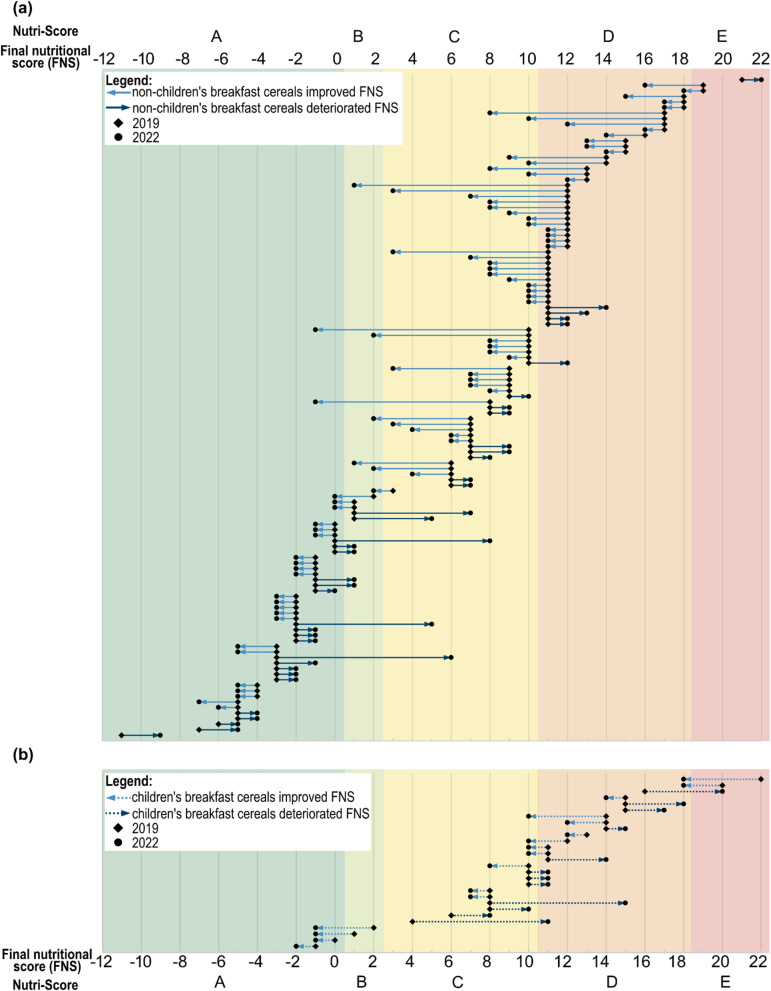
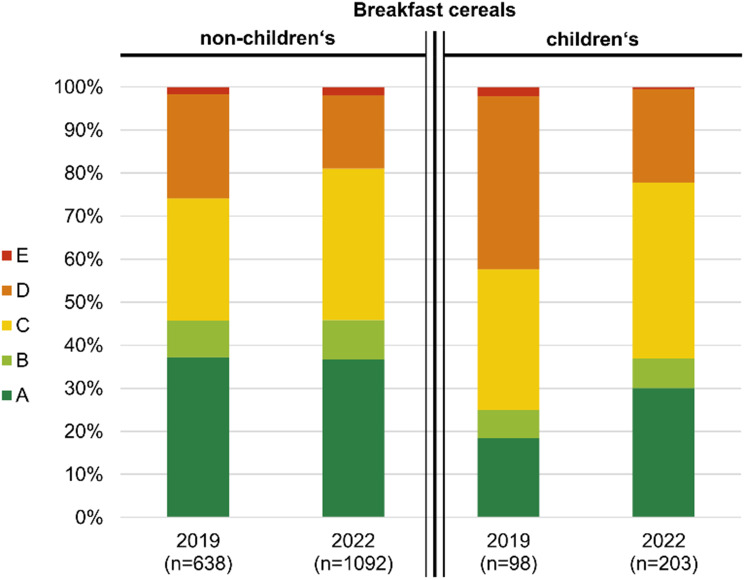
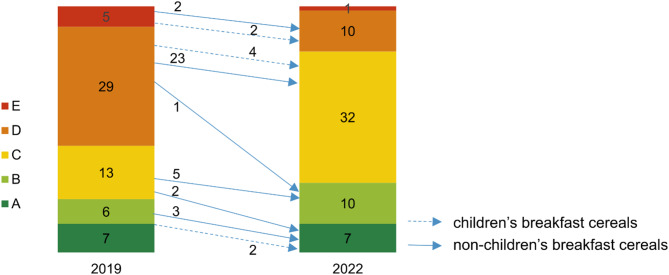
Sugar content of children's and non-children's breakfast cereals decreased by 25.5% (p < 0.001) and 8.7% (p < 0.001), respectively, while fat content increased (+ 32.0% (p < 0.001) and + 7.0% (p < 0.036)). Especially for children's breakfast cereals, the share of products with a 'green' (A or B) Nutri-Score was higher in 2022 than in 2019. At the same time, the share of less favourable breakfast cereals (Nutri-Score C-E) was higher for children's than for non-children's breakfast cereals in both years. For paired products, the FNS changed (positively or negatively) in 34.6% and concomitantly the Nutri-Score in 14.2% of cases. Products showing a better Nutri-Score were often reformulated in a way to just make it into the better class.
Improvements in nutrient content and FNS of breakfast cereals in Germany were mainly driven by shifts in the product portfolio, not by reformulation of existing products. Hence, any benefit for public health would require that consumers switch to (newly introduced) breakfast cereals with a more favourable composition. Overall, more reformulation efforts guided by a holistic product monitoring are needed to improve the nutritional quality of the food supply.
将常见食品重新配方,减少糖、脂肪和盐的含量,是一项重要的公共卫生策略,有助于改善消费者的食物选择,从而应对超重和肥胖的高患病率。像营养评分(Nutri-Score)这样的包装正面营养标签可能会推动重新配方,并支持营养方面更有益的食物选择。早餐谷物特别值得关注,因为它们往往含糖量高,而且相对经常以儿童为目标受众。因此,本研究旨在评估德国早餐谷物市场的重新配方努力情况,以及这些努力在多大程度上会体现在更好的营养评分上。
利用德国包装食品监测数据,评估了2019年(n = 888)至2022年(n = 1473)早餐谷物(分为儿童产品和非儿童产品)的能量和营养成分变化以及最终营养评分(FNS)(对两个独立样本进行曼-惠特尼检验)。在两年都有的配对产品子样本(n = 424)中分析重新配方努力情况。营养评分使用2023年算法计算。
儿童和非儿童早餐谷物的糖含量分别下降了25.5%(p < 0.001)和8.7%(p <