• 文献检索
  • 文档翻译
  • 深度研究
  • 学术资讯
  • Suppr Zotero 插件Zotero 插件
  • 邀请有礼
  • 套餐&价格
  • 历史记录
应用&插件
Suppr Zotero 插件Zotero 插件浏览器插件Mac 客户端Windows 客户端微信小程序
定价
高级版会员购买积分包购买API积分包
服务
文献检索文档翻译深度研究API 文档MCP 服务
关于我们
关于 Suppr公司介绍联系我们用户协议隐私条款
关注我们

Suppr 超能文献

核心技术专利:CN118964589B侵权必究
粤ICP备2023148730 号-1Suppr @ 2026

文献检索

告别复杂PubMed语法,用中文像聊天一样搜索,搜遍4000万医学文献。AI智能推荐,让科研检索更轻松。

立即免费搜索

文件翻译

保留排版,准确专业,支持PDF/Word/PPT等文件格式,支持 12+语言互译。

免费翻译文档

深度研究

AI帮你快速写综述,25分钟生成高质量综述,智能提取关键信息,辅助科研写作。

立即免费体验

银纳米颗粒的合成、固定化、表征及多方面应用进展:全面综述

Advancements in synthesis, immobilization, characterization, and multifaceted applications of silver nanoparticles: A comprehensive review.

作者信息

Uddin Rabbi Md Belal, Haque Sadia, Bedoura Sultana

机构信息

Department of Wet Process Engineering, Bangladesh University of Textiles, Dhaka, 1208, Bangladesh.

Department of Dyes and Chemical Engineering, Bangladesh University of Textiles, Dhaka, 1208, Bangladesh.

出版信息

Heliyon. 2024 Dec 10;10(24):e40931. doi: 10.1016/j.heliyon.2024.e40931. eCollection 2024 Dec 30.

DOI:10.1016/j.heliyon.2024.e40931
PMID:39759340
原文链接:https://pmc.ncbi.nlm.nih.gov/articles/PMC11700253/
Abstract

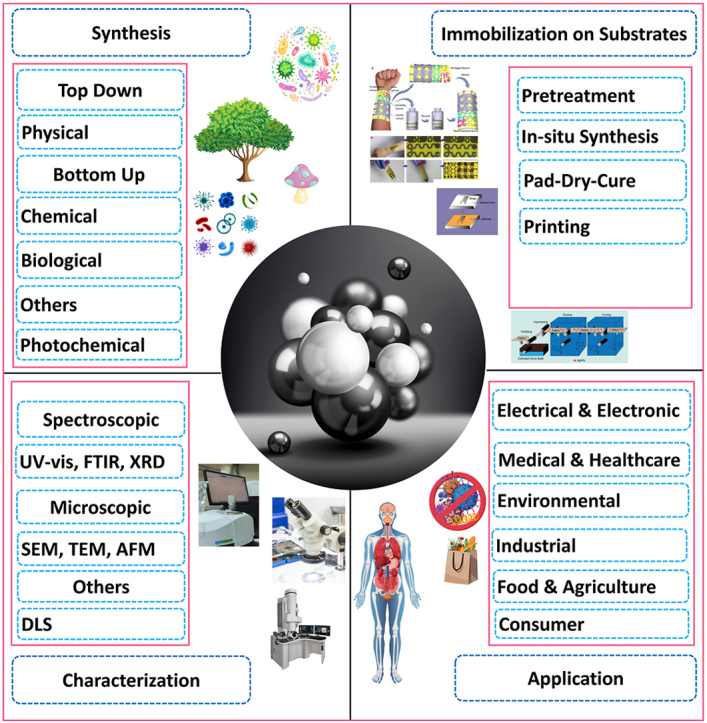
Silver nanoparticles (AgNPs) have attracted significant interest in recent years owing to their unique physicochemical properties, including antimicrobial reduction capabilities, photocatalytic activity, self-cleaning features, superhydrophobicity, and electrical conductivity. Their characteristics render them highly advantageous for various textile, electronics, food and agriculture, water treatment, and biomedical applications. This detailed analysis explores the recent benefits and drawbacks of various synthesis methods, immobilization techniques, and characterization of AgNPs while emphasizing novel strategies that improve their functionality across different substrates. A comprehensive analysis is conducted on various synthesis methods, including physical, chemical, and biological approaches. Additionally, immobilization techniques such as in-situ synthesis, pad-dry-cure, and printing on diverse substrates are thoroughly examined for their role in enhancing the functionality of textile substrates. Advanced characterization techniques, encompassing spectroscopic and microscopic methods, have been reviewed to provide a comprehensive understanding of AgNPs' structural and functional properties. This review highlights the progress made in synthesizing AgNPs, focusing on the ability to control their size and shape for targeted applications. Improved immobilization methods have significantly enhanced the stability of AgNPs in intricate environments. In contrast, advanced characterization techniques facilitate a more accurate control and assessment of the properties of AgNPs. The utilization of AgNPs as an antimicrobial agent for surface and food protection, medical devices, antiviral agents, and therapeutic tools showcases their extensive influence across the field. The cytotoxic effects of AgNPs on the human body have been thoroughly examined. This review examines recent advancements in AgNPs to encourage additional research and the development of innovative formulations. It also highlights future perspectives and research directions to effectively and sustainably utilize the potential of AgNPs.

摘要

近年来,银纳米颗粒(AgNPs)因其独特的物理化学性质而备受关注,这些性质包括抗菌还原能力、光催化活性、自清洁特性、超疏水性和导电性。它们的特性使其在各种纺织、电子、食品和农业、水处理及生物医学应用中具有高度优势。本详细分析探讨了AgNPs各种合成方法、固定化技术和表征的近期优缺点,同时强调了改善其在不同基质上功能的新策略。对各种合成方法进行了全面分析,包括物理、化学和生物方法。此外,还深入研究了诸如原位合成、轧染焙烘和在不同基质上印花等固定化技术在增强纺织基质功能方面的作用。对包括光谱和显微镜方法在内的先进表征技术进行了综述,以全面了解AgNPs的结构和功能特性。本综述突出了在合成AgNPs方面取得的进展,重点是控制其尺寸和形状以用于特定应用的能力。改进的固定化方法显著提高了AgNPs在复杂环境中的稳定性。相比之下,先进的表征技术有助于更准确地控制和评估AgNPs的性质。将AgNPs用作表面和食品保护、医疗设备、抗病毒剂及治疗工具的抗菌剂,展示了它们在该领域的广泛影响。已全面研究了AgNPs对人体的细胞毒性作用。本综述考察了AgNPs的近期进展,以鼓励更多研究和创新配方的开发。它还突出了有效和可持续利用AgNPs潜力的未来前景和研究方向。
https://cdn.ncbi.nlm.nih.gov/pmc/blobs/be64/11700253/ffae9bba4db4/gr32.jpg
https://cdn.ncbi.nlm.nih.gov/pmc/blobs/be64/11700253/ac3a54e14a13/ga1.jpg
https://cdn.ncbi.nlm.nih.gov/pmc/blobs/be64/11700253/1d90f13c2d45/gr1.jpg
https://cdn.ncbi.nlm.nih.gov/pmc/blobs/be64/11700253/19ed909e1742/gr2.jpg
https://cdn.ncbi.nlm.nih.gov/pmc/blobs/be64/11700253/059431bac27e/gr3.jpg
https://cdn.ncbi.nlm.nih.gov/pmc/blobs/be64/11700253/66719d3ad844/gr4.jpg
https://cdn.ncbi.nlm.nih.gov/pmc/blobs/be64/11700253/7ce3829ef128/gr5.jpg
https://cdn.ncbi.nlm.nih.gov/pmc/blobs/be64/11700253/da8e8a8b2cfd/gr6.jpg
https://cdn.ncbi.nlm.nih.gov/pmc/blobs/be64/11700253/9ce720269b71/gr7.jpg
https://cdn.ncbi.nlm.nih.gov/pmc/blobs/be64/11700253/58046d7af840/gr8.jpg
https://cdn.ncbi.nlm.nih.gov/pmc/blobs/be64/11700253/4d3174cffff9/gr9.jpg
https://cdn.ncbi.nlm.nih.gov/pmc/blobs/be64/11700253/af80f9ba6c3f/gr10.jpg
https://cdn.ncbi.nlm.nih.gov/pmc/blobs/be64/11700253/8a72c6edcec4/gr11.jpg
https://cdn.ncbi.nlm.nih.gov/pmc/blobs/be64/11700253/49b5385207f7/gr12.jpg
https://cdn.ncbi.nlm.nih.gov/pmc/blobs/be64/11700253/bd99dd86e22b/gr13.jpg
https://cdn.ncbi.nlm.nih.gov/pmc/blobs/be64/11700253/78daac90082b/gr14.jpg
https://cdn.ncbi.nlm.nih.gov/pmc/blobs/be64/11700253/f79335cc84c7/gr15.jpg
https://cdn.ncbi.nlm.nih.gov/pmc/blobs/be64/11700253/7d5fa7373da9/gr16.jpg
https://cdn.ncbi.nlm.nih.gov/pmc/blobs/be64/11700253/38a86e501465/gr17.jpg
https://cdn.ncbi.nlm.nih.gov/pmc/blobs/be64/11700253/20d683ec3db9/gr18.jpg
https://cdn.ncbi.nlm.nih.gov/pmc/blobs/be64/11700253/81f324c3b2a0/gr19.jpg
https://cdn.ncbi.nlm.nih.gov/pmc/blobs/be64/11700253/3bfea65c278e/gr20.jpg
https://cdn.ncbi.nlm.nih.gov/pmc/blobs/be64/11700253/2bea6b79becd/gr21.jpg
https://cdn.ncbi.nlm.nih.gov/pmc/blobs/be64/11700253/2d33c48f0e36/gr22.jpg
https://cdn.ncbi.nlm.nih.gov/pmc/blobs/be64/11700253/bacf1ba70e60/gr24.jpg
https://cdn.ncbi.nlm.nih.gov/pmc/blobs/be64/11700253/e3f4bf43d50b/gr25.jpg
https://cdn.ncbi.nlm.nih.gov/pmc/blobs/be64/11700253/dc37eca33598/gr26.jpg
https://cdn.ncbi.nlm.nih.gov/pmc/blobs/be64/11700253/2c5058671ffb/gr28.jpg
https://cdn.ncbi.nlm.nih.gov/pmc/blobs/be64/11700253/b087f0c1e490/gr30.jpg
https://cdn.ncbi.nlm.nih.gov/pmc/blobs/be64/11700253/ffae9bba4db4/gr32.jpg
https://cdn.ncbi.nlm.nih.gov/pmc/blobs/be64/11700253/ac3a54e14a13/ga1.jpg
https://cdn.ncbi.nlm.nih.gov/pmc/blobs/be64/11700253/1d90f13c2d45/gr1.jpg
https://cdn.ncbi.nlm.nih.gov/pmc/blobs/be64/11700253/19ed909e1742/gr2.jpg
https://cdn.ncbi.nlm.nih.gov/pmc/blobs/be64/11700253/059431bac27e/gr3.jpg
https://cdn.ncbi.nlm.nih.gov/pmc/blobs/be64/11700253/66719d3ad844/gr4.jpg
https://cdn.ncbi.nlm.nih.gov/pmc/blobs/be64/11700253/7ce3829ef128/gr5.jpg
https://cdn.ncbi.nlm.nih.gov/pmc/blobs/be64/11700253/da8e8a8b2cfd/gr6.jpg
https://cdn.ncbi.nlm.nih.gov/pmc/blobs/be64/11700253/9ce720269b71/gr7.jpg
https://cdn.ncbi.nlm.nih.gov/pmc/blobs/be64/11700253/58046d7af840/gr8.jpg
https://cdn.ncbi.nlm.nih.gov/pmc/blobs/be64/11700253/4d3174cffff9/gr9.jpg
https://cdn.ncbi.nlm.nih.gov/pmc/blobs/be64/11700253/af80f9ba6c3f/gr10.jpg
https://cdn.ncbi.nlm.nih.gov/pmc/blobs/be64/11700253/8a72c6edcec4/gr11.jpg
https://cdn.ncbi.nlm.nih.gov/pmc/blobs/be64/11700253/49b5385207f7/gr12.jpg
https://cdn.ncbi.nlm.nih.gov/pmc/blobs/be64/11700253/bd99dd86e22b/gr13.jpg
https://cdn.ncbi.nlm.nih.gov/pmc/blobs/be64/11700253/78daac90082b/gr14.jpg
https://cdn.ncbi.nlm.nih.gov/pmc/blobs/be64/11700253/f79335cc84c7/gr15.jpg
https://cdn.ncbi.nlm.nih.gov/pmc/blobs/be64/11700253/7d5fa7373da9/gr16.jpg
https://cdn.ncbi.nlm.nih.gov/pmc/blobs/be64/11700253/38a86e501465/gr17.jpg
https://cdn.ncbi.nlm.nih.gov/pmc/blobs/be64/11700253/20d683ec3db9/gr18.jpg
https://cdn.ncbi.nlm.nih.gov/pmc/blobs/be64/11700253/81f324c3b2a0/gr19.jpg
https://cdn.ncbi.nlm.nih.gov/pmc/blobs/be64/11700253/3bfea65c278e/gr20.jpg
https://cdn.ncbi.nlm.nih.gov/pmc/blobs/be64/11700253/2bea6b79becd/gr21.jpg
https://cdn.ncbi.nlm.nih.gov/pmc/blobs/be64/11700253/2d33c48f0e36/gr22.jpg
https://cdn.ncbi.nlm.nih.gov/pmc/blobs/be64/11700253/bacf1ba70e60/gr24.jpg
https://cdn.ncbi.nlm.nih.gov/pmc/blobs/be64/11700253/e3f4bf43d50b/gr25.jpg
https://cdn.ncbi.nlm.nih.gov/pmc/blobs/be64/11700253/dc37eca33598/gr26.jpg
https://cdn.ncbi.nlm.nih.gov/pmc/blobs/be64/11700253/2c5058671ffb/gr28.jpg
https://cdn.ncbi.nlm.nih.gov/pmc/blobs/be64/11700253/b087f0c1e490/gr30.jpg
https://cdn.ncbi.nlm.nih.gov/pmc/blobs/be64/11700253/ffae9bba4db4/gr32.jpg

相似文献

1
Advancements in synthesis, immobilization, characterization, and multifaceted applications of silver nanoparticles: A comprehensive review.银纳米颗粒的合成、固定化、表征及多方面应用进展:全面综述
Heliyon. 2024 Dec 10;10(24):e40931. doi: 10.1016/j.heliyon.2024.e40931. eCollection 2024 Dec 30.
2
Green Synthesis of Silver Nanoparticles; A Sustainable Approach with Diverse Applications.绿色合成银纳米粒子;一种具有多种应用的可持续方法。
Zhongguo Ying Yong Sheng Li Xue Za Zhi. 2023 Dec 21;39:e20230007. doi: 10.62958/j.cjap.2023.007.
3
Green Synthesis of Silver Nanoparticles and their Potential Applications in Mitigating Cancer.银纳米颗粒的绿色合成及其在缓解癌症方面的潜在应用。
Curr Pharm Des. 2024;30(31):2445-2467. doi: 10.2174/0113816128291705240428060456.
4
"Therapeutic advancements in nanomedicine: The multifaceted roles of silver nanoparticles".纳米医学的治疗进展:银纳米颗粒的多方面作用
Biotechnol Notes. 2024 Jun 1;5:64-79. doi: 10.1016/j.biotno.2024.05.002. eCollection 2024.
5
An overview of green synthesized silver nanoparticles towards bioactive antibacterial, antimicrobial and antifungal applications.绿色合成银纳米颗粒在生物活性抗菌、抗微生物和抗真菌应用方面的综述。
Adv Colloid Interface Sci. 2024 Jan;323:103053. doi: 10.1016/j.cis.2023.103053. Epub 2023 Nov 26.
6
Mapping the Progress in Surface Plasmon Resonance Analysis of Phytogenic Silver Nanoparticles with Colorimetric Sensing Applications.绘制基于表面等离子共振分析的植物源银纳米粒子的进展图及其比色传感应用。
Chem Biodivers. 2023 Aug;20(8):e202300510. doi: 10.1002/cbdv.202300510. Epub 2023 Jul 31.
7
Unlocking the Potential of Silver Nanoparticles: From Synthesis to Versatile Bio-Applications.释放银纳米颗粒的潜力:从合成到多样的生物应用
Pharmaceutics. 2024 Sep 21;16(9):1232. doi: 10.3390/pharmaceutics16091232.
8
A comprehensive review on the green synthesis of silver nanoparticles from marine sources.关于从海洋来源绿色合成银纳米颗粒的综合综述。
Naunyn Schmiedebergs Arch Pharmacol. 2025 Apr;398(4):3409-3432. doi: 10.1007/s00210-024-03547-0. Epub 2024 Nov 19.
9
Green Fabrication of Silver Nanoparticles, Statistical Process Optimization, Characterization, and Molecular Docking Analysis of Their Antimicrobial Activities onto Cotton Fabrics.银纳米粒子的绿色制备、统计工艺优化、表征及其对棉织物抗菌活性的分子对接分析
J Funct Biomater. 2024 Nov 21;15(12):354. doi: 10.3390/jfb15120354.
10
Current Progress in Synthesis, Characterization and Applications of Silver Nanoparticles: Precepts and Prospects.银纳米颗粒的合成、表征及应用的当前进展:原理与展望
Recent Pat Antiinfect Drug Discov. 2018;13(1):53-69. doi: 10.2174/1574891X12666171006102833.

引用本文的文献

1
Potential effect of phyto-synthesized silver nanoparticles using Cotula cinerea Del Raw extract on salt tolerance of wheat seeds (Triticum durum desf, Boussellam variety) germination.使用灰香丝草提取物植物合成的银纳米颗粒对小麦种子(硬粒小麦,布塞拉姆品种)萌发耐盐性的潜在影响。
Sci Rep. 2025 Aug 1;15(1):28061. doi: 10.1038/s41598-025-13681-1.
2
Silver Nanoparticles for Biosensing and Drug Delivery: A Mechanical Study on DNA Interaction.用于生物传感与药物递送的银纳米颗粒:关于DNA相互作用的力学研究
Biosensors (Basel). 2025 May 21;15(5):331. doi: 10.3390/bios15050331.

本文引用的文献

1
Facile synthesis of silver nanoparticles using Calotropis procera leaves: unraveling biological and electrochemical potentials.利用牛角瓜叶简便合成银纳米颗粒:揭示其生物学和电化学潜力
Discov Nano. 2024 Sep 3;19(1):139. doi: 10.1186/s11671-024-04090-w.
2
Biogenic metallic nanoparticles: from green synthesis to clinical translation.生物成因金属纳米颗粒:从绿色合成到临床转化。
Naunyn Schmiedebergs Arch Pharmacol. 2024 Nov;397(11):8603-8631. doi: 10.1007/s00210-024-03236-y. Epub 2024 Jun 27.
3
Optimization of the biosynthesis of silver nanoparticles using bacterial extracts and their antimicrobial potential.
利用细菌提取物优化银纳米颗粒的生物合成及其抗菌潜力。
Biotechnol Rep (Amst). 2023 Oct 29;40:e00816. doi: 10.1016/j.btre.2023.e00816. eCollection 2023 Dec.
4
Green Synthesis of Silver Nanoparticles Using Plant Cortex Extract for Efficient Removal of Rhodamine B Cationic Dye from Wastewater and the Evaluation of Antimicrobial Activity.利用植物皮层提取物绿色合成银纳米颗粒用于高效去除废水中的罗丹明B阳离子染料及抗菌活性评估
ACS Omega. 2023 May 15;8(21):18901-18914. doi: 10.1021/acsomega.3c01292. eCollection 2023 May 30.
5
Review of Antimicrobial Nanocoatings in Medicine and Dentistry: Mechanisms of Action, Biocompatibility Performance, Safety, and Benefits Compared to Antibiotics.医学和牙科抗菌纳米涂层的综述:与抗生素相比,其作用机制、生物相容性表现、安全性和益处。
ACS Nano. 2023 Apr 25;17(8):7064-7092. doi: 10.1021/acsnano.2c12488. Epub 2023 Apr 7.
6
Antibacterial efficacy of synthesized silver nanoparticles of Microbacterium proteolyticum LA2(R) and Streptomyces rochei LA2(O) against biofilm forming meningitis causing microbes.微杆菌 LA2(R)和罗奇氏链霉菌 LA2(O)合成的银纳米粒子对生物膜形成性脑膜炎致病菌的抗菌效果。
Sci Rep. 2023 Mar 13;13(1):4150. doi: 10.1038/s41598-023-30215-9.
7
Green synthesis and characterization of silver nanoparticles for reducing the damage to sperm parameters in diabetic compared to metformin.银纳米粒子的绿色合成与表征,用于减轻糖尿病对精子参数的损害,优于二甲双胍。
Sci Rep. 2023 Feb 8;13(1):2256. doi: 10.1038/s41598-023-29412-3.
8
Green synthesis of silver nanoparticles using leaf extract: characterizations, antioxidant, antibacterial and photocatalytic activities.利用树叶提取物绿色合成银纳米颗粒:表征、抗氧化、抗菌及光催化活性
Chem Zvesti. 2023;77(6):2947-2956. doi: 10.1007/s11696-023-02676-9. Epub 2023 Jan 25.
9
Fabrication of silver nanoparticles-deposited fabrics as a potential candidate for the development of reusable facemasks and evaluation of their performance.银纳米粒子沉积织物的制备作为开发可重复使用口罩的潜在候选材料及其性能评估。
Sci Rep. 2023 Jan 28;13(1):1593. doi: 10.1038/s41598-023-28858-9.
10
Mechanochemical synthesis of metal oxide nanoparticles.金属氧化物纳米颗粒的机械化学合成
Commun Chem. 2021 Oct 12;4(1):143. doi: 10.1038/s42004-021-00582-3.