Lopez Juanita, Powles Thomas, Braiteh Fadi, Siu Lillian L, LoRusso Patricia, Friedman Claire F, Balmanoukian Ani S, Gordon Michael, Yachnin Jeffrey, Rottey Sylvie, Karydis Ioannis, Fisher George A, Schmidt Marcus, Schuler Martin, Sullivan Ryan J, Burris Howard A, Galvao Vladimir, Henick Brian S, Dirix Luc, Jaeger Dirk, Ott Patrick A, Wong Kit Man, Jerusalem Guy, Schiza Aglaia, Fong Lawrence, Steeghs Neeltje, Leidner Rom S, Rittmeyer Achim, Laurie Scott A, Gort Eelke, Aljumaily Raid, Melero Ignacio, Sabado Rachel L, Rhee Ina, Mancuso Michael R, Muller Lars, Fine Gregg D, Yadav Mahesh, Kim Leesun, Leveque Vincent J P, Robert Alberto, Darwish Martine, Qi Ting, Zhu Jiawen, Zhang Jingbin, Twomey Patrick, Rao Gautham K, Low Donald W, Petry Chris, Lo Amy A, Schartner Jill M, Delamarre Lélia, Mellman Ira, Löwer Martin, Müller Felicitas, Derhovanessian Evelyna, Cortini Andrea, Manning Luisa, Maurus Daniel, Brachtendorf Sebastian, Lörks Verena, Omokoko Tana, Godehardt Eva, Becker Dirk, Hawner Christine, Wallrapp Christine, Albrecht Christian, Kröner Christoph, Tadmor Arbel D, Diekmann Jan, Vormehr Mathias, Jork Anette, Paruzynski Anna, Lang Maren, Blake Jonathon, Hennig Oliver, Kuhn Andreas N, Sahin Ugur, Türeci Özlem, Camidge D Ross
The Royal Marsden Hospital and the Institute of Cancer Research, Sutton, UK.
Barts Cancer Institute, Centre for Experimental Cancer Medicine, Queen Mary University of London, London, UK.
Nat Med. 2025 Jan;31(1):152-164. doi: 10.1038/s41591-024-03334-7. Epub 2025 Jan 6.
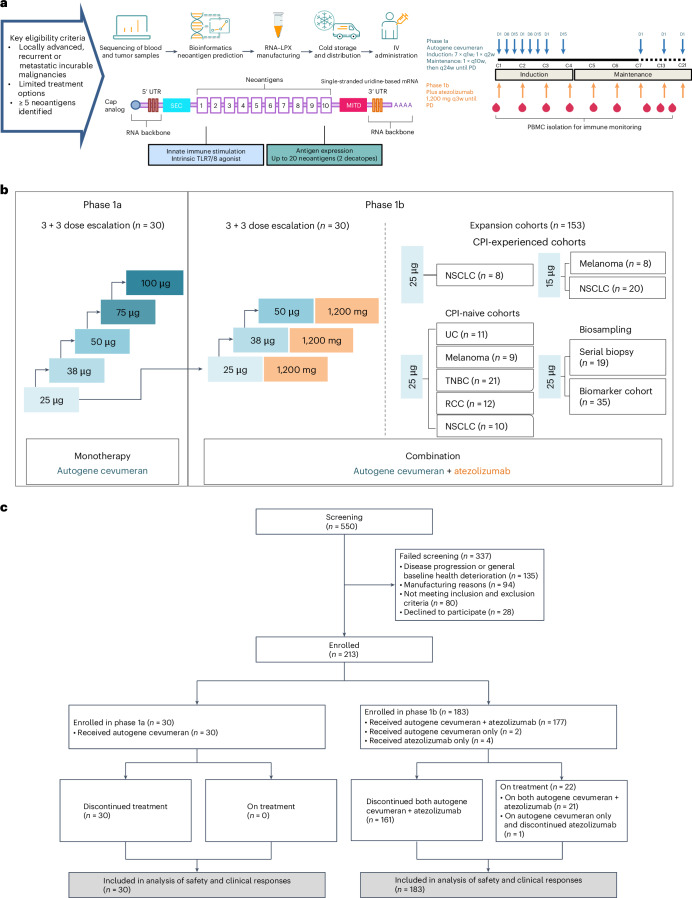
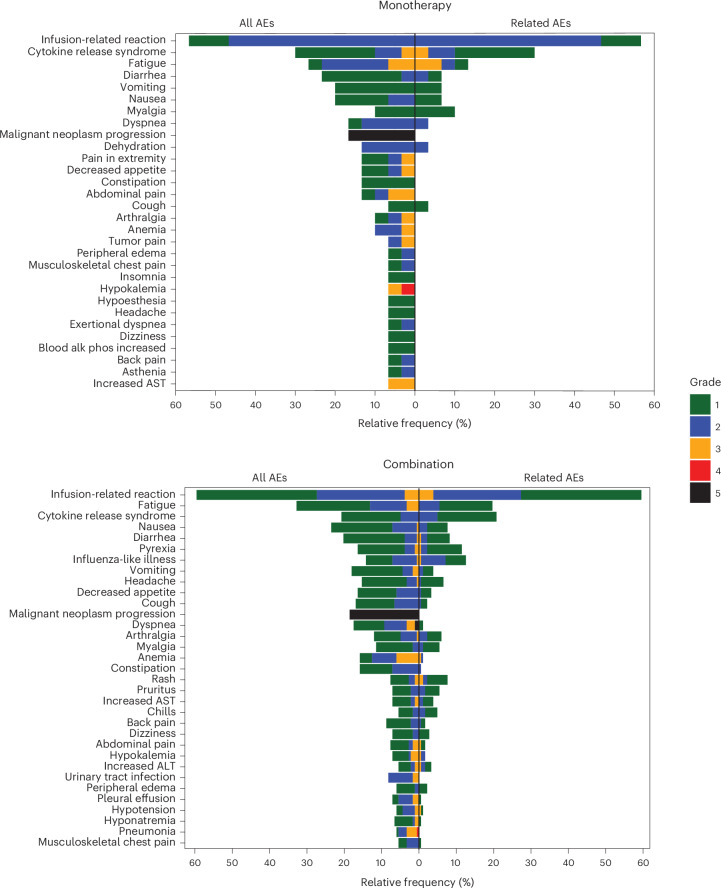
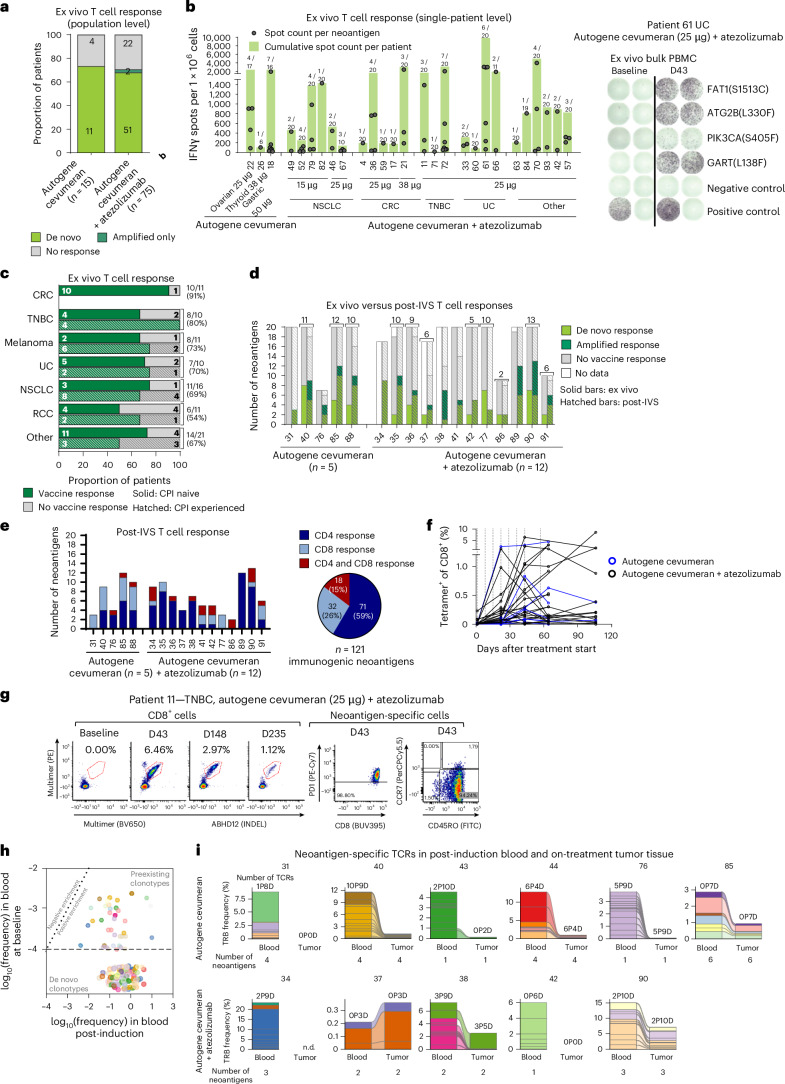
Effective targeting of somatic cancer mutations to enhance the efficacy of cancer immunotherapy requires an individualized approach. Autogene cevumeran is a uridine messenger RNA lipoplex-based individualized neoantigen-specific immunotherapy designed from tumor-specific somatic mutation data obtained from tumor tissue of each individual patient to stimulate T cell responses against up to 20 neoantigens. This ongoing phase 1 study evaluated autogene cevumeran as monotherapy (n = 30) and in combination with atezolizumab (n = 183) in pretreated patients with advanced solid tumors. The primary objective was safety and tolerability; exploratory objectives included evaluation of pharmacokinetics, pharmacodynamics, preliminary antitumor activity and immunogenicity. Non-prespecified interim analysis showed that autogene cevumeran was well tolerated and elicited poly-epitopic neoantigen-specific responses, encompassing CD4 and/or CD8 T cells, in 71% of patients, most of them undetectable at baseline. Responses were detectable up to 23 months after treatment initiation. CD8 T cells specific for several neoantigens constituted a median of 7.3% of circulating CD8 T cells, reaching up to 23% in some patients. Autogene cevumeran-induced T cells were found within tumor lesions constituting up to 7.2% of tumor-infiltrating T cells. Clinical activity was observed, including one objective response in monotherapy dose escalation and in two patients with disease characteristics unfavorable for response to immunotherapy treated in combination with atezolizumab. These findings support the continued development of autogene cevumeran in earlier treatment lines. ClinicalTrials.gov registration: NCT03289962 .
有效靶向体细胞癌突变以提高癌症免疫治疗的疗效需要个体化方法。Autogene cevumeran是一种基于尿苷信使核糖核酸脂质复合物的个体化新抗原特异性免疫疗法,它根据从每位患者肿瘤组织获得的肿瘤特异性体细胞突变数据设计,以刺激针对多达20种新抗原的T细胞反应。这项正在进行的1期研究评估了Autogene cevumeran作为单药疗法(n = 30)以及与阿替利珠单抗联合使用(n = 183)在先前接受过治疗的晚期实体瘤患者中的效果。主要目标是安全性和耐受性;探索性目标包括评估药代动力学、药效学、初步抗肿瘤活性和免疫原性。非预先指定的中期分析表明,Autogene cevumeran耐受性良好,并在71%的患者中引发了多表位新抗原特异性反应,包括CD4和/或CD8 T细胞,其中大多数在基线时无法检测到。治疗开始后长达23个月仍可检测到反应。针对几种新抗原的CD8 T细胞中位数占循环CD8 T细胞的7.3%,在一些患者中高达23%。在肿瘤病变中发现了Autogene cevumeran诱导的T细胞,占肿瘤浸润T细胞的比例高达7.2%。观察到了临床活性,包括在单药疗法剂量递增中出现一例客观反应以及在两名疾病特征不利于免疫治疗反应的患者中与阿替利珠单抗联合使用时出现反应。这些发现支持Autogene cevumeran在更早治疗线中的持续研发。ClinicalTrials.gov注册号:NCT03289962 。