Sederman Casey, Yang Chieh-Hsiang, Cortes-Sanchez Emilio, Di Sera Tony, Huang Xiaomeng, Scherer Sandra D, Zhao Ling, Chu Zhengtao, White Eliza R, Atkinson Aaron, Wagstaff Jadon, Varley Katherine E, Lewis Michael T, Qiao Yi, Welm Bryan E, Welm Alana L, Marth Gabor T
Eccles Institute of Human Genetics, University of Utah, Salt Lake City, Utah, USA.
Huntsman Cancer Institute, University of Utah, Salt Lake City, Utah, USA.
bioRxiv. 2024 Dec 16:2024.12.12.628190. doi: 10.1101/2024.12.12.628190.
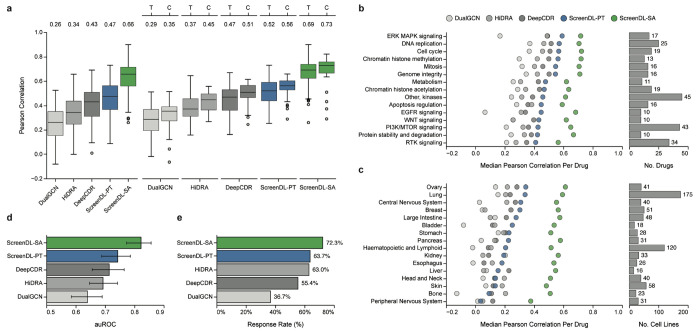
Precision oncology matches tumors to targeted therapies based on the presence of actionable molecular alterations. However, most tumors lack actionable alterations, restricting treatment options to cytotoxic chemotherapies for which few data-driven prioritization strategies currently exist. Here, we report an integrated computational/experimental treatment selection approach applicable for both chemotherapies and targeted agents irrespective of actionable alterations. We generated functional drug response data on a large collection of patient-derived tumor models and used it to train ScreenDL, a novel deep learning-based cancer drug response prediction model. ScreenDL leverages the combination of tumor omic and functional drug screening data to predict the most efficacious treatments. We show that ScreenDL accurately predicts response to drugs with diverse mechanisms, outperforming existing methods and approved biomarkers. In our preclinical study, this approach achieved superior clinical benefit and objective response rates in breast cancer patient-derived xenografts, suggesting that testing ScreenDL in clinical trials may be warranted.
精准肿瘤学根据可操作分子改变的存在情况将肿瘤与靶向治疗相匹配。然而,大多数肿瘤缺乏可操作的改变,这使得治疗选择仅限于细胞毒性化疗,而目前针对细胞毒性化疗几乎没有数据驱动的优先级排序策略。在此,我们报告了一种综合计算/实验性治疗选择方法,该方法适用于化疗药物和靶向药物,无论是否存在可操作的改变。我们在大量患者来源的肿瘤模型上生成了功能性药物反应数据,并利用这些数据训练了ScreenDL,这是一种基于深度学习的新型癌症药物反应预测模型。ScreenDL利用肿瘤组学和功能性药物筛选数据的组合来预测最有效的治疗方法。我们表明,ScreenDL能够准确预测对具有不同作用机制药物的反应,优于现有方法和已批准的生物标志物。在我们的临床前研究中,这种方法在乳腺癌患者来源的异种移植物中实现了更好的临床获益和客观缓解率,这表明在临床试验中测试ScreenDL可能是有必要的。