Zhou Qiaochu, Wang Wei, Wang Jinhui, Li Changchang, Ji Jianle
Wenzhou Hospital of Integrated Traditional Chinese and Western Medicine, Wenzhou, China.
Front Nutr. 2024 Dec 23;11:1461818. doi: 10.3389/fnut.2024.1461818. eCollection 2024.
Melanoma is the fourth leading cause of cancer-related death worldwide. The continuous exploration and reporting of risk factors of melanoma is important for standardizing and reducing the incidence of the disease. Calcium signaling is a promising therapeutic target for melanoma; however, the relationship between total serum calcium levels and melanoma development remains unclear.
In this study, we included patients with melanoma from the National Health and Nutrition Examination Survey (NHANES) database from 2003 to 2006 and from 2009 to 2016. The baseline clinical characteristics of the participants were analyzed using the chi-square and rank-sum tests. Subsequently, a fitted model was constructed to evaluate the relationship between total serum calcium levels and melanoma development. The performance of total serum calcium levels and covariates in predicting the risk of melanoma was assessed based on ROC curves. Finally, LASSO regression analysis was performed using the "glmnet" R package to identify clinical characteristics associated with melanoma.
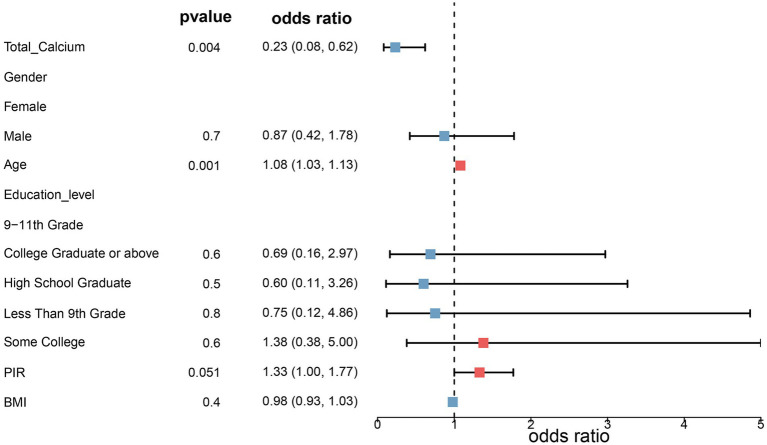
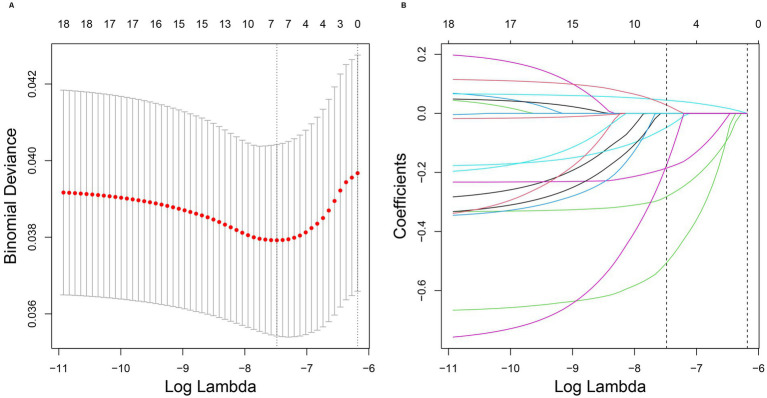
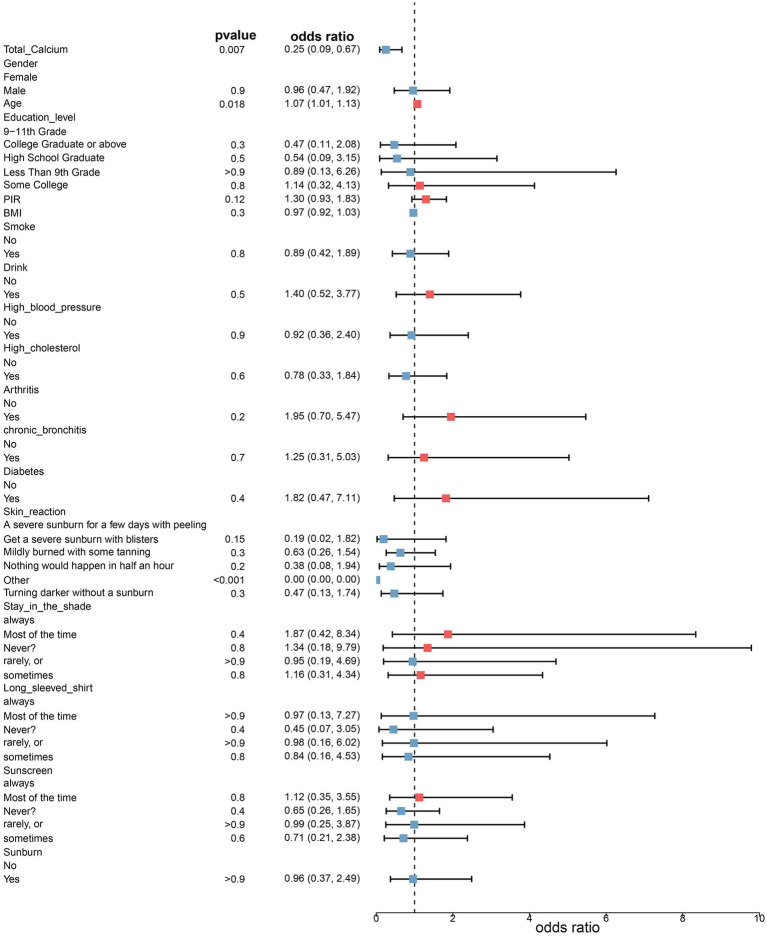
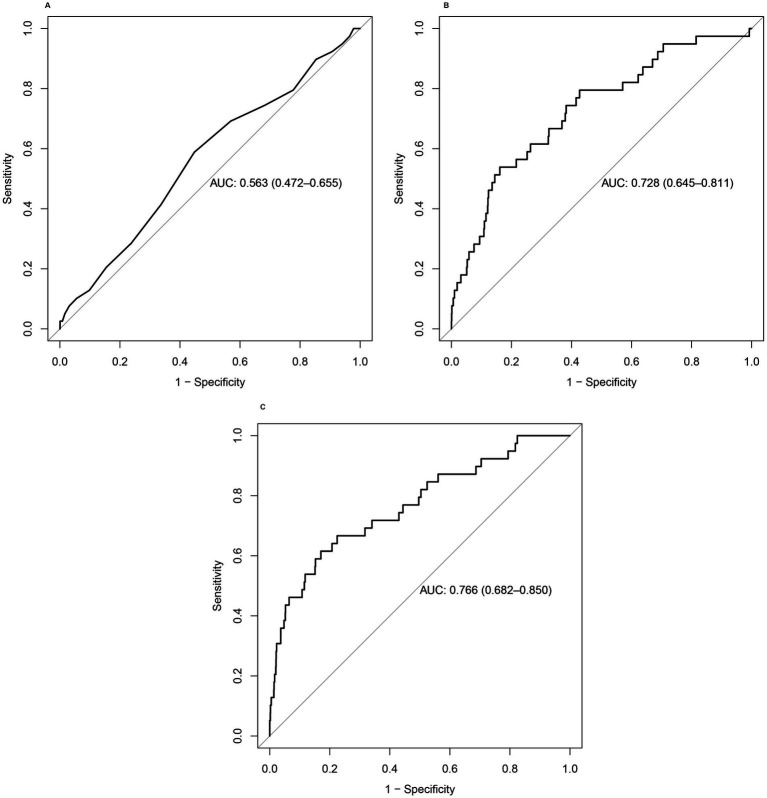
A total of 13,432 participants were included in this study. Age, race, household poverty-to-income ratio, response of the skin to sunlight after a certain period of non-exposure, wearing long-sleeved shirts, frequency of sunscreen use, and arthritis were significantly correlated with the development of melanoma. The -values of total serum calcium levels in three fitted models were < 0.05, and the OR values were < 1. According to the ROC curves, the AUC values of models 2 and 3 were 0.728 and 0.766, respectively, indicating that the combination of total serum calcium levels and covariates showed better performance in predicting the occurrence of melanoma. Furthermore, LASSO regression analysis revealed seven clinical characteristics significantly associated with melanoma.
This study revealed a relationship between total serum calcium levels and melanoma development. Total serum calcium levels combined with phenotypic and clinical characteristics were found to be more effective in predicting the occurrence of melanoma. Therefore, the relationship between total serum calcium levels and melanoma development warrants further investigation in prospective cohort studies.
黑色素瘤是全球癌症相关死亡的第四大主要原因。持续探索和报告黑色素瘤的风险因素对于规范和降低该疾病的发病率至关重要。钙信号传导是黑色素瘤一个有前景的治疗靶点;然而,血清总钙水平与黑色素瘤发生发展之间的关系仍不清楚。
在本研究中,我们纳入了来自2003年至2006年以及2009年至2016年美国国家健康与营养检查调查(NHANES)数据库中的黑色素瘤患者。使用卡方检验和秩和检验分析参与者的基线临床特征。随后,构建一个拟合模型来评估血清总钙水平与黑色素瘤发生发展之间的关系。基于ROC曲线评估血清总钙水平和协变量在预测黑色素瘤风险方面的表现。最后,使用“glmnet”R包进行LASSO回归分析,以确定与黑色素瘤相关的临床特征。
本研究共纳入13432名参与者。年龄、种族、家庭贫困与收入比、皮肤在一段时间未暴露后对阳光的反应、穿长袖衬衫、使用防晒霜的频率以及关节炎与黑色素瘤的发生发展显著相关。三个拟合模型中血清总钙水平的P值均<0.05,OR值均<1。根据ROC曲线,模型2和模型3的AUC值分别为0.728和0.766,表明血清总钙水平与协变量的组合在预测黑色素瘤发生方面表现更好。此外,LASSO回归分析揭示了七个与黑色素瘤显著相关的临床特征。
本研究揭示了血清总钙水平与黑色素瘤发生发展之间的关系。发现血清总钙水平与表型和临床特征相结合在预测黑色素瘤发生方面更有效。因此,血清总钙水平与黑色素瘤发生发展之间的关系值得在前瞻性队列研究中进一步探究。