Milošević Ivana, Beronja Branko, Filipović Ana, Mitrović Nikola, Simić Jelena, Knežević Nataša, Ranin Jovana, Todorović Nevena, Stevanović Olja, Radovanović-Spurnić Aleksandra, Katanić Nataša, Hristović Dejan, Nikolić Nataša
Clinic for Infectious and Tropical Diseases, University Clinical Center of Serbia, Bulevar Oslobođenja 16, 11000 Belgrade, Serbia.
Faculty of Medicine, University of Belgrade, Dr Subotica 8, 11000 Belgrade, Serbia.
Microorganisms. 2024 Dec 11;12(12):2554. doi: 10.3390/microorganisms12122554.
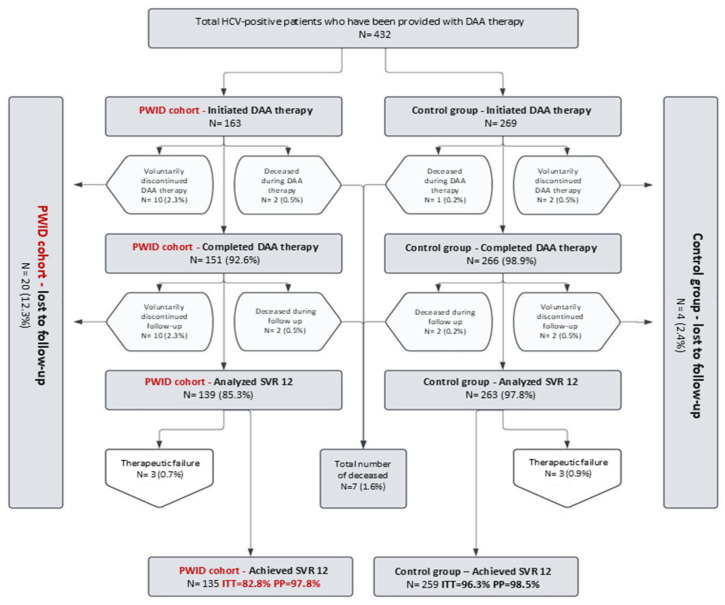
People who inject drugs (PWIDs) experience high rates of hepatitis C virus (HCV) infection, primarily due to needle sharing and limited healthcare access, resulting in a disproportionate disease burden within this population. This prospective study evaluated treatment outcomes in 432 adult patients with chronic hepatitis C (CHC) treated with direct-acting antivirals (DAAs) at the University Clinical Center of Serbia. Patients were categorized into two groups based on a history of drug addiction: PWIDs (163, 37.7%) and non-PWIDs (269, 62.3%). The PWID group was further categorized into subpopulations of problematic PWIDs (39, 23.9%), ex-PWIDs (124, 76.1%), and PWIDs on OST (96, 58.9%). The PWID group demonstrated significantly lower treatment adherence, with an intention-to-treat (ITT) rate of 82.8%, compared to 96.3% in the control group ( < 0.001). In contrast, no significant differences were observed in per-protocol (PP) outcomes between the two groups. Additionally, PWIDs were significantly younger ( < 0.001) and had higher rates of psychiatric disorders ( < 0.001), alcohol abuse ( < 0.001), and HCV genotype 1a ( < 0.001). Advanced fibrosis was predictor of PP treatment failure among PWIDs, while mood disorders and alcohol use disorder were associated with interruptions before the scheduled completion time. For non-PWIDs, older age and advanced fibrosis emerged as key predictors of PP treatment failure. The loss to follow-up was most commonly observed in the problematic PWID subgroup ( = 0.001). These findings highlight the importance of addressing barriers in PWIDs through integrated care strategies that concurrently manage addiction and HCV.
注射毒品者(PWIDs)丙型肝炎病毒(HCV)感染率很高,主要原因是共用针头和医疗保健机会有限,导致该人群疾病负担过重。这项前瞻性研究评估了塞尔维亚大学临床中心432例接受直接抗病毒药物(DAAs)治疗的成年慢性丙型肝炎(CHC)患者的治疗结果。根据药物成瘾史,患者分为两组:注射毒品者(163例,37.7%)和非注射毒品者(269例,62.3%)。注射毒品者组进一步分为问题注射毒品者亚群(39例,23.9%)、既往注射毒品者亚群(124例,76.1%)和接受阿片类药物替代治疗的注射毒品者亚群(96例,58.9%)。注射毒品者组的治疗依从性显著较低,意向性治疗(ITT)率为82.8%,而对照组为96.3%(P<0.001)。相比之下,两组之间的符合方案(PP)结果没有显著差异。此外,注射毒品者明显更年轻(P<0.001),精神疾病发病率更高(P<0.001)、酒精滥用率更高(P<0.001)以及HCV基因1a型感染率更高(P<0.001)。在注射毒品者中,肝纤维化进展是PP治疗失败的预测因素,而情绪障碍和酒精使用障碍与在预定完成时间之前中断治疗有关。对于非注射毒品者,年龄较大和肝纤维化进展是PP治疗失败的关键预测因素。失访最常见于问题注射毒品者亚组(P = 0.001)。这些发现强调了通过综合护理策略解决注射毒品者障碍的重要性,这些策略同时管理成瘾和HCV。