Han Minjee, Woo Kyungsook, Kim Kirang
Department of Food Science and Nutrition, Dankook University, Cheonan 31116, Republic of Korea.
Institute of Health and Society, Hanyang University, Seoul 04763, Republic of Korea.
Nutrients. 2024 Dec 17;16(24):4350. doi: 10.3390/nu16244350.
Due to variations in the standards for optimal protein intake and conflicting results across studies for Korean older adults, this study aimed to quantitatively integrate existing research on the association of protein intake with sarcopenia and related indicators in Koreans aged 65 and older through meta-analysis.
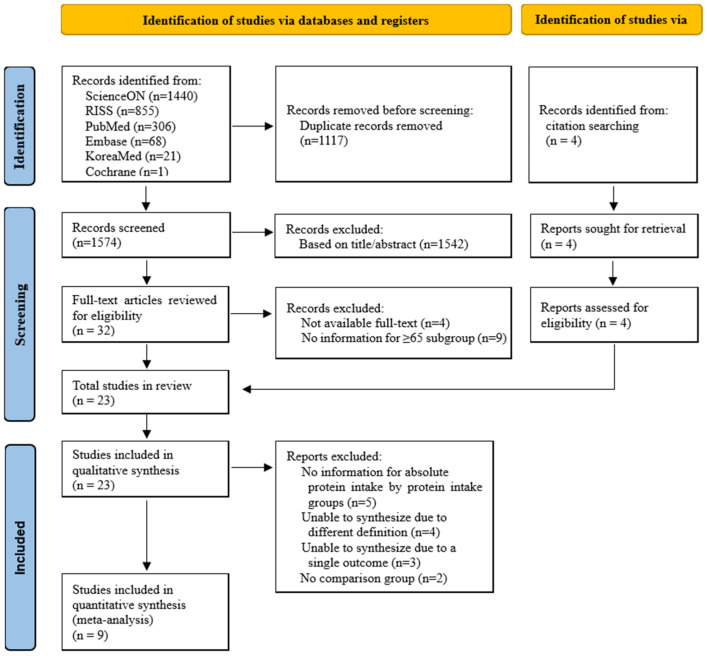
A total of 23 studies were selected according to the study selection criteria (PICOS). Sixteen cross-sectional studies, 5 randomized controlled trials (RCTs), and 2 non-RCTs were included in the review, with 9 out of 23 studies included in the meta-analysis. We used fixed-effects models and performed subgroup and sensitivity analyses.
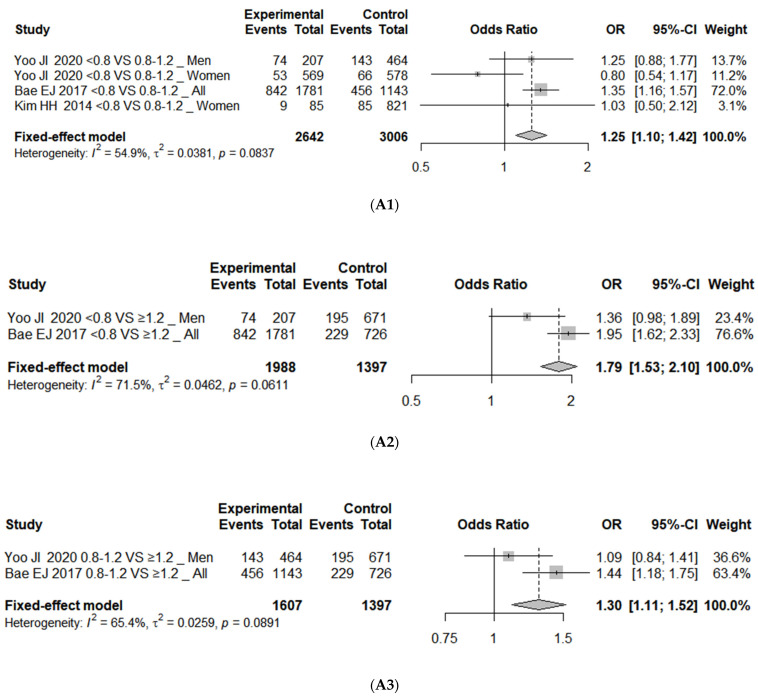
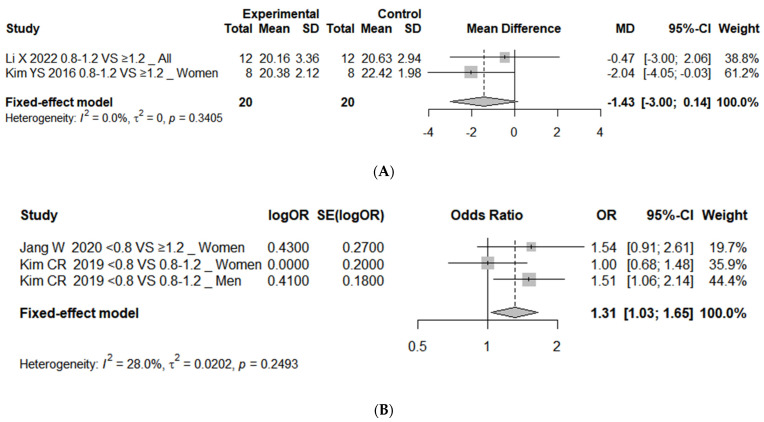
A meta-analysis found that the risk of sarcopenia was significantly higher in the <0.8 g/kg/day protein intake group compared to the 0.8-1.2 g/kg/day and ≥1.2 g/kg/day groups, with odds ratios (ORs) of 1.25 (95% confidence interval (CI), 1.10 to 1.42; = 55%) and 1.79 (95% CI, 1.53 to 2.10; = 71%), respectively. For low hand grip strength (HGS), the risk was higher in the <0.8 g/kg/day group compared to the 0.8-1.2 g/kg/day or ≥1.2 g/kg/day groups (OR 1.31; 95% CI, 1.03 to 1.65; = 28%). No significant associations were found with other sarcopenia indicators, such as skeletal muscle mass, short physical performance battery score, balance test, gait speed, and timed up-and-go test.
Lower protein intake is associated with a higher risk of sarcopenia and low HGS in Korean older adults. To establish protein intake recommendations for the prevention and management of sarcopenia in this population, further well-designed RCTs incorporating both protein supplementation and resistance training are necessary.
由于韩国老年人最佳蛋白质摄入量标准存在差异,且各项研究结果相互矛盾,本研究旨在通过荟萃分析,对65岁及以上韩国人蛋白质摄入量与肌肉减少症及相关指标之间关联的现有研究进行定量整合。
根据研究选择标准(PICOS)共筛选出23项研究。纳入综述的有16项横断面研究、5项随机对照试验(RCT)和2项非随机对照试验,23项研究中有9项纳入荟萃分析。我们使用固定效应模型并进行亚组分析和敏感性分析。
荟萃分析发现,蛋白质摄入量<0.8 g/kg/天组的肌肉减少症风险显著高于0.8 - 1.2 g/kg/天组和≥1.2 g/kg/天组,优势比(OR)分别为1.25(95%置信区间(CI),1.10至1.42;P = 55%)和1.79(95% CI,1.53至2.10;P = 71%)。对于低握力(HGS),<0.8 g/kg/天组的风险高于0.8 - 1.2 g/kg/天组或≥1.2 g/kg/天组(OR 1.31;95% CI,1.03至1.65;P = 28%)。未发现与其他肌肉减少症指标有显著关联,如骨骼肌质量、简短体能测试得分、平衡测试、步速和定时起立行走测试。
蛋白质摄入量较低与韩国老年人肌肉减少症风险较高和握力较低有关。为制定该人群预防和管理肌肉减少症的蛋白质摄入量建议,有必要进一步开展设计良好的同时纳入蛋白质补充和抗阻训练的随机对照试验。