
复杂肝脏手术规划中测量受限注意力:可行性研究。
Measuring Bound Attention During Complex Liver Surgery Planning: Feasibility Study.
作者信息
Schneider Tim, Cetin Timur, Uppenkamp Stefan, Weyhe Dirk, Muender Thomas, Reinschluessel Anke V, Salzmann Daniela, Uslar Verena
机构信息
University Hospital for Visceral Surgery, PIUS-Hospital, Department for Human Medicine, Faculty VI, University of Oldenburg, Oldenburg, Germany.
Department of Medical Physics and Acoustics, Faculty VI, University of Oldenburg, Oldenburg, Germany.
出版信息
JMIR Form Res. 2025 Jan 8;9:e62740. doi: 10.2196/62740.
BACKGROUND
The integration of advanced technologies such as augmented reality (AR) and virtual reality (VR) into surgical procedures has garnered significant attention. However, the introduction of these innovations requires thorough evaluation in the context of human-machine interaction. Despite their potential benefits, new technologies can complicate surgical tasks and increase the cognitive load on surgeons, potentially offsetting their intended advantages. It is crucial to evaluate these technologies not only for their functional improvements but also for their impact on the surgeon's workload in clinical settings. A surgical team today must increasingly navigate advanced technologies such as AR and VR, aiming to reduce surgical trauma and enhance patient safety. However, each innovation needs to be evaluated in terms of human-machine interaction. Even if an innovation appears to bring advancements to the field it is applied in, it may complicate the work and increase the surgeon's workload rather than benefiting the surgeon.
OBJECTIVE
This study aims to establish a method for objectively determining the additional workload generated using AR or VR glasses in a clinical context for the first time.
METHODS
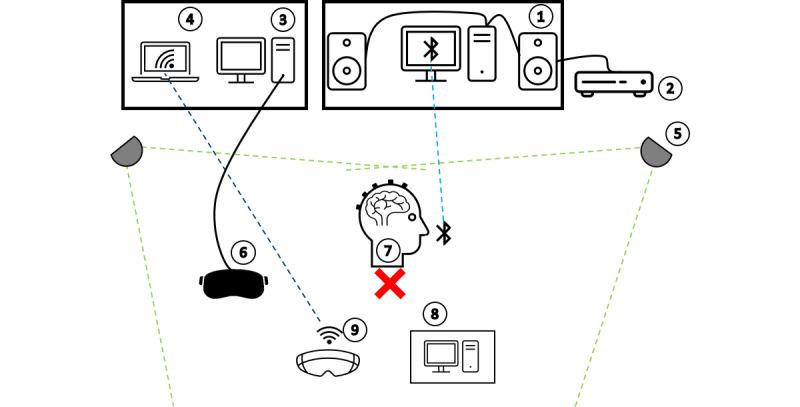
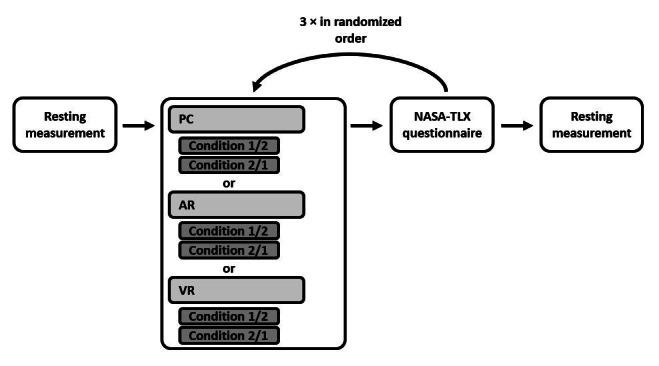
Electroencephalography (EEG) signals were recorded using a passive auditory oddball paradigm while 9 participants performed surgical planning for liver resection across 3 different conditions: (1) using AR glasses, (2) VR glasses, and (3) the conventional planning software on a computer.
RESULTS
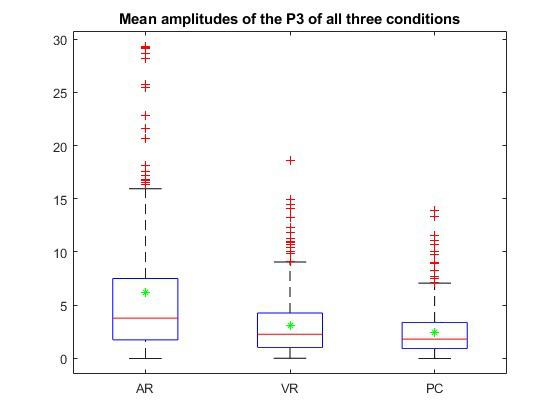
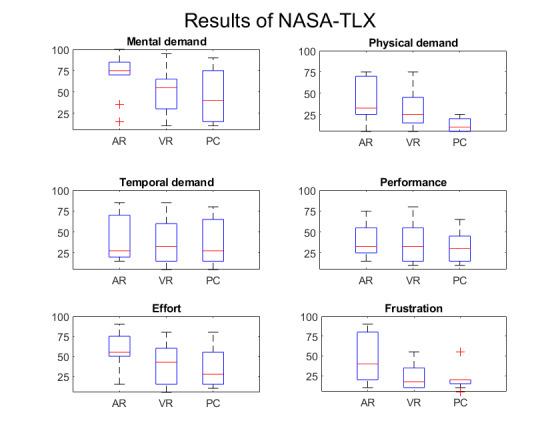
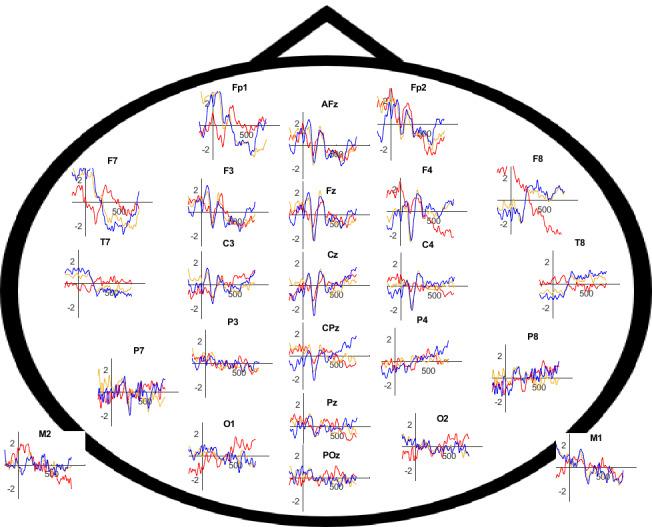
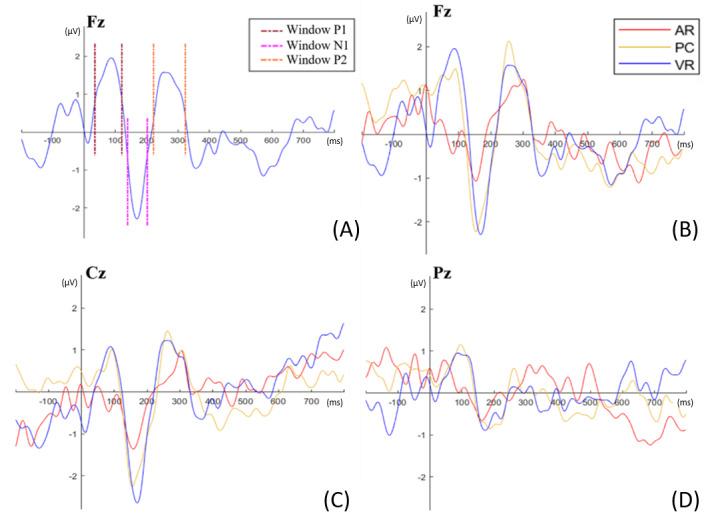
The electrophysiological results, that is, the potentials evoked by the auditory stimulus, were compared with the subjectively perceived stress of the participants, as determined by the National Aeronautics and Space Administration-Task Load Index (NASA-TLX) questionnaire. The AR condition had the highest scores for mental demand (median 75, IQR 70-85), effort (median 55, IQR 30-65), and frustration (median 40, IQR 15-75) compared with the VR and PC conditions. The analysis of the EEG revealed a trend toward a lower amplitude of the N1 component as well as for the P3 component at the central electrodes in the AR condition, suggesting a higher workload for participants when using AR glasses. In addition, EEG components in the VR condition did not reveal any noticeable differences compared with the EEG components in the conventional planning condition. For the P1 component, the VR condition elicited significantly earlier latencies at the Fz electrode (mean 75.3 ms, SD 25.8 ms) compared with the PC condition (mean 99.4 ms, SD 28.6 ms).
CONCLUSIONS
The results suggest a lower stress level when using VR glasses compared with AR glasses, likely due to the 3D visualization of the liver model. Additionally, the alignment between subjectively determined results and objectively determined results confirms the validity of the study design applied in this research.
背景
将增强现实(AR)和虚拟现实(VR)等先进技术融入外科手术已引起广泛关注。然而,这些创新技术的引入需要在人机交互的背景下进行全面评估。尽管它们具有潜在的益处,但新技术可能会使手术任务复杂化,并增加外科医生的认知负荷,从而可能抵消其预期优势。不仅要评估这些技术的功能改进,还要评估其对临床环境中外科医生工作量的影响,这一点至关重要。如今的手术团队必须越来越多地应对AR和VR等先进技术,旨在减少手术创伤并提高患者安全性。然而,每项创新都需要从人机交互的角度进行评估。即使一项创新似乎为其应用领域带来了进步,但它可能会使工作复杂化并增加外科医生的工作量,而不是让外科医生受益。
目的
本研究旨在首次建立一种客观确定在临床环境中使用AR或VR眼镜所产生的额外工作量的方法。
方法
使用被动听觉奇偶数范式记录脑电图(EEG)信号,9名参与者在3种不同条件下进行肝切除手术规划:(1)使用AR眼镜,(2)使用VR眼镜,(3)在计算机上使用传统规划软件。
结果
将电生理结果,即听觉刺激诱发的电位,与参与者主观感受到的压力进行比较,主观压力由美国国家航空航天局任务负荷指数(NASA - TLX)问卷确定。与VR和PC条件相比,AR条件在心理需求(中位数75,四分位间距70 - 85)、努力程度(中位数55,四分位间距30 - 65)和挫败感(中位数40,四分位间距15 - 75)方面得分最高。对EEG的分析显示,在AR条件下,中央电极处N1成分以及P3成分的振幅有降低趋势,这表明参与者使用AR眼镜时工作量更大。此外,与传统规划条件下的EEG成分相比,VR条件下的EEG成分没有显示出任何明显差异。对于P1成分,与PC条件(平均99.4毫秒,标准差28.6毫秒)相比,VR条件在Fz电极处诱发的潜伏期明显更早(平均75.3毫秒,标准差25.8毫秒)。
结论
结果表明,与AR眼镜相比,使用VR眼镜时压力水平较低,这可能是由于肝脏模型的3D可视化。此外,主观确定结果与客观确定结果之间的一致性证实了本研究中应用的研究设计的有效性。
 Zotero 插件