Park Jong Wan, Ko Chang Woo, Lee Diane Youngmi, Kim Jae Chul
Department of Counseling, Graduate School of Hannam University, 70 Hannam-ro, Daedeok- gu, Daejeon, 34430, South Korea.
Department of Biomedical Science, Seoul National University College of Medicine, 103 Daehak-ro, Jongno-gu, Seoul, 03080, South Korea.
Sci Rep. 2025 Jan 7;15(1):1196. doi: 10.1038/s41598-025-85157-1.
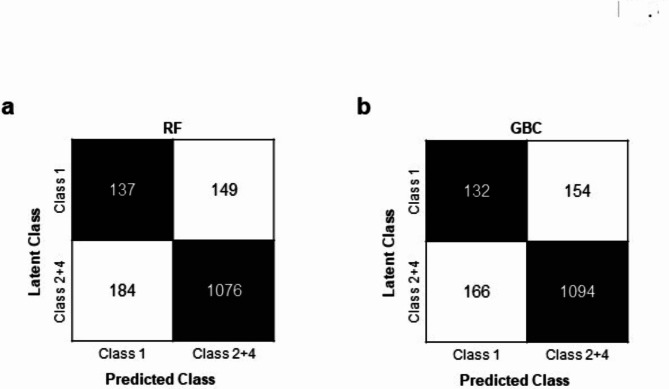
Late-onset depression (LOD) refers to depression that newly appears in elderly individuals without prior depression episodes. Predicting future depression is crucial for mitigating the risk of major depression in prospective patients. This study aims to develop machine learning models to predict future depression. Using public data from the nationwide panel survey 'Korean Longitudinal Study of Aging,' we employed latent growth modeling and growth mixture modeling to identify four latent classes of depression trajectories in the elderly Korean population. Based on the results of binary logistic regression, we selected 12 variables capable of distinguishing the LOD population from the reference population and tested 12 machine learning (ML) algorithms. While most ML algorithms showed acceptable predictive capability, Random Forest Classifier and Gradient Boosting Classifier demonstrated superior performance. Consequently, we successfully established new ML-based LOD prediction programs. These programs could be further developed into self-checking online tools, expected to serve as decision support systems for primary medical care and health screening services.
迟发性抑郁症(LOD)是指在没有既往抑郁发作史的老年人中新出现的抑郁症。预测未来的抑郁症对于降低潜在患者发生重度抑郁症的风险至关重要。本研究旨在开发机器学习模型来预测未来的抑郁症。利用全国性面板调查“韩国老年纵向研究”的公开数据,我们采用潜在增长模型和增长混合模型,在韩国老年人群中识别出四类潜在的抑郁轨迹。基于二元逻辑回归的结果,我们选择了12个能够区分迟发性抑郁症人群和参照人群的变量,并测试了12种机器学习(ML)算法。虽然大多数ML算法显示出可接受的预测能力,但随机森林分类器和梯度提升分类器表现出卓越的性能。因此,我们成功建立了基于机器学习的新型迟发性抑郁症预测程序。这些程序可以进一步开发成自我检查的在线工具,有望作为初级医疗保健和健康筛查服务的决策支持系统。