Fashedemi O, Ozoemena Okoroike C, Peteni Siwaphiwe, Haruna Aderemi B, Shai Leshweni J, Chen Aicheng, Rawson Frankie, Cruickshank Maggie E, Grant David, Ola Oluwafunmilola, Ozoemena Kenneth I
Advanced Materials Group, Faculty of Engineering, The University of Nottingham, Nottingham NG7 2RD, UK.
Department of Chemistry, University of Guelph, Ontario, Canada.
Anal Methods. 2025 Feb 13;17(7):1428-1450. doi: 10.1039/d4ay01921k.
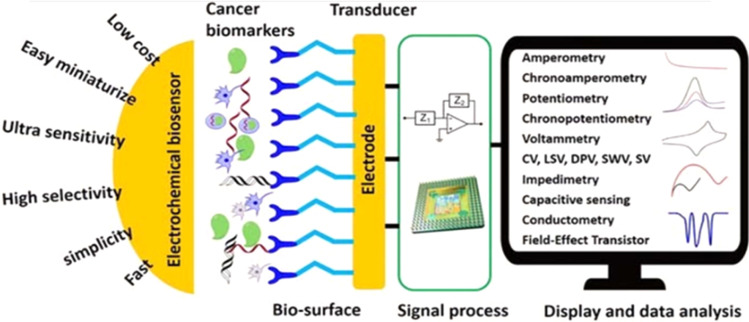
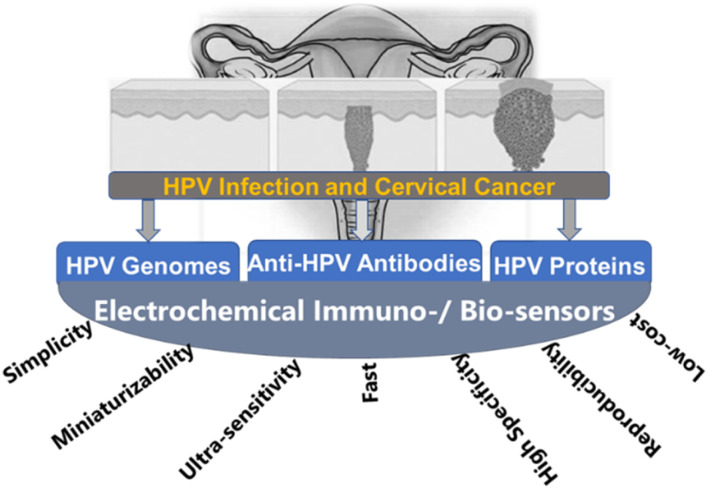
Human papillomavirus (HPV) infection is the main cause of cervical cancer and other cancers such as anogenital and oropharyngeal cancers. The prevention screening and treatment of cervical cancer has remained one of the top priorities of the World Health Organization (WHO). In 2020, the WHO came up with the 90-70-90 strategy aimed at eliminating cervical cancers as a public health problem by the year 2030. One of the key priorities of this strategy is the recommendation for countries to ensure that 70% of their women are screened using a high-performance test by the age of 35, and again by the age of 45. Over the years, several traditional methods (notably, Pap smear and nucleic acid-based techniques) have been used for the detection of cervical cancer. While these methods have significantly reduced the incidence of cervical cancer and death, they still come short of excellence for the total eradication of HPV infection. The challenges include low sensitivity, low specificity, poor reproducibility, the need for high-level specialists, and the high cost of access to the facilities, to mention a few. Interestingly, however, several efforts are being made today to mitigate these challenges. In this review, we discussed the pros and cons of the traditional screening and testing of HPV infections, the efforts being made to improve their performances, and the emergent tools (especially, the electrochemical methods) that promise to revolutionize the screening and testing of HPV infections. The main aim of the review is to provide some novel clues to researchers that would allow for the development of high-performance, affordable, and triage-suitable electrochemical-based diagnostic tools for HPV and cervical cancer.
人乳头瘤病毒(HPV)感染是宫颈癌以及肛门生殖器癌和口咽癌等其他癌症的主要病因。宫颈癌的预防筛查和治疗一直是世界卫生组织(WHO)的首要任务之一。2020年,WHO提出了90-70-90战略,旨在到2030年将宫颈癌作为一个公共卫生问题消除。该战略的关键优先事项之一是建议各国确保70%的女性在35岁时使用高性能检测方法进行筛查,并在45岁时再次进行筛查。多年来,几种传统方法(尤其是巴氏涂片和基于核酸的技术)已被用于宫颈癌的检测。虽然这些方法显著降低了宫颈癌的发病率和死亡率,但在完全根除HPV感染方面仍有不足。这些挑战包括灵敏度低、特异性低、重现性差、需要高水平专家以及使用这些设备的成本高昂等等。然而,有趣的是,如今正在做出一些努力来缓解这些挑战。在这篇综述中,我们讨论了传统HPV感染筛查和检测方法的优缺点、为提高其性能所做的努力以及有望彻底改变HPV感染筛查和检测的新兴工具(尤其是电化学方法)。这篇综述的主要目的是为研究人员提供一些新线索,以便开发出用于HPV和宫颈癌检测的高性能、经济实惠且适合分流的基于电化学的诊断工具。