Department of Anatomy and Embryology, Leiden University Medical Center, Leiden, the Netherlands.
Electron Microscopy Facility, Netherlands Cancer Institute, Amsterdam, the Netherlands.
Stem Cell Reports. 2022 Jun 14;17(6):1279-1288. doi: 10.1016/j.stemcr.2022.04.008. Epub 2022 May 12.
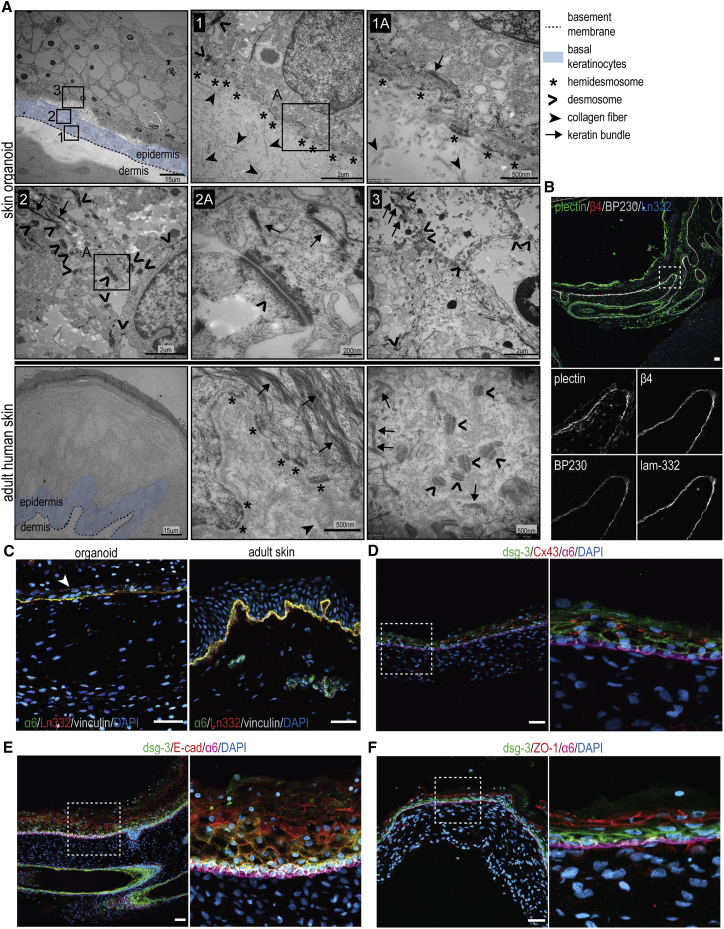
Human induced pluripotent stem cell (hiPSC)-derived hair-bearing skin organoids offer exciting new possibilities for modeling diseases like epidermolysis bullosa (EB). These inherited diseases affect 1 in 30,000 people worldwide and result from perturbed expression and/or structure of components of the epidermal-dermal junction (EDJ). To establish whether hiPSC-derived skin organoids might be able to capture salient features of EB, it is thus important to characterize their EDJ. Here, we report successful generation of hair-bearing skin organoids from two hiPSC lines that exhibited fully stratified interfollicular epidermis. Using immunofluorescence and electron microscopy, we showed that basal keratinocytes in organoids adhere to laminin-332 and type IV collagen-rich basement membrane via type I hemidesmosomes and integrin β1-based adhesion complexes. Importantly, we demonstrated that EDJs in organoids are almost devoid of type VII collagen, a fibril that mediates anchorage of the epidermis to dermis. This should be considered when using skin organoids for EB modeling.
人诱导多能干细胞(hiPSC)衍生的有毛皮肤类器官为模拟大疱性表皮松解症(EB)等疾病提供了令人兴奋的新可能性。这些遗传性疾病影响全球每 30000 人中的 1 人,是由于表皮-真皮连接(EDJ)成分的表达和/或结构受到干扰而导致的。为了确定 hiPSC 衍生的皮肤类器官是否能够捕获 EB 的显著特征,因此重要的是要对其 EDJ 进行特征描述。在这里,我们报告了从两条 hiPSC 系成功生成有毛皮肤类器官,这些类器官表现出完全分层的毛囊间表皮。使用免疫荧光和电子显微镜,我们表明类器官中的基底角质形成细胞通过 I 型半桥粒和整合素 β1 为基础的黏附复合物黏附至层粘连蛋白-332 和富含 IV 型胶原的基底膜。重要的是,我们证明了类器官中的 EDJ 几乎不含 VII 型胶原,VII 型胶原是一种纤维,介导表皮与真皮的锚定。在使用皮肤类器官进行 EB 建模时应考虑到这一点。