Ripoll Lucas, Iserte Javier, Cerrudo Carolina Susana, Presti Damian, Serrat José Humberto, Poma Ramiro, Mangione Federico Alejandro Javier, Micheloud Gabriela Analía, Gioria Verónica Viviana, Berrón Clara Inés, Zago M Paola, Borio Cristina, Bilen Marcos
Laboratorio de Ingeniería Genética y Biología Celular y Molecular-Área de virus de insectos, Departamento de Ciencia y Tecnología, Universidad Nacional de Quilmes, Quilmes, Buenos Aires, Argentina.
Laboratorio de Bioinformática Estructural, Fundación Instituto Leloir, Ciudad de Buenos Aires, Buenos Aires, Argentina.
PLoS Negl Trop Dis. 2025 Jan 10;19(1):e0012792. doi: 10.1371/journal.pntd.0012792. eCollection 2025 Jan.
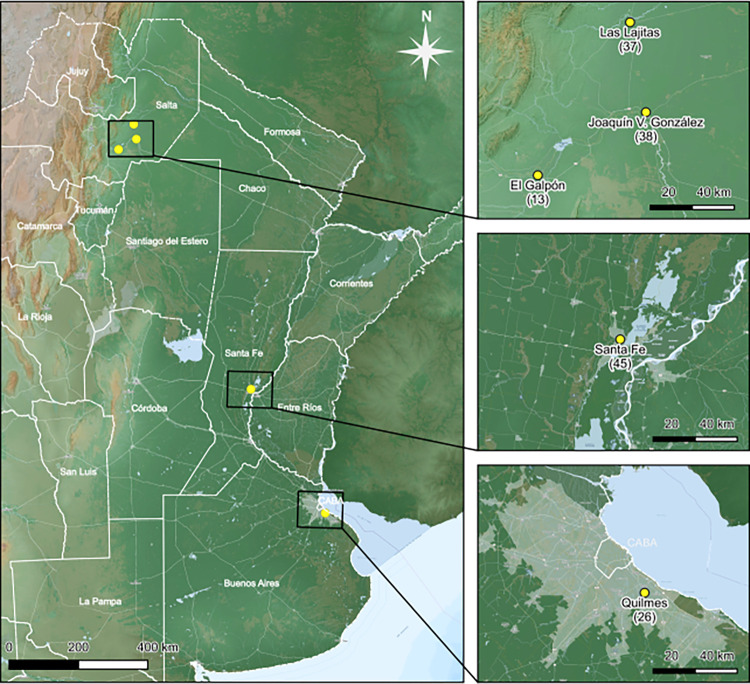
Mosquitoes are the primary vectors of arthropod-borne pathogens. Aedes aegypti is one of the most widespread mosquito species worldwide, responsible for transmitting diseases such as Dengue, Zika, and Chikungunya, among other medically significant viruses. Characterizing the array of viruses circulating in mosquitoes, particularly in Aedes aegypti, is a crucial tool for detecting and developing novel strategies to prevent arbovirus outbreaks. In this study, we address the implementation of a sequencing and analysis pipeline based on the Oxford Nanopore Technologies MinION Mk1b system, for arboviral detection in field-caught mosquitoes from Argentina. Full genome of Humaita Tubiacanga Virus (HTV), Phasi Charoen-like Phasivirus (PCLV), Aedes aegypti totivirus (AaeTV) has been sequenced in three distinct regions of Argentina comprising Buenos Aires province, Santa Fe province and the northern province of Salta. Viral sequences enriched by SISPA and coupled with Nanopore sequencing can be a useful tool for viral surveillance, not only for detecting viruses that have a high impact on human and animal health, but also for detecting insect-specific viruses that could promote the transmission of arboviruses.
蚊子是节肢动物传播病原体的主要媒介。埃及伊蚊是全球分布最广的蚊种之一,负责传播登革热、寨卡病毒和基孔肯雅热等疾病以及其他具有重要医学意义的病毒。确定在蚊子中传播的病毒种类,特别是在埃及伊蚊中传播的病毒种类,是检测和制定预防虫媒病毒爆发新策略的关键工具。在本研究中,我们阐述了基于牛津纳米孔技术MinION Mk1b系统的测序和分析流程在检测阿根廷野外捕获蚊子中虫媒病毒的应用。胡马伊塔图比阿坎加病毒(HTV)、帕西乔恩样噬菌体病毒(PCLV)、埃及伊蚊全病毒(AaeTV)的全基因组已在阿根廷的三个不同地区进行了测序,包括布宜诺斯艾利斯省、圣菲省和北部的萨尔塔省。通过序列独立单引物扩增(SISPA)富集并结合纳米孔测序的病毒序列可能是一种有用的病毒监测工具,不仅可用于检测对人类和动物健康有重大影响的病毒,还可用于检测可能促进虫媒病毒传播的昆虫特异性病毒。