Hasni Soumaya, Riguene Hajer, Mendiola Jose A, Ibáñez Elena, Montero Lidia, Domínguez-Rodríguez Gloria, Ghazghazi Hanene, Rigane Ghayth, Salem Ridha Ben
Laboratory of Organic Chemistry LR17ES08, Faculty of Sciences of Sfax, University of Sfax, B.P 1171, Sfax 3038, Tunisia.
Foodomics Laboratory, Bioactivity and Food Analysis Department, Institute of Food Science Research CIAL (CSIC-UAM), Calle Nicolas Cabrera 9, 28049 Madrid, Spain.
Int J Mol Sci. 2024 Dec 26;26(1):94. doi: 10.3390/ijms26010094.
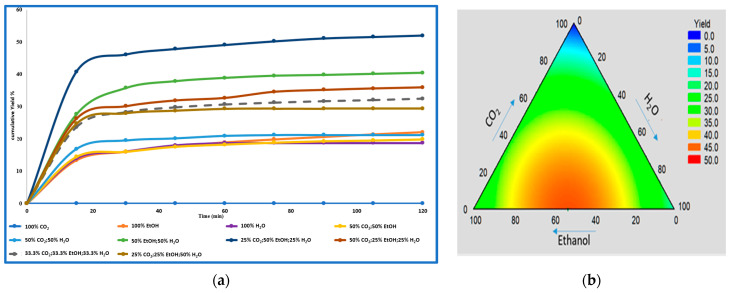
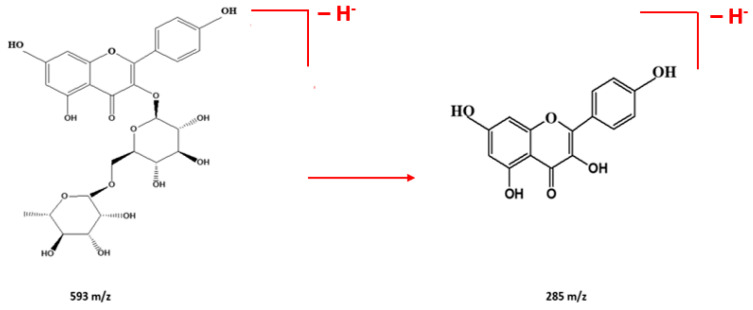
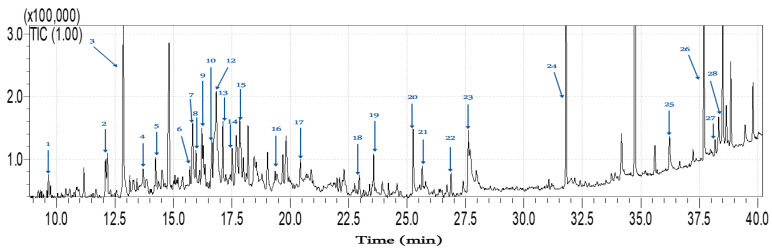
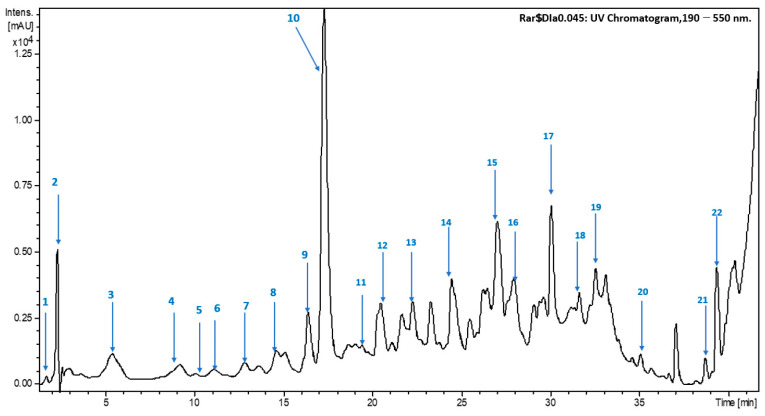
Green chemistry focuses on reducing the environmental impacts of chemicals through sustainable practices. Traditional methods for extracting bioactive compounds from leaves, such as hydro-distillation and organic solvent extraction, have limitations, including long extraction times, high energy consumption, and potential toxic solvent residues. This study explored the use of supercritical fluid extraction (SFE), pressurized liquid extraction (PLE), and gas-expanded liquid (GXL) processes to improve efficiency and selectivity. These techniques were combined in a single mixture design, where CO was used in the experiments carried out under SFE, while water and ethanol were used for the PLE and GXL experiments by varying the concentration of the solvents to cover all the extraction possibilities. The neuroprotective activity of the extracts was evaluated by measuring their antioxidant, anti-inflammatory, and acetylcholinesterase inhibition properties. The optimization resulted in a novel GXL extraction with an optimal ternary mixture of 27% CO, 55% ethanol, and 18% water, with a high degree of desirability (R = 88.59%). Chromatographic analysis carried out by GC-MS and HPLC-ESI-MS/MS identified over 49 metabolites. The designed sustainable extraction process offers a promising approach for producing phenolic-rich plant extracts in industrial applications.
绿色化学致力于通过可持续的方法减少化学品对环境的影响。传统的从树叶中提取生物活性化合物的方法,如水蒸馏法和有机溶剂萃取法,存在局限性,包括提取时间长、能源消耗高以及潜在的有毒溶剂残留。本研究探索了使用超临界流体萃取(SFE)、加压液体萃取(PLE)和气体膨胀液体(GXL)工艺来提高效率和选择性。这些技术被整合到一个单一的混合设计中,在超临界流体萃取实验中使用二氧化碳,而在加压液体萃取和气体膨胀液体实验中使用水和乙醇,并通过改变溶剂浓度来涵盖所有的萃取可能性。通过测量提取物的抗氧化、抗炎和乙酰胆碱酯酶抑制特性来评估其神经保护活性。优化后得到了一种新型的气体膨胀液体萃取方法,其最佳三元混合物为27%的二氧化碳、55%的乙醇和18%的水,可取性程度较高(R = 88.59%)。通过气相色谱 - 质谱联用(GC-MS)和高效液相色谱 - 电喷雾串联质谱(HPLC-ESI-MS/MS)进行的色谱分析鉴定出了49种以上的代谢物。所设计的可持续萃取工艺为工业应用中生产富含酚类的植物提取物提供了一种有前景的方法。