Li Jianye, Wilczyńska Dominika Maria, Lipowska Małgorzata, Łada-Maśko Ariadna Beata, Radtke Bartosz M, Sajewicz-Radtke Urszula, Izydorczyk Bernadetta, Liu Taofeng, Wang Zitong, Lu Junyu, Lipowski Mariusz
Faculty of Physical Education, Gdańsk University of Physical Education and Sport, Górskiego 1, 80-336 Gdańsk, Poland.
Faculty of Social and Humanities, WSB Merito University Gdansk, 80-266 Gdańsk, Poland.
Nutrients. 2024 Dec 26;17(1):41. doi: 10.3390/nu17010041.
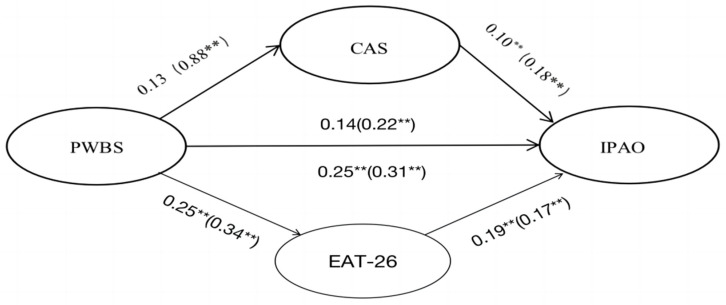
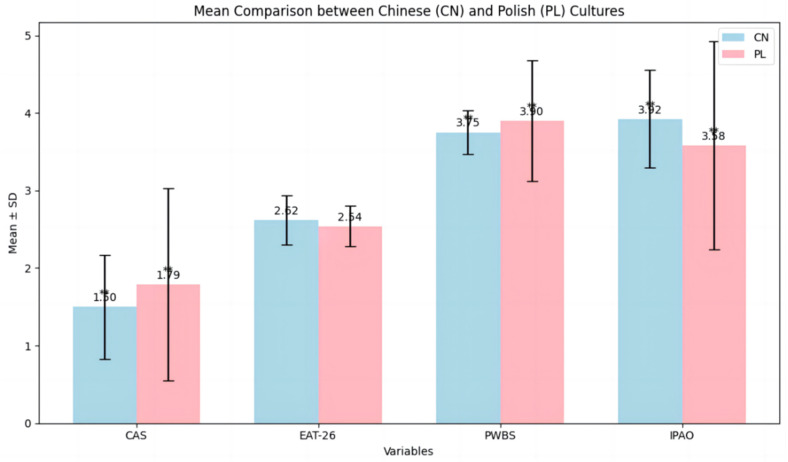
The mechanisms linking eating attitudes to well-being and physical activity objectives have increasingly attracted the attention of researchers in recent years. This research is particularly significant in the context of the COVID-19 pandemic, which has profoundly disrupted eating habits, exercise routines, and psychosocial well-being across the globe. Additionally, these variables are influenced by cultural dimensions, such as individualism in Poland and collectivism in China. These two countries represent distinct approaches to social health and well-being during the pandemic, offering valuable comparative insights into how cultural contexts shape mental and physical health behaviors; Methods: The study included 644 Polish and 690 Chinese participants. It utilized the Psychological Well-Being Scale (PWBS), the Coronavirus Anxiety Scale (CAS), the Eating Attitudes Test (EAT-26), and the Inventory of Physical Activity Objectives (IPAO); Results: The results indicate that both COVID-19 anxiety and eating attitudes fully mediate the relationship between well-being and physical activity objectives. Full mediation implies that the observed relationship between well-being and physical activity objectives operates entirely through the mediators. Notably, the mediating effect of COVID-19 anxiety was observed only in the Chinese sample, highlighting cultural differences in coping mechanisms and societal responses to anxiety. Cultural differences significantly influenced well-being and physical activity objectives, while eating disorders remained unaffected by cultural and social differences. Additionally, a significant positive correlation was found between COVID-19 anxiety, eating attitudes, and health-related physical activity objectives, underscoring the interplay between mental health and physical activity; Conclusions: These findings underscore the importance of addressing anxiety and eating attitudes to enhance well-being and physical activity behaviors. The study provides a strong theoretical basis for targeted interventions tailored to cultural contexts. Potential limitations include the reliance on self-reported data and differences in demographic characteristics between the Polish and Chinese samples, which may affect generalizability.
近年来,将饮食态度与幸福感及体育活动目标联系起来的机制越来越受到研究人员的关注。在新冠疫情背景下,这项研究尤为重要,因为疫情已在全球范围内深刻扰乱了饮食习惯、锻炼习惯以及心理社会幸福感。此外,这些变量还受到文化维度的影响,比如波兰的个人主义和中国的集体主义。这两个国家代表了疫情期间社会健康与幸福感的不同方式,为文化背景如何塑造身心健康行为提供了有价值的比较见解。方法:该研究纳入了644名波兰参与者和690名中国参与者。研究使用了心理幸福感量表(PWBS)、新冠病毒焦虑量表(CAS)、饮食态度测试(EAT - 26)以及体育活动目标量表(IPAO)。结果:结果表明,新冠疫情焦虑和饮食态度均完全中介了幸福感与体育活动目标之间的关系。完全中介意味着幸福感与体育活动目标之间观察到的关系完全通过中介变量起作用。值得注意的是,新冠疫情焦虑的中介作用仅在中国样本中观察到,凸显了应对机制以及社会对焦虑反应方面的文化差异。文化差异显著影响了幸福感和体育活动目标,而饮食失调则不受文化和社会差异的影响。此外,还发现新冠疫情焦虑、饮食态度与健康相关体育活动目标之间存在显著正相关,强调了心理健康与体育活动之间的相互作用。结论:这些发现强调了应对焦虑和饮食态度对于提高幸福感和体育活动行为的重要性。该研究为针对文化背景的定向干预提供了坚实的理论基础。潜在局限性包括依赖自我报告数据以及波兰和中国样本在人口统计学特征上的差异,这可能会影响研究结果的普遍性。