Chen Pin-Jane, Antonelli Marta
Barilla Center for Food & Nutrition Foundation, Via Madre Teresa di Calcutta, 3/a, 43121 Parma, Italy.
Division on Impacts on Agriculture, Forests and Ecosystem Services (IAFES), CMCC Foundation-Euro-Mediterranean Centre on Climate Change, Viale Trieste 127, 01100 Viterbo, Italy.
Foods. 2020 Dec 18;9(12):1898. doi: 10.3390/foods9121898.
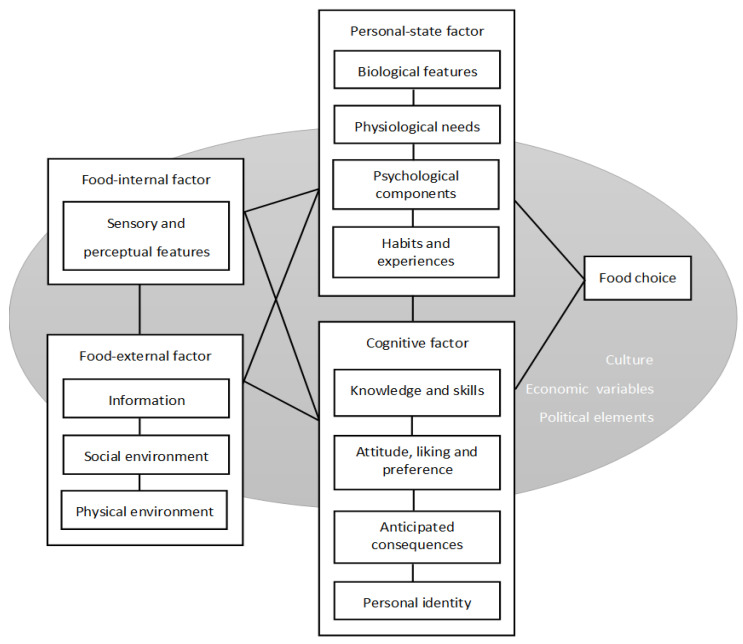
Understanding individual food choices is critical for transforming the current food system to ensure healthiness of people and sustainability of the planet. Throughout the years, researchers from different fields have proposed conceptual models addressing factors influencing the food choice, recognized as a key leverage to improve planetary and human health. However, a multidisciplinary approach is needed to better understand how different factors are involved and interact with each other in the decision-making process. The present paper reviews and analyzes existing models, providing an intact point-of-view by integrating key elements into a bigger framework. Key determinants of general food choice are identified and categorized, including food-internal factor (sensory and perceptual features), food-external factors (information, social environment, physical environment), personal-state factors (biological features and physiological needs, psychological components, habits and experiences), cognitive factors (knowledge and skills, attitude, liking and preference, anticipated consequences, and personal identity), as well as sociocultural factors (culture, economic variables, political elements). Moreover, possible directions of influence among the factors towards final food choice were discussed. The need of multidisciplinary impulses across research field with the support of empirical data are crucial for understanding factors influencing food choice as well as for enriching existing conceptual models. The framework proposed here would serve as a roadmap for facilitating communications and collaborations between research fields in a structural and systematic way.
了解个人的食物选择对于转变当前的食物系统以确保人类健康和地球可持续发展至关重要。多年来,来自不同领域的研究人员提出了一些概念模型,阐述影响食物选择的因素,这些因素被视为改善地球和人类健康的关键杠杆。然而,需要一种多学科方法来更好地理解不同因素在决策过程中是如何相互关联和相互作用的。本文对现有模型进行了综述和分析,通过将关键要素整合到一个更大的框架中提供了一个完整的视角。确定并分类了一般食物选择的关键决定因素,包括食物内部因素(感官和感知特征)、食物外部因素(信息、社会环境、物理环境)、个人状态因素(生物学特征和生理需求、心理成分、习惯和经历)、认知因素(知识和技能、态度、喜好和偏好、预期后果以及个人身份),以及社会文化因素(文化、经济变量、政治因素)。此外,还讨论了这些因素对最终食物选择可能的影响方向。在实证数据的支持下,跨研究领域的多学科推动对于理解影响食物选择的因素以及丰富现有的概念模型至关重要。这里提出的框架将作为一条路线图,以结构化和系统化的方式促进研究领域之间的交流与合作。